1Same week, opposite report cards
On Thursday, November 5, the Nasdaq Composite fell 5.52%, its biggest one-day drop since April 2025. Most headlines summed up the day as an "AI stock crash," but across the full week that description is only half right.
From October 30 to November 6, eight suppliers (chipmakers such as Nvidia, Broadcom and AMD, power-equipment makers Vertiv and GE Vernova, and optics firms Corning and Coherent) lost a combined $773 billion in market value, or 9.7%. Over the same days Microsoft, Alphabet, Amazon and Meta together gained about $318 billion. Both groups were lumped together as "AI winners," yet in the same week they received opposite report cards.
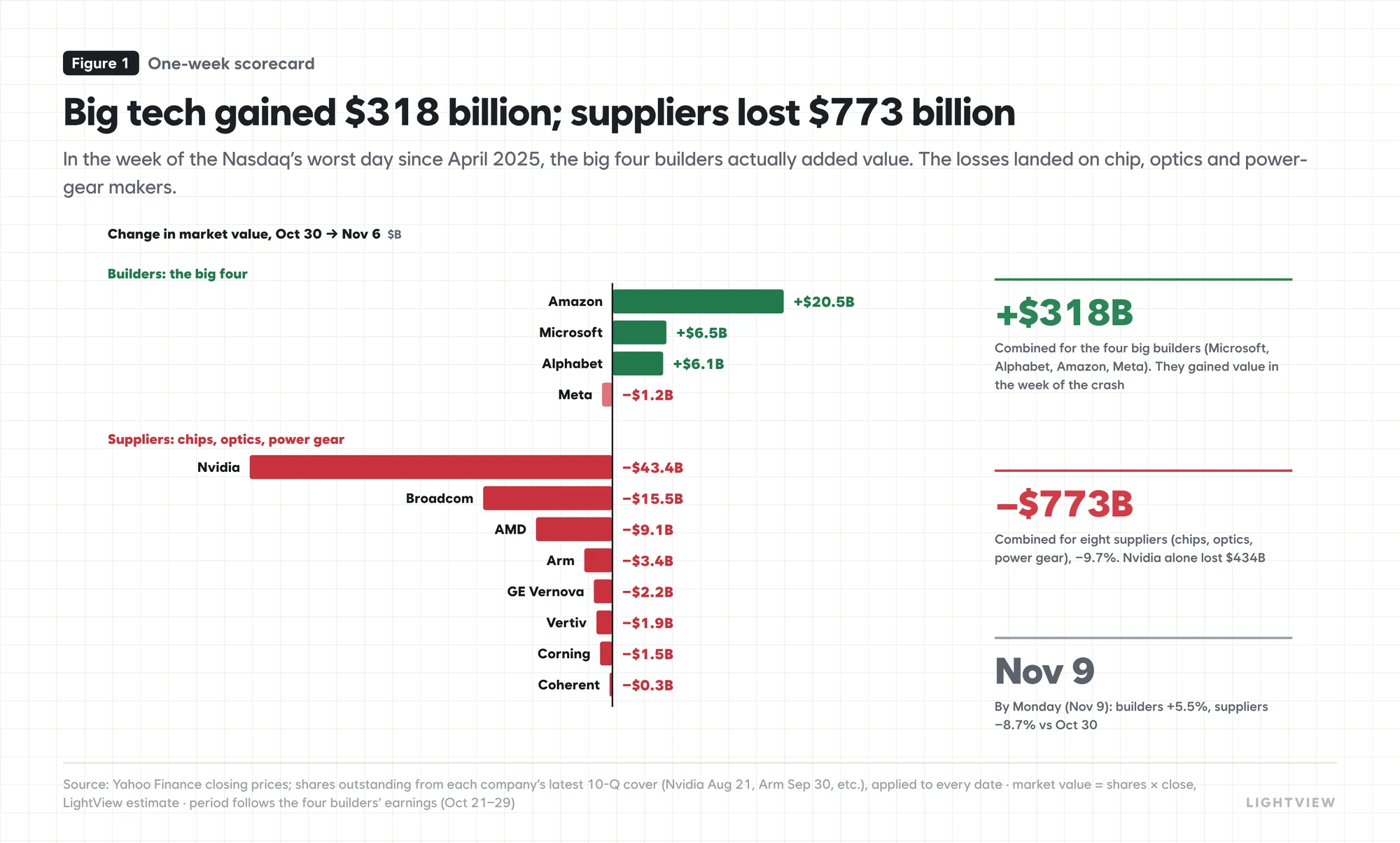
Nvidia alone lost $434 billion, more than the big four gained. NYU professor Aswath Damodaran counted almost $1.8 trillion in AI market value lost on November 5 alone (another tally of 12 stocks put it at about $1.45 trillion); on LightView’s own calculation, suppliers lost about $819 billion that day and the big four about $352 billion, more than twice as much on the supplier side. By the next trading day, November 9, the four were still 5.5% above their October 30 level and the suppliers 8.7% below it.
Stock by stock, the dividing line gets sharper. Amazon rose 7.9% that week and Alphabet and Microsoft edged up, but Oracle and CoreWeave, also classed as builders, fell 11.2% and 15.4%, moving like suppliers. Oracle has reportedly planned $90–95 billion in capex this fiscal year and about $40 billion in new debt and equity; builders more reliant on borrowing than the big four appear to have been treated like suppliers.
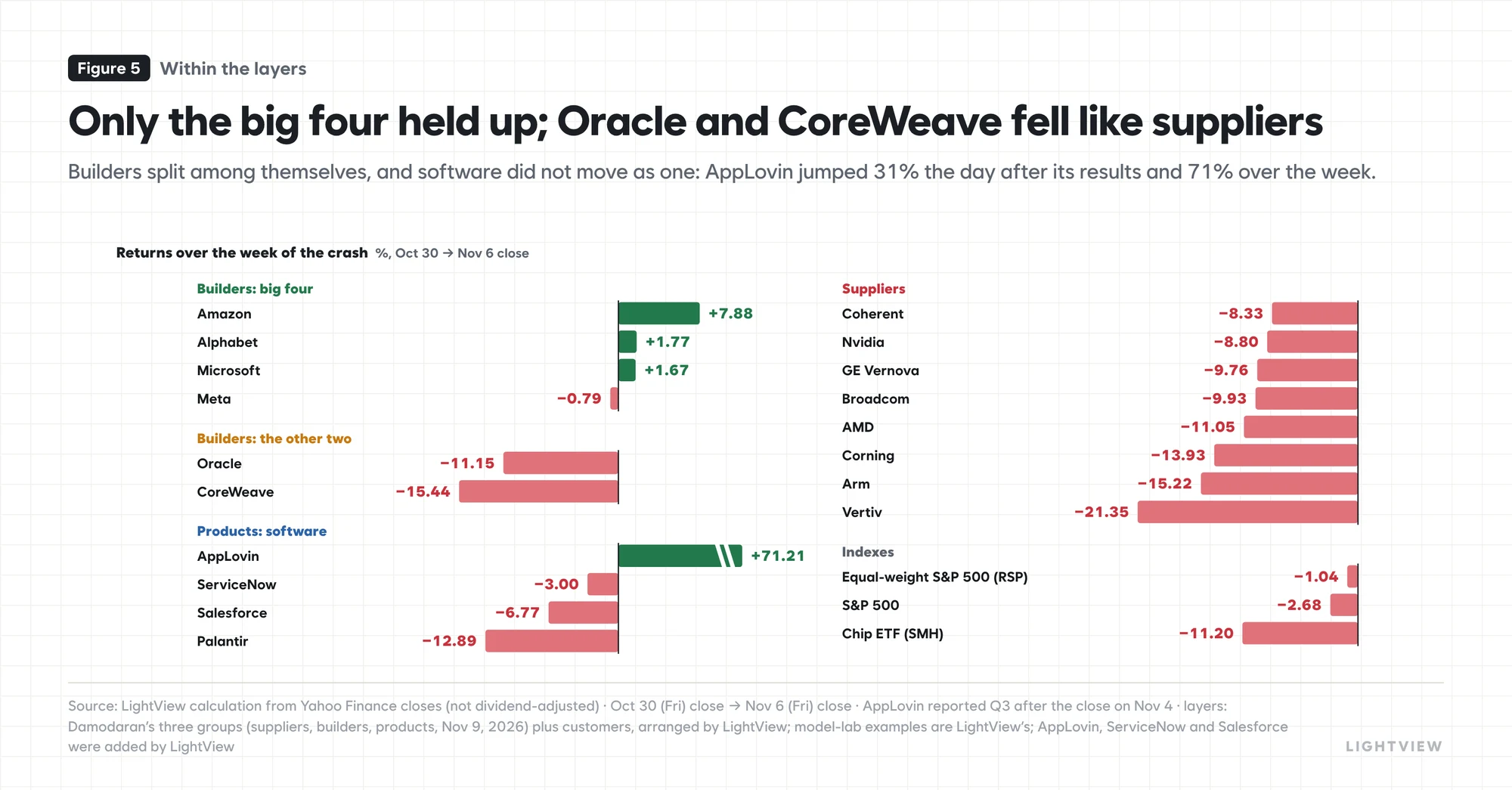
Software did not move as one either. AppLovin, which reported third-quarter results above expectations after the close on November 4, jumped 31% the next day and 71% over the week, while Palantir fell 12.9%. The equal-weight S&P 500 ETF (RSP) slipped just 1.0% while the chip ETF (SMH) fell 11.2%. The rout looked less like selling AI and more like moving around within it, which raises the next question: on what basis?
2Companies whose revenue is someone else’s capex
In a November 9 post, Damodaran split AI companies into three groups: suppliers, builders and products. Adding the end customers who pay makes four layers, and following them shows that stocks sharing the AI label earn money in a different order and carry different risks.
Suppliers sell what goes into data centers: chips, power equipment and optics. Builders are the big-tech firms that buy that gear to build clouds. The product layer rents those clouds to make AI services, from model labs such as Anthropic and OpenAI to software companies, and at the end are the businesses and people who pay. The four spent about $201.5 billion on capex in the July–September quarter alone, and in the quarter before (May–July) Nvidia’s data center revenue reached $89.0 billion, up 117% in a year, with 55% of it coming from hyperscalers.
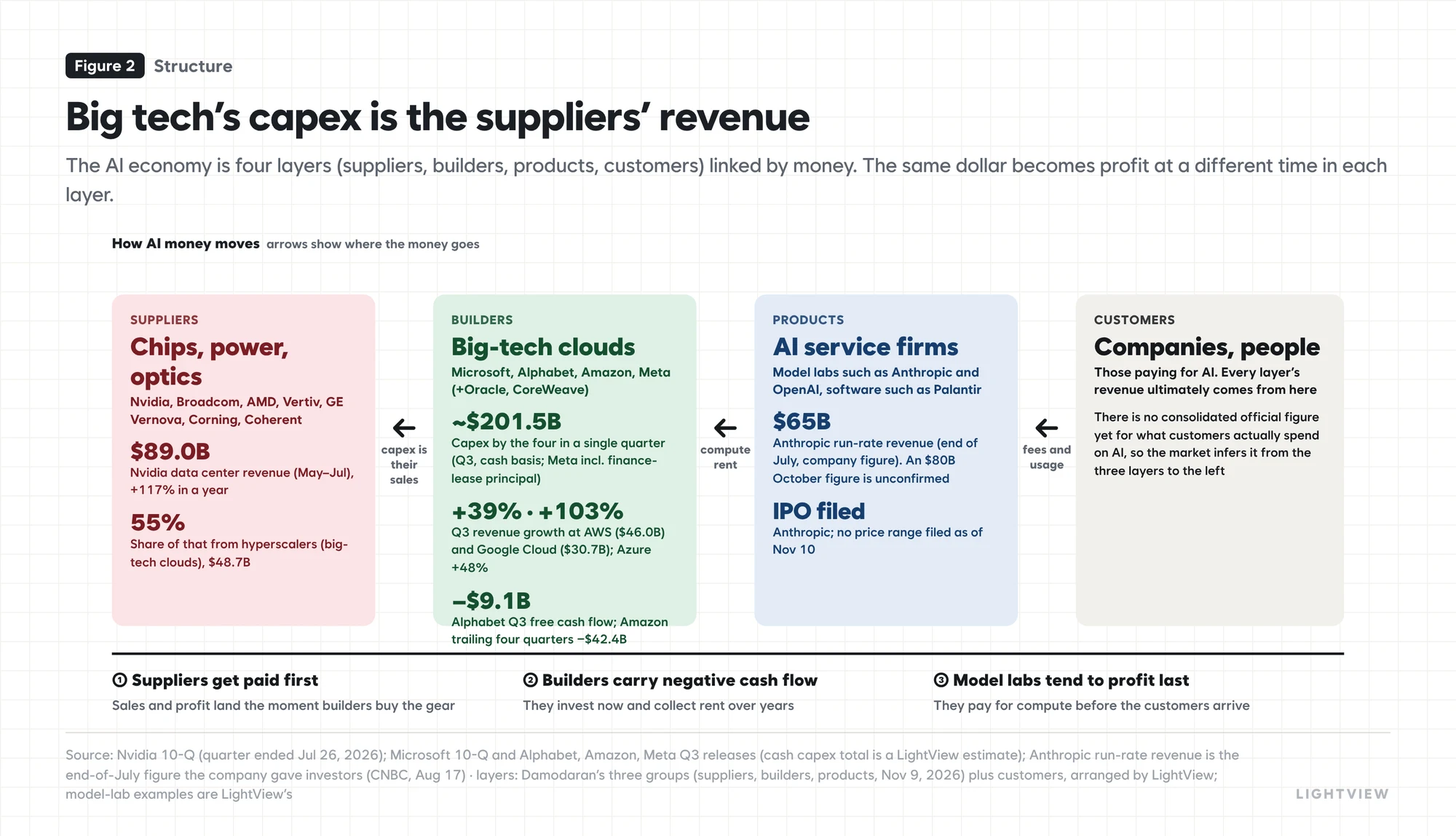
In this structure profit arrives at a different time in each layer. Suppliers book revenue and profit the moment builders buy, while builders invest first and collect rent over years, so they must live with negative cash flow for a while: Alphabet’s third-quarter free cash flow was −$9.1 billion and Amazon’s over the last four quarters −$42.4 billion. That order has favored suppliers so far, but this week showed they are also the first to shake when investment looks set to slow.
3The problem is the pace, not the amount
Notably, right up to the rout none of the big four said it would cut capex meaningfully. If anything, plans rose all year.
Alphabet raised its 2026 capex plan from $175–185 billion in February to $195–205 billion in July; Amazon went from about $200 billion to $220 billion; Meta from $115–135 billion to $135–145 billion. Microsoft’s calendar-year plan fell from about $190 billion to $170 billion, which the company attributed mostly to a change in data center lease accounting. Combined annual capex at the four rose from $147 billion in 2023 to $376 billion in 2025, and October guidance puts 2026 at about $730 billion, up 94% in a year.
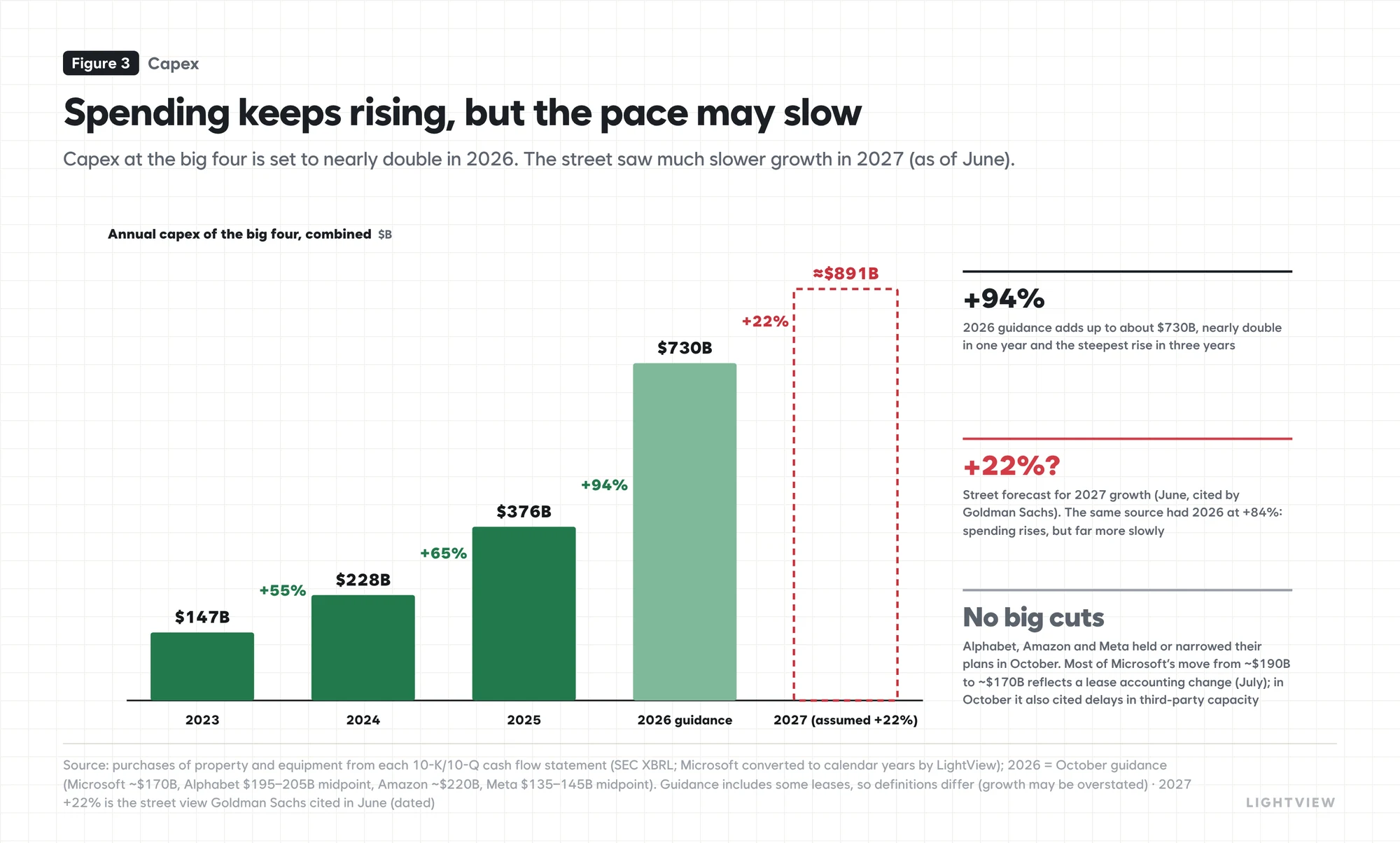
The problem is the year after. The street forecast Goldman Sachs cited in June put 2027 growth at around 22%. Against 84% for 2026 in the same source, spending still rises but far more slowly. Amazon said it will spend "meaningfully more" in 2027 and Alphabet that capex will "increase significantly," yet neither gave numbers, and Meta said it has nothing quantitative until its fourth-quarter call. Because the 2026 growth rate also mixes in definitional differences such as leases, the true pace may be lower, and the market appears to have started pricing in growth that is passing its peak.
The same slowdown plays out in opposite ways by layer. Bank of America reportedly estimates that if 2027 big-tech capex comes in 20% below current hopes, AI chip revenue would fall more than 20% and earnings per share 35–40%. Revenue can drop quickly while costs such as R&D and production capacity do not, so profit swings much harder than sales.
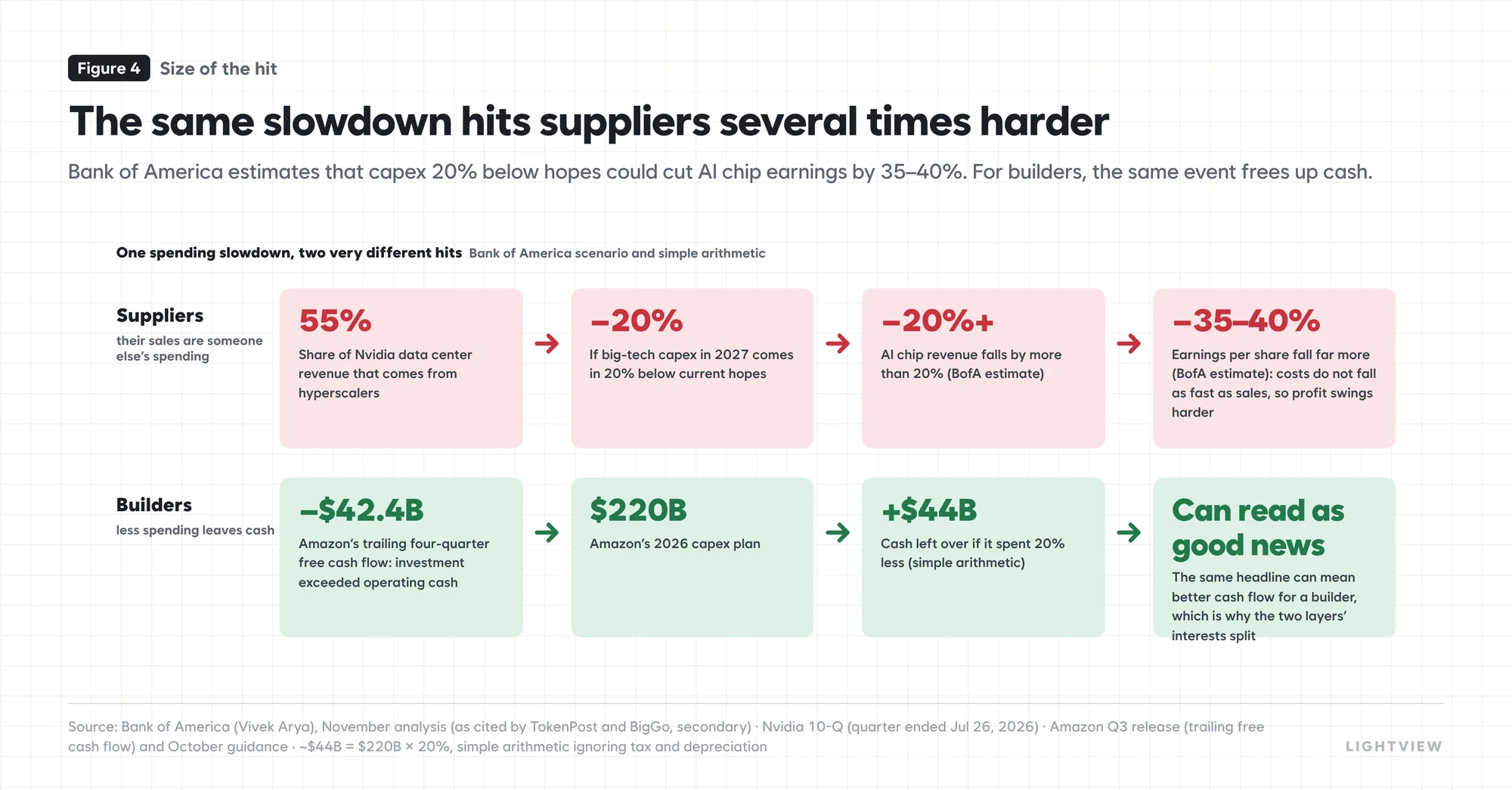
Builders read the same news differently. If Amazon spent 20% less than its $220 billion plan for 2026, simple arithmetic leaves about $44 billion in cash, more than enough to cover its trailing four-quarter free cash flow deficit of $42.4 billion. A slower pace trims suppliers’ earnings outlook but can improve builders’ cash flow outlook, so the two layers share the AI label while their interests diverge. This week the market appears to have priced that difference in earnest.
4Ballot boxes and outlooks, not interest rates
When stocks fall together, rates are the usual suspect, but not this time. On November 5 the 10-year Treasury yield actually fell to 4.84% from 4.90% the day before, well below the more than 5.3% it touched last month.
Chips had already fallen more than 14% in October while the index slipped 0.9%, and on November 4, the day after the election, the S&P 500 rose 1.6% while the chip ETF still fell 2.8%. That day tallies were reported showing data center limits winning 40 of 41 related local ballot measures (unofficial reports citing Ballotpedia’s count), and with a weak Qualcomm outlook on top, the chip ETF fell 11.2% on November 5. Our November 9 column, "The Ballot Box Meets AI Infrastructure," covers the votes in detail.
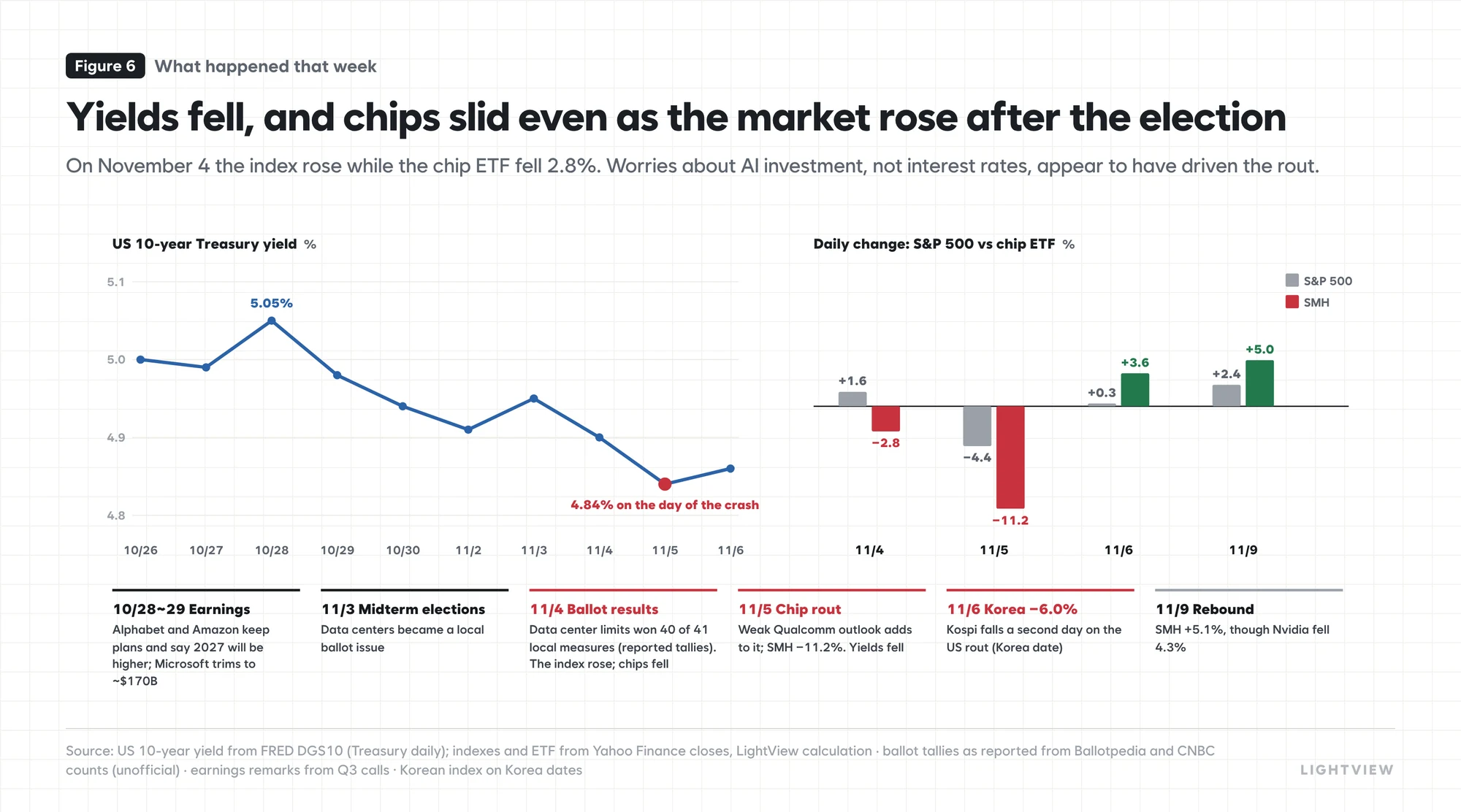
Harder-to-build data centers affect each layer differently. For suppliers they mean orders delayed or reduced, but for builders that already hold power and land they can become a moat against new entrants. On November 9 the chip ETF rose 5.1%, recovering part of the drop, yet Nvidia fell 4.3%, so reactions split even among suppliers. At the center of the rout, it appears, was not rates but the worry that AI infrastructure may be built more slowly than expected.
5Why Korea hurt more
The rout stung Korean investors for a reason: memory and power-equipment makers in the supplier layer sit near the top of the Kospi by market value.
Samsung Electronics and SK hynix sell memory that goes into big-tech data centers, while HD Hyundai Electric, Hyosung Heavy Industries and LS ELECTRIC sell transformers and power equipment for data centers and grids. From September 30 to November 6 the Kospi fell 26.0%, nearly the same as the average drop for the eight US suppliers (26.0%); SK hynix fell 36.3% and the three power-equipment makers 43–45%. Over the same period the US big four fell 6.4% on average and the S&P 500 3.6%.
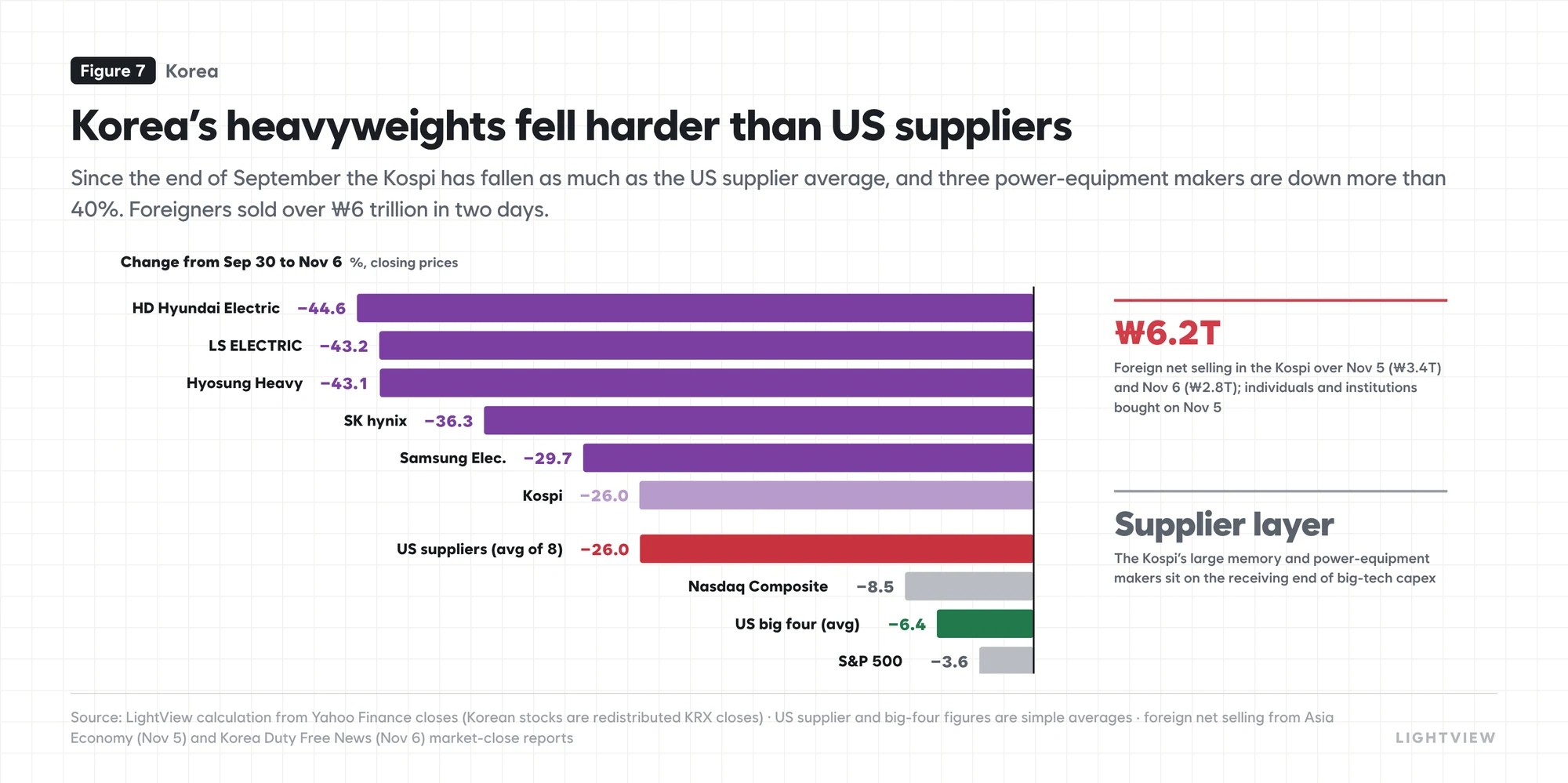
The dates show Korea fell hard before the US rout (November 5, US time). Korea’s November 5 session closed before the US rout, yet the Kospi fell 5.28%, with local reports pointing to the slide in US chip stocks and about ₩3.4 trillion of foreign net selling. The next day it fell another 6.02% in the wake of the US rout, with foreigners selling about ₩2.77 trillion more. One brokerage analyst was quoted as saying worries about slower AI infrastructure spending spread across Korea’s chip sector, a sign that the bigger a market’s supplier weighting, the more sensitive it is to the pace of big-tech spending.
6Three crossroads ahead
Whether the layer-by-layer pricing sticks or AI stocks move as one again depends on three upcoming sets of numbers.
First is Nvidia’s third-quarter report on November 17: whether hyperscaler revenue kept growing and what it guides for next quarter could set the mood for the whole supplier layer. Second is the Anthropic IPO. As of November 10 no amended filing with a price range had appeared; a smooth big listing of an AI model lab would signal that money for compute keeps flowing, while a stumble could raise doubts about demand at both builders and suppliers (see our November 10 column, "Why Anthropic Is Going Public, Even at a Discount"). Third are the first 2027 capex numbers, due with big tech’s fourth-quarter results in January and February.
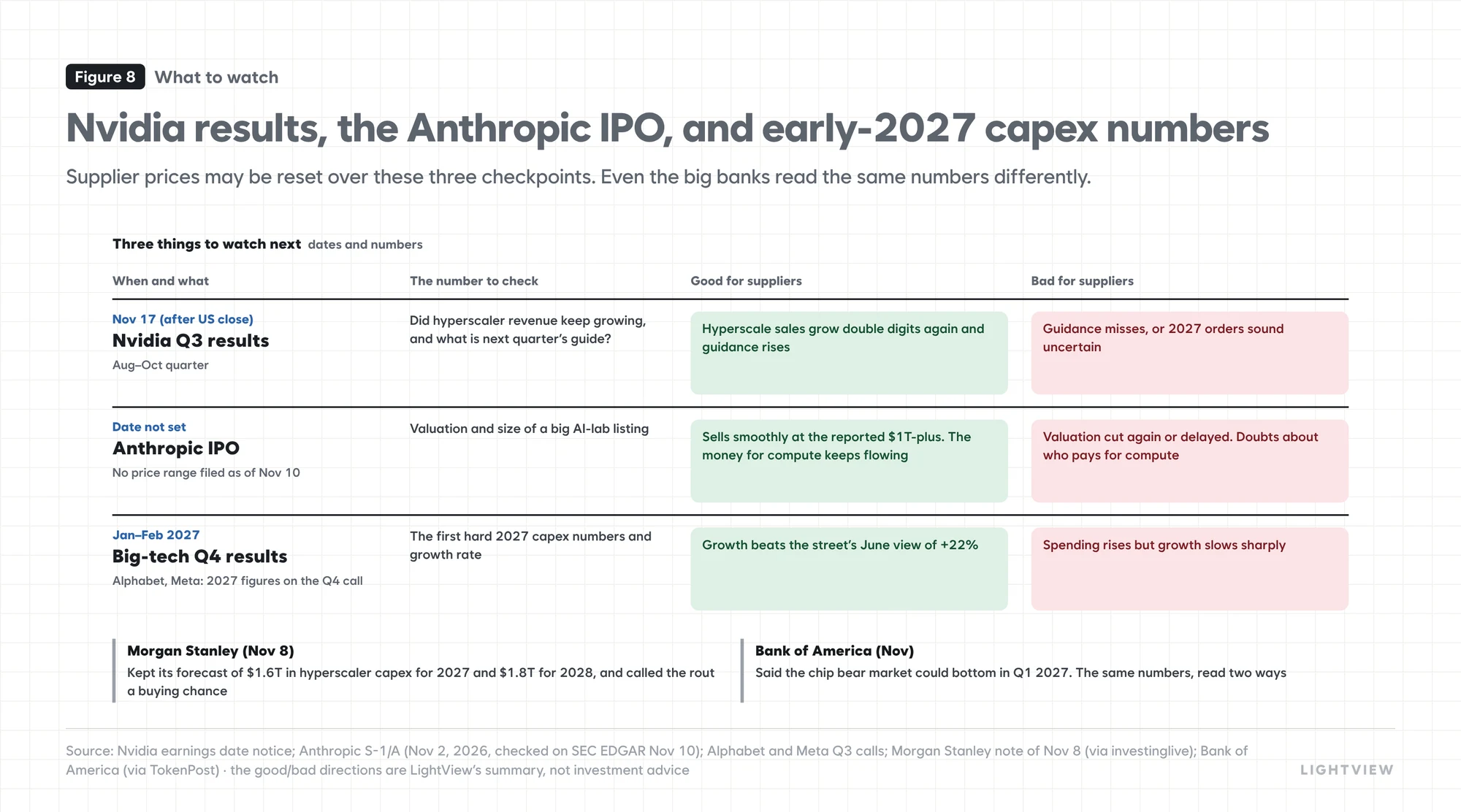
Readings of the same numbers differ. Morgan Stanley kept its forecast of $1.6 trillion in hyperscaler capex for 2027 and called the rout a buying chance, while Bank of America said the chip bear market could bottom in the first quarter of 2027. What is clear is that the market no longer puts stocks in one basket just for carrying the AI name. Checking whether a holding spends big tech’s money, receives it, or sells services built on it may be the most practical lesson of this rout.
+Glossary and sources
Glossary
- Microsoft, Alphabet, Amazon and Meta 10-Ks (2023–2025 capex, SEC XBRL), 10-Qs and Q3 releases (Oct 21–29, 2026) · Nvidia 10-Q (quarter ended Jul 26, 2026; data center and hyperscale revenue) · Vertiv and GE Vernova Q3 calls · Anthropic S-1 and S-1/A (SEC EDGAR, checked Nov 10)
- Earnings-call remarks from Motley Fool transcripts · some February and April guidance from CNBC, GeekWire, Fortune and AP reports
- Stock, index and ETF closes: Yahoo Finance (Korean stocks are redistributed KRX closes) · US 10-year yield: FRED DGS10 · market value = shares on each company’s latest 10-Q cover × close (LightView estimate)
- AP (Nov 5), CNBC (Nov 5) · Aswath Damodaran blog and Substack (Nov 9) · Goldman Sachs 2027 consensus (Jun 11, via Yahoo/Investing.com) · Morgan Stanley (Nov 8, investinglive) · Bank of America (via TokenPost and BigGo) · ballot measures: Baxtel, Fortune (Nov 7), citing Ballotpedia counts · Oracle capex and financing (Outlook Business and others, secondary) · Korea: Asia Economy, SBS Biz (Nov 5); Shinailbo, Korea Duty Free News, Newsway (Nov 6)
Filings and company announcements
Market data
Reporting and analysis
This column's topic and analytical direction are set by the editor, who reviews and revises it before publication. AI tools were used for research, drafting and infographics, and every figure was checked against its source.