1Built the technology, took the first hit
Part 1 ended in autumn 2024, with Hassabis receiving the Nobel while Google struggled on a very different battlefield. Ironically, the weapon in that battle was one Google had made.
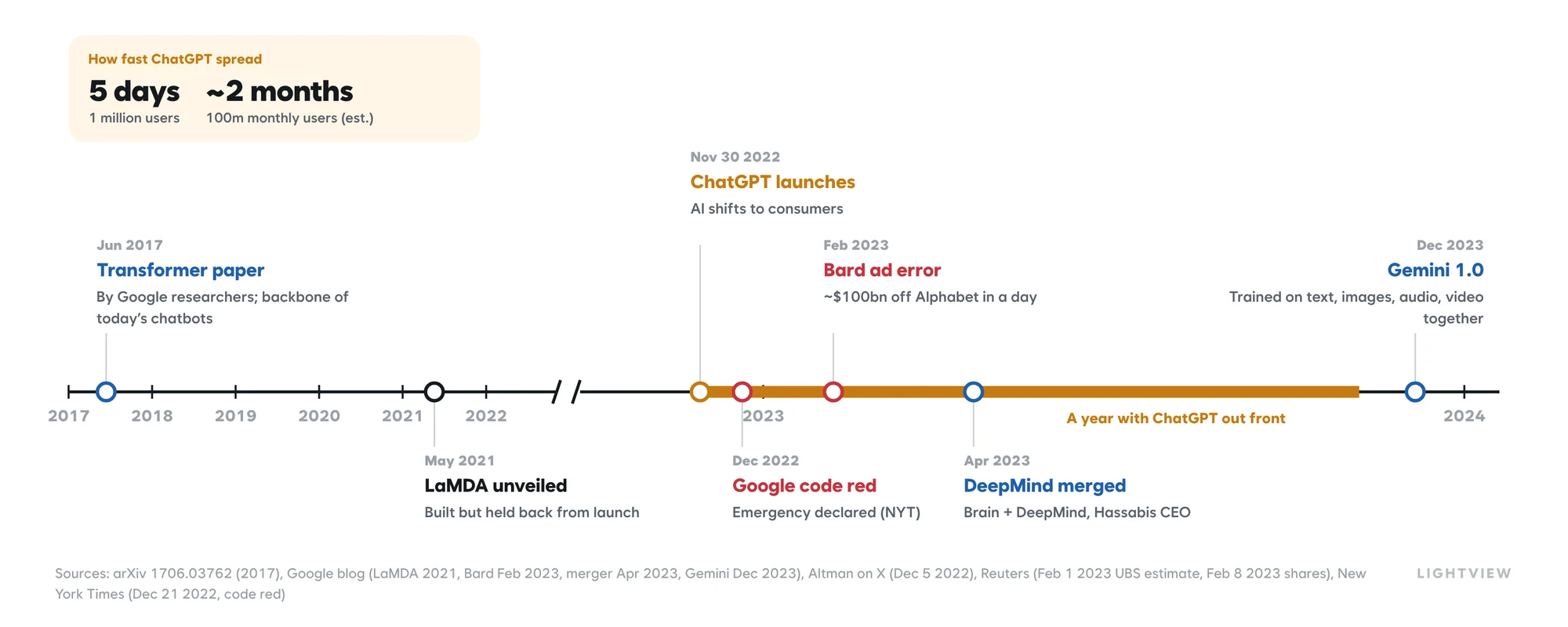
In June 2017, Google researchers published "Attention Is All You Need", introducing the transformer that underpins today's chatbots. Google unveiled its conversational model LaMDA in 2021 and was ahead technically, but it was cautious about releasing a chatbot to the public. Commonly cited reasons: wrong answers could hurt trust in a search company, and a chatbot could eat into its lucrative search ads.
Meanwhile, on November 30 2022, OpenAI released ChatGPT. It passed 1 million users in five days and was estimated to reach 100 million monthly users in two months. That December, Google's leaders reportedly declared a "code red".
The rushed response backfired. In February 2023 a Bard chatbot promo got a fact about the James Webb Space Telescope wrong, and Alphabet shares fell about 7.7% in a day, erasing roughly $100bn.
Two months later Google reorganized, merging Google Brain and DeepMind into "Google DeepMind" under Hassabis. Sundar Pichai said bringing the talent into one team, backed by Google's computing resources, would speed up progress.
| When | OpenAI | |
|---|---|---|
| Jun 2017 | Transformer paper | |
| May 2021 | LaMDA unveiled (no public launch) | |
| Nov 2022 | ChatGPT launched | |
| Feb–Dec 2023 | Bard → merger → Gemini 1.0 | GPT-4 (Mar 2023) |
2Gemini, built to learn it all together, and the comeback
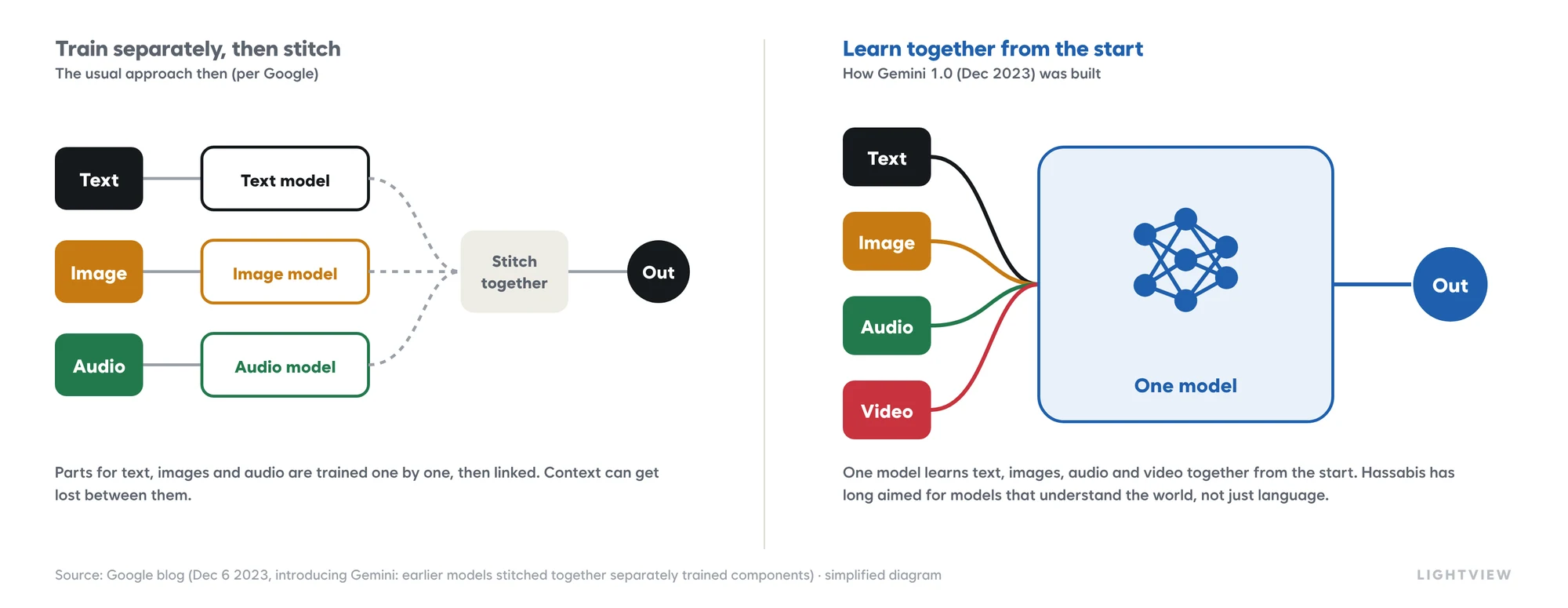
Gemini 1.0, released in December 2023, was designed to learn text, images, audio and video in one model from the start, reflecting Hassabis's long-stated aim of AI that understands the world beyond language. The start was rocky: its demo video was criticized as smoother than reality, and in February 2024 Google paused generating images of people after historical figures came out wrong.
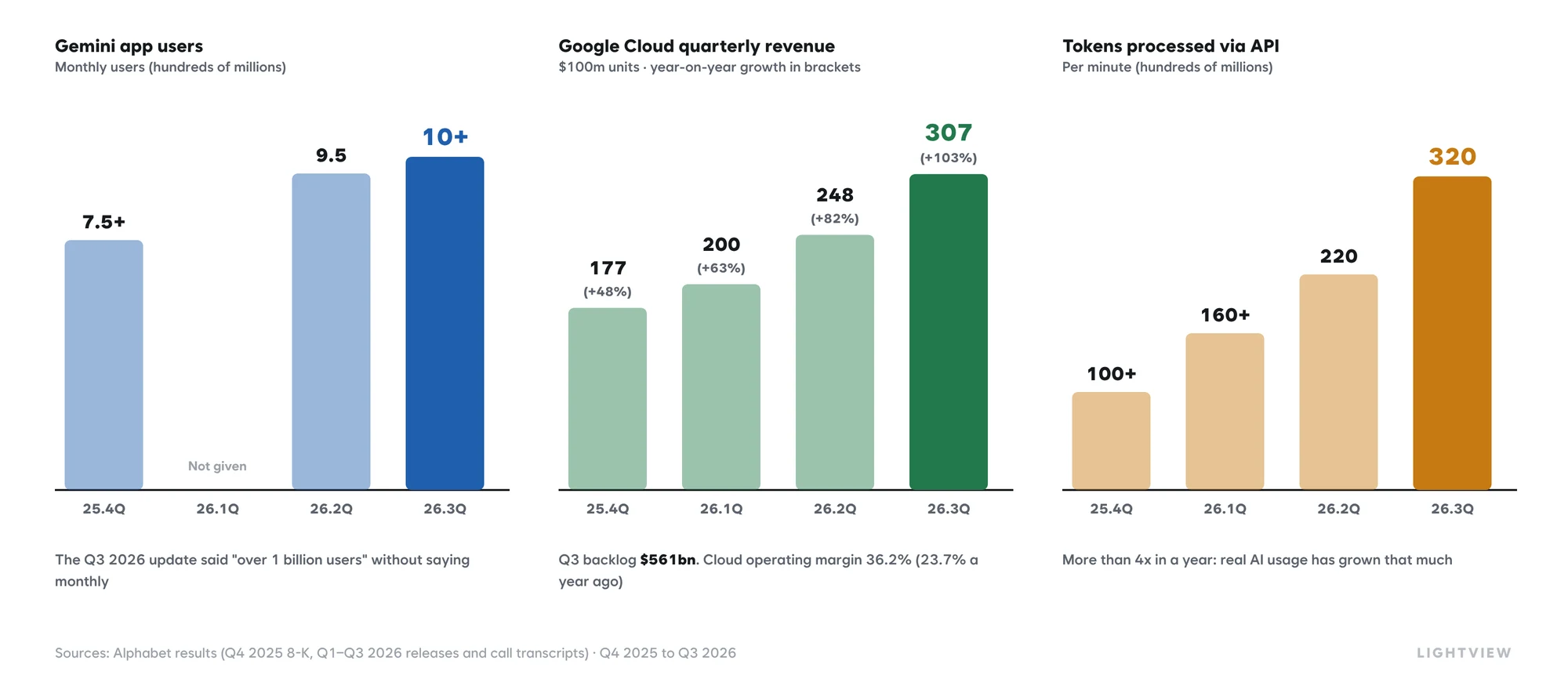
2025 was the comeback year. A string of model gains and hit features even pushed the Gemini app past ChatGPT in the App Store rankings. That December, it was OpenAI's Sam Altman who reportedly declared a "code red". In three years, the roles had flipped.
| When | What happened |
|---|---|
| Mar 2025 | Gemini 2.5 Pro debuts at No. 1 on the LMArena user-vote leaderboard |
| Jul 2025 | Gold-medal standard at the International Mathematical Olympiad, officially graded |
| Aug–Sep 2025 | "Nano Banana" image editing takes off → Gemini app No. 1 free app in the US App Store |
3Stepping back from CEO
On August 5 2026, Hassabis stepped down as CEO of Google DeepMind. He became chair and Alphabet's Chief Scientist and continues to lead the drug-discovery company Isomorphic Labs. Day-to-day operations went to Koray Kavukcuoglu, previously CTO, as senior vice president.
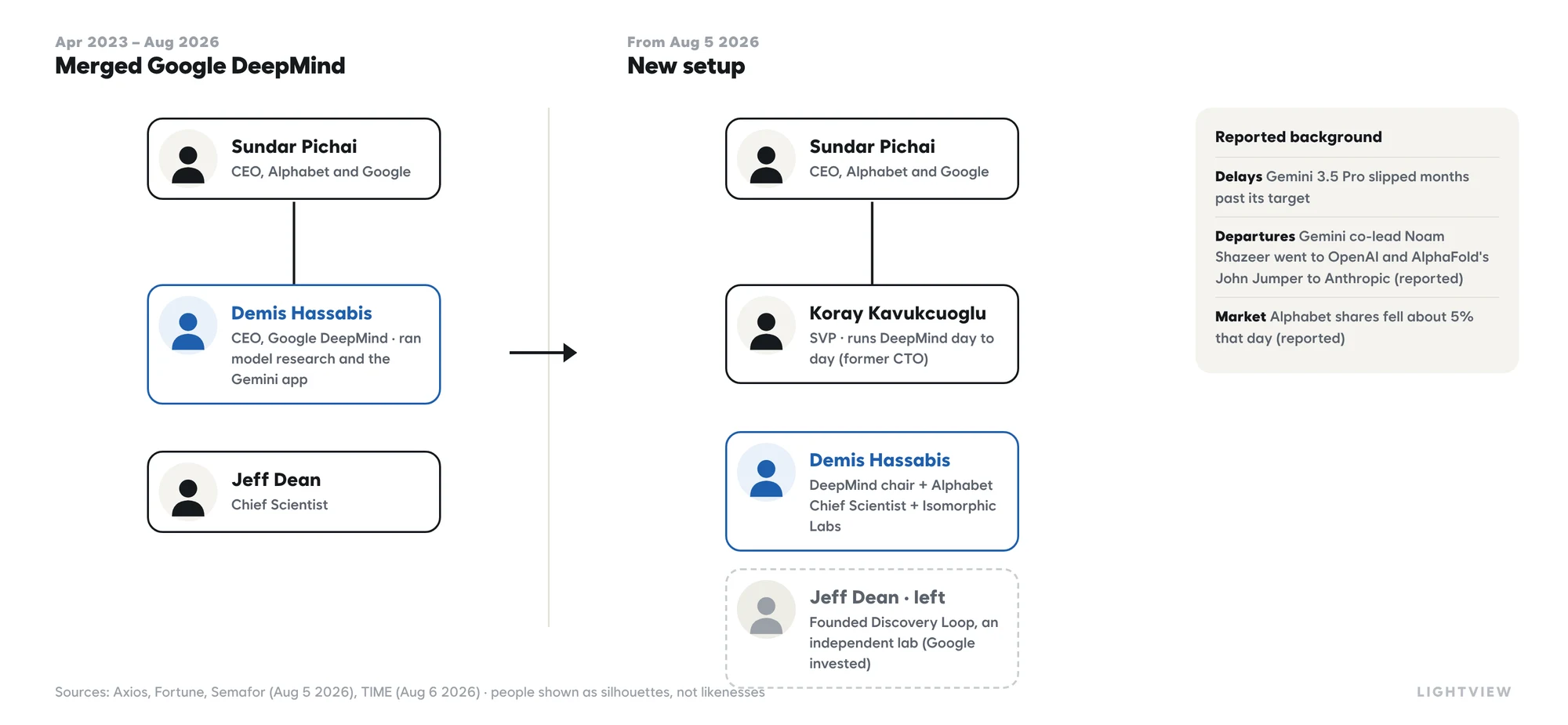
The reported backdrop was rough. Gemini 3.5 Pro, aimed at a summer launch, was months late, and reports said Gemini co-lead Noam Shazeer had moved to OpenAI and John Jumper, his AlphaFold Nobel co-laureate, to Anthropic. Alphabet shares were reported to have fallen about 5% that day.
Hassabis tells it differently. In an internal memo he said he was handing over daily duties to have time and space for the big picture. Whether this was accountability for a rough stretch or a researcher returning to research is open to interpretation.
What is clear is the pace since. Within two months came Gemini 4 Argon and Carbon and the Genie 4 world model. How a Google DeepMind no longer run day to day by Hassabis turns his ideas into products is the thing to watch now.
| Role | What it involves |
|---|---|
| Chair, Google DeepMind | Leads research direction and the big picture (Kavukcuoglu runs daily operations) |
| Chief Scientist, Alphabet | Advises on science and technology strategy across Google |
| Head of Isomorphic Labs | Runs the subsidiary using AlphaFold technology to find drug candidates (founded 2021; Eli Lilly and Novartis research deals in 2024; first outside funding of $600m in 2025) |
4Gemini 4, back in the front row
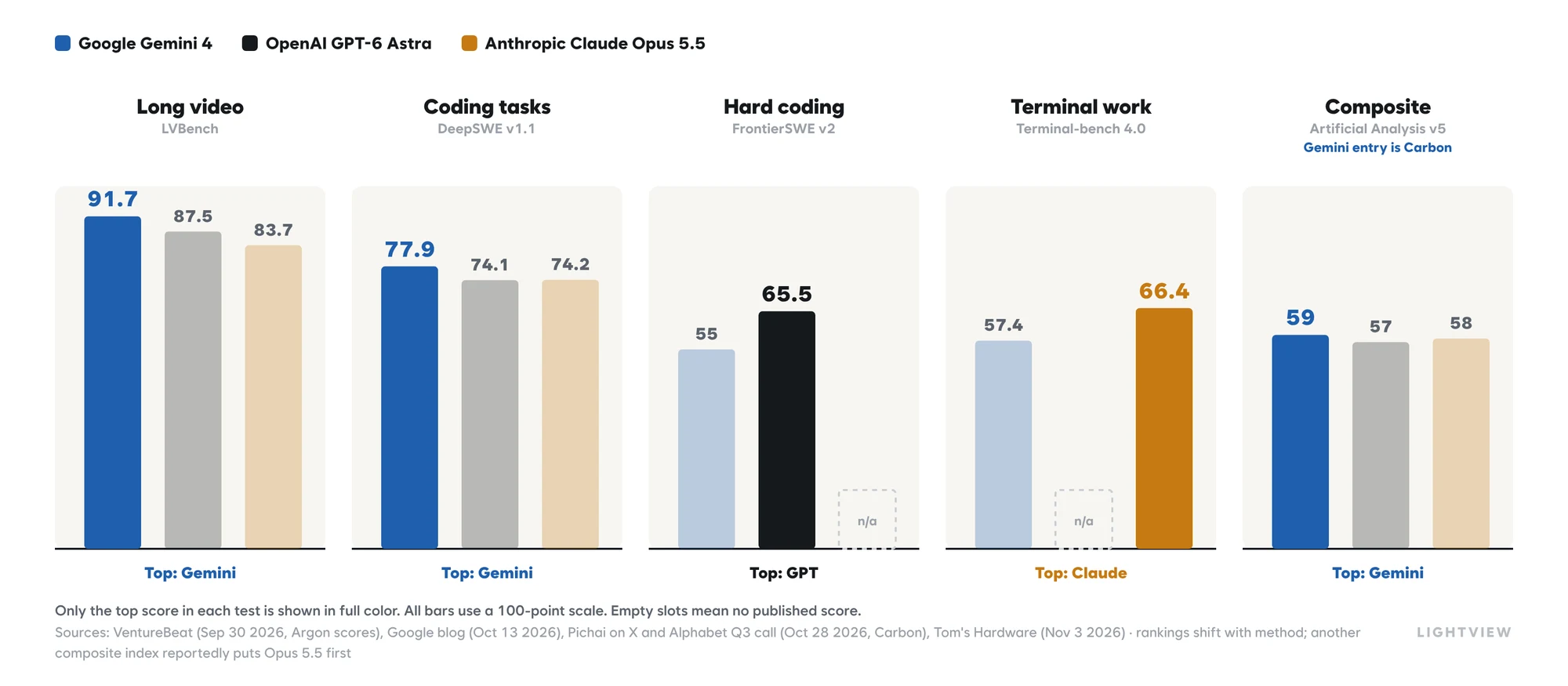
Skipping Gemini 3.5 Pro, Google jumped to a fourth generation. Gemini 4 Argon went first to cyber defenders on September 30 (the US government also took part in a pre-release review) and opened to developers on October 13. It was reported to lead outright on 12 of 18 published benchmarks, pulling well ahead on long-video understanding. Google also said it scored 87% on ERQA, a test of how well AI understands space and chooses actions, as a robot must.
| Area | Test | What it checks |
|---|---|---|
| Long video | LVBench | Answering questions about videos around an hour long |
| Coding, hard coding | DeepSWE, FrontierSWE | How well it solves realistic software tasks |
| Terminal work | Terminal-bench | Finishing multi-step tasks in a command line on its own |
| Composite | Artificial Analysis | Many test scores combined into one |
The weak spots were clear too. On hard coding tasks and terminal work, it trailed the OpenAI and Anthropic models. Carbon, the higher-end model Sundar Pichai unveiled at the October 28 earnings call, scored 59 on one composite index, 1–2 points ahead of Claude Opus 5.5 (58) and GPT-6 Astra (57), though another index reportedly ranks Opus 5.5 first. Leaderboard leads change within weeks, so it is more useful to look at where each company is strong than at a single number.
| Argon | Carbon | |
|---|---|---|
| Strengths | Long video, spatial and action reasoning, 1 million tokens at once | No. 1 on one composite index; claimed lowest hallucination rate |
| Price (per million tokens) | $2 in / $10 out; $4 / $20 after Nov 30 | Not yet open to developers |
Sources: Google blog (Oct 13 2026), Tom's Hardware (Nov 3 2026) · Kavukcuoglu said in September that "we are always gonna be at the frontier" (9to5Google)
5Three companies, three centers of gravity
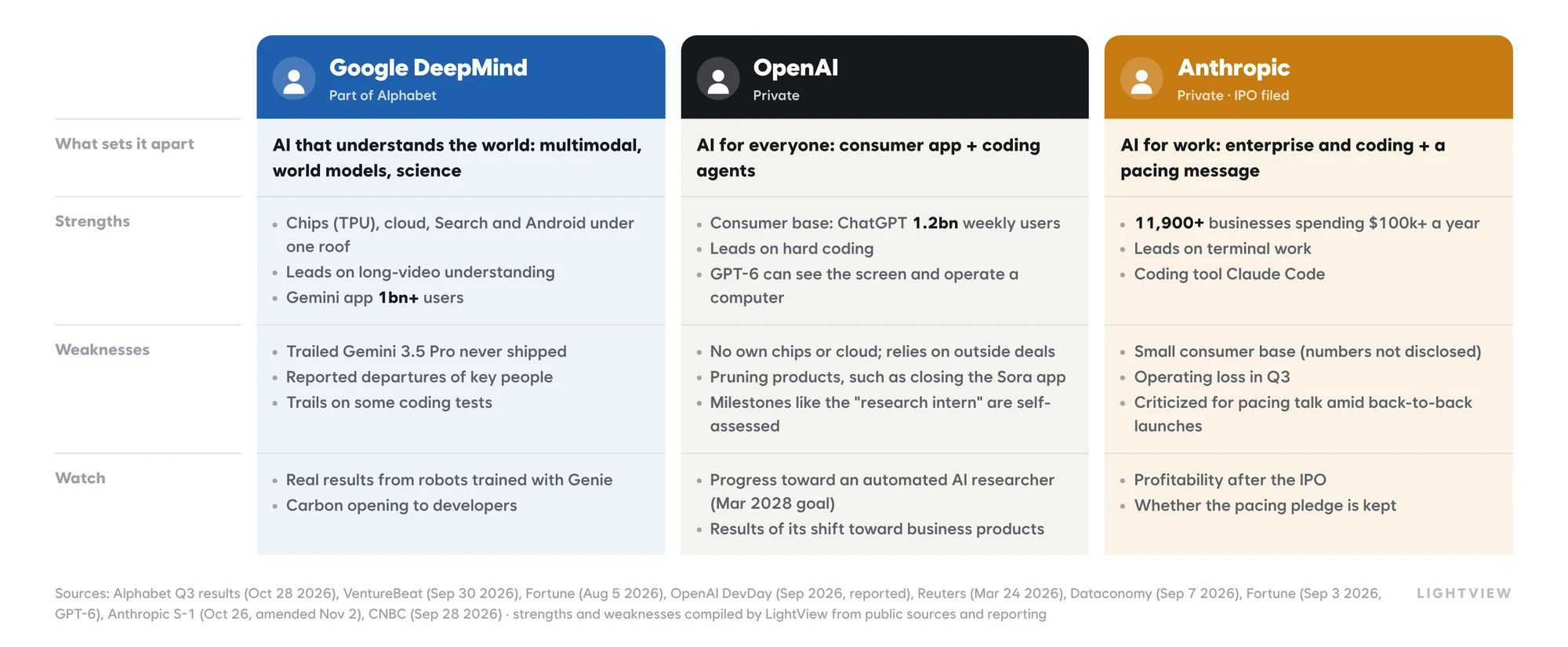
OpenAI started as a consumer company, with ChatGPT used by 1.2 billion people a week, but it has recently leaned into coding agents and business products. In March 2026 it decided to close the Sora video app; Reuters said the aim was to focus on enterprise products. In September it announced that it had met its own goal of an "AI research intern", a self-assessment without outside verification.
Anthropic made businesses its main customers from the start. Business customers grew fast, but its amended IPO filing in November shows short-term compute costs and a one-off non-cash charge pushed it to an operating loss in the third quarter. In a September essay Dario Amodei said AI progress should be slowed and that Anthropic would move first, yet it kept releasing new models, drawing criticism that words and actions did not match.
Google's strength is having chips (TPUs), cloud and distribution through Search and Android under one roof. That lets it set its own pace between research and products. The relationships are not simple, though: Anthropic rents Google TPUs at scale and is also a company Google has invested in. Rival and customer at once.
In the end, the three differ on where they look for their next growth. OpenAI layers work tools on its user base, Anthropic sells AI that businesses can trust, and Google bets that AI which understands the world will go further. Their choices over the past year show the same direction.
| Company | Choice | Direction it suggests |
|---|---|---|
| Google DeepMind | Hassabis moves from CEO to chair and Chief Scientist (Aug 2026); Genie 4 world model (Oct) | Product race to operators; the founder to science and world models |
| OpenAI | Decides to close the Sora video app (Mar 2026); claims an "AI research intern" (Sep) | From consumer buzz toward business products and automating AI research |
| Anthropic | "Pace the frontier" essay (Sep 2026); IPO filing (Oct) | Safety-first AI for business, while still shipping |
"Direction it suggests" is LightView's reading of company announcements and reporting
6The code road and the world road
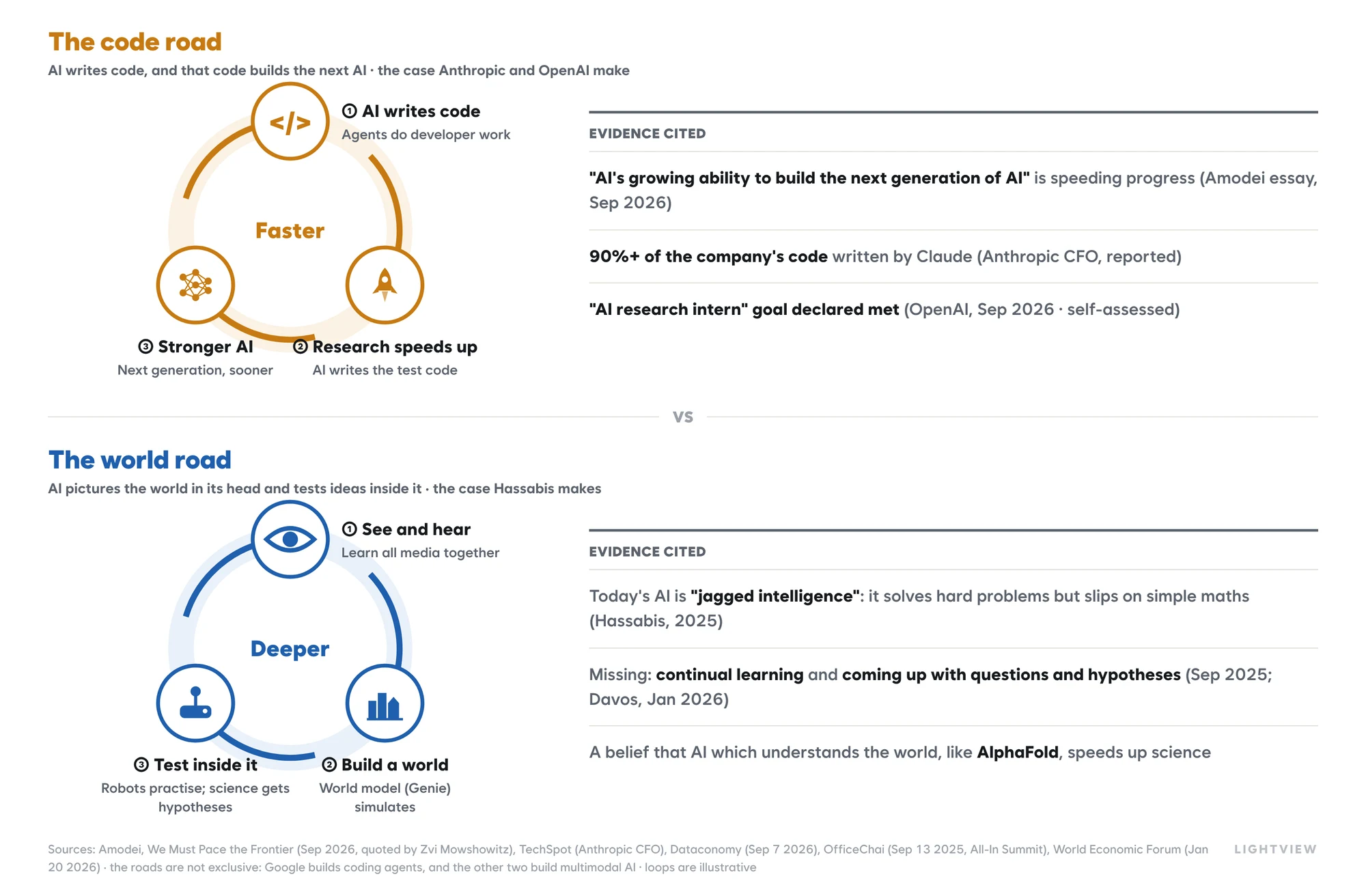
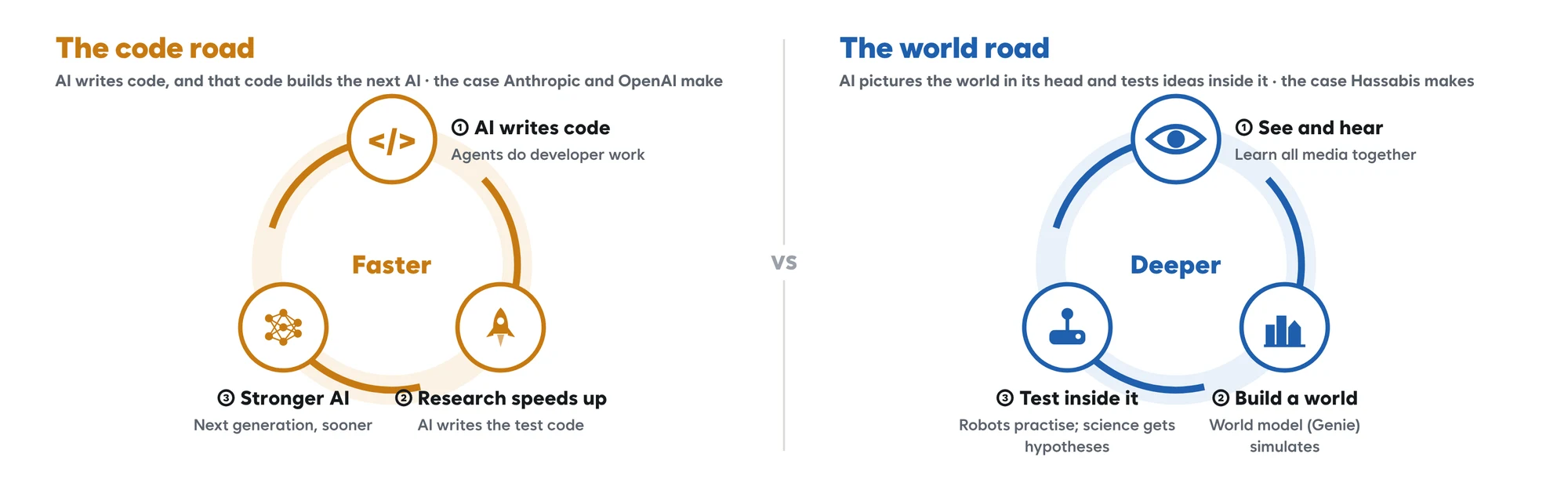
The logic of the code road is simple. If AI writes code well, AI research itself speeds up, and the stronger AI it produces speeds research up again. Amodei wrote in September that AI progress is accelerating sharply, "driven primarily by AI's growing ability to build the next generation of AI."
Hassabis looks elsewhere. He calls today's AI "jagged intelligence", solving hard problems but slipping on simple arithmetic, and says it still lacks continual learning and the ability to come up with its own questions and hypotheses. As in his hippocampus research (Part 1), real intelligence must build a world in its head and test the future there.
| The code road | The world road | |
|---|---|---|
| Strength | Quick revenue; easy to measure | Aims at big markets not yet open, like robots and science |
| Weakness | The physical world is a separate problem | Slow to make money; progress is hard to measure |
| Sign of success | More AI research results produced by AI | Sim-trained robots work in reality |
LightView's comparison based on company announcements and leaders' statements
7Genie 4, AI that builds a world in its head
The signature work of the world road is the Genie world model. Give it an image or a line of text, and it generates, in real time, a world you can walk around and control.
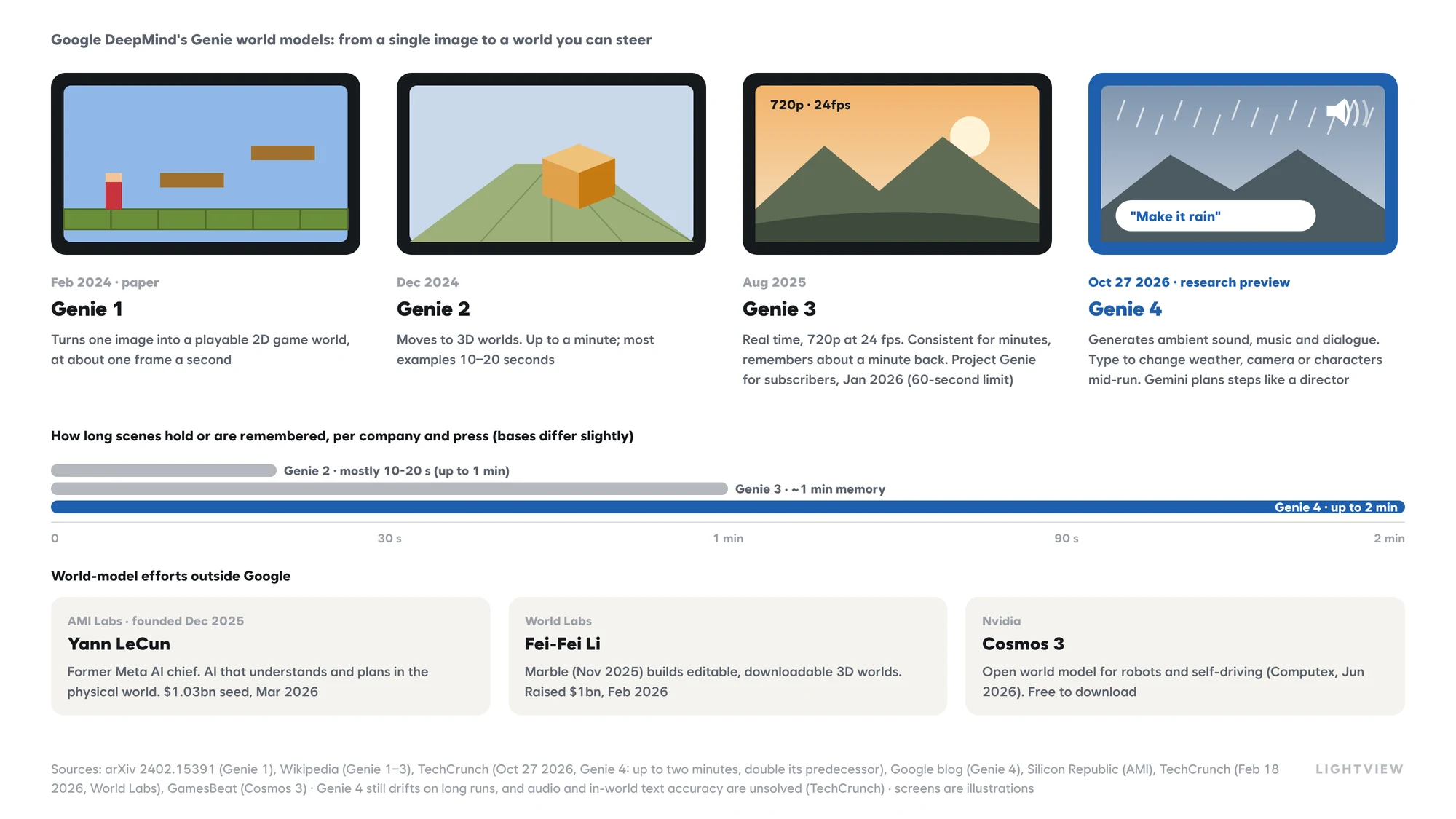
Genie 4, unveiled on October 27, generates ambient sound, music and even dialogue, and lets you type to change the weather or camera angle or add characters while the world runs. It can keep a scene consistent for up to two minutes, double its predecessor, according to TechCrunch.
Given Hassabis's career in games, the direction feels natural, but the goal is not play. Google described a research experiment in which Gemini 4 Argon broke a robot's task into steps and Genie 4 simulated the scene in real time: practise in a virtual world before moving a real robot. Limits remain, such as details drifting on long runs. Outside Google, Yann LeCun's AMI Labs, Fei-Fei Li's World Labs and Nvidia are betting big on the same road.
| Field | Use | Stage now |
|---|---|---|
| Robots | Practise hard or risky moves in a virtual world first | Research experiment (Genie 4 + Gemini Robotics) |
| Games and film | Worlds you can try from a few lines of text; scene ideation | Subscriber trial (Project Genie); testers using it for storyboards |
| Self-driving | Rare crash scenes to train driving AI | Open models such as Nvidia Cosmos |
| AI agents | AI that sets goals, learns in 3D | DeepMind SIMA 2 research (Nov 2025) |
Sources: TechCrunch (Oct 27 2026), Google DeepMind (Nov 2025, SIMA 2), GamesBeat (Cosmos 3)
8The AGI clock, and what investors should watch
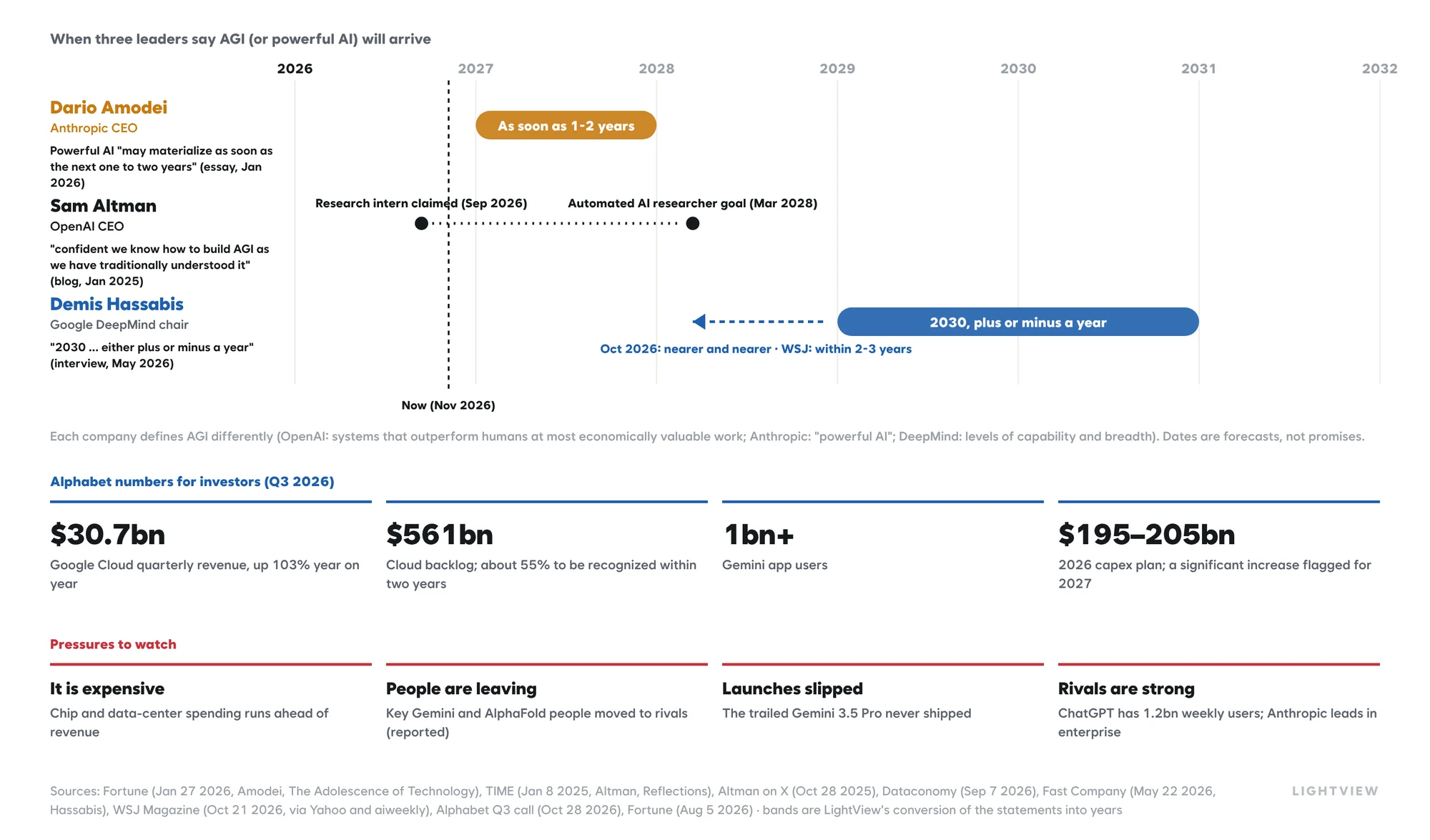
The three leaders' clocks differ. In January 2026 Amodei wrote that powerful AI could arrive as soon as the next one to two years, and in January 2025 Altman wrote that OpenAI was confident it knew how to build AGI "as we have traditionally understood it." Hassabis, the most cautious, has long said 2030 plus or minus a year, but in an October interview he said it looks nearer and nearer, and the Wall Street Journal read his outlook as within two to three years. Each defines AGI differently, so what they cite as evidence matters more than the dates.
For investors, Google's bet shows up in numbers. Cloud revenue and backlog show AI demand turning into real money, but this year's capex of around $200bn is a heavy load. Whether Hassabis's answer to the question that began at the chessboard is right depends, in the end, on whether AI that understands the world creates more value than AI that writes code.
| Watch | Good sign | Bad sign |
|---|---|---|
| Cloud | Revenue growth and backlog keep rising | Revenue grows slower than capex |
| Gemini | Carbon opens to developers and users keep growing | New models slip again |
| World models | Real results from robots trained with Genie are published | Stays at demos, never becomes products |
| People | Key researchers stay and new talent arrives | Moves to rivals continue |
+Terms and sources
Terms
- arXiv 1706.03762 (Jun 2017, transformer) · Google blog (May 2021 LaMDA, Apr 20 2023 merger, Dec 6 2023 Gemini) · Altman on X (Dec 5 2022) · Reuters (Feb 1 2023 UBS estimate, Feb 8 2023 Bard) · New York Times (Dec 21 2022, code red) · Bloomberg (Dec 7 2023, demo video) · Google blog (Feb 23 2024, image generation pause)
- Google DeepMind (Mar 2025 Gemini 2.5, Jul 2025 IMO) · TechCrunch (Sep 16 2025, App Store No. 1) · Google blog (Nov 18 2025, Gemini 3) · Fortune (Dec 2 2025, Aug 5 2026) · Axios, Semafor (Aug 5 2026) · TIME (Aug 6 2026) · 9to5Google (Sep 24 2026) · Alphabet results (Q4 2025 to Q3 2026, SEC 8-K) · Alphabet Q3 call (Oct 28 2026) · Isomorphic Labs (Jan 2024 Eli Lilly and Novartis deals, Mar 2025 funding) · OpenAI (Mar 2023, GPT-4)
- VentureBeat (Sep 30 2026) · Google blog (Oct 13 2026 Argon, Oct 27 2026 Genie 4) · Pichai on X (Oct 28 2026) · Tom's Hardware (Nov 3 2026) · TechCrunch (Oct 27 2026) · arXiv 2402.15391 (Genie 1) · Wikipedia (Genie) · Silicon Republic (AMI Labs) · TechCrunch (Feb 18 2026, World Labs) · GamesBeat (Cosmos 3) · Google DeepMind (Nov 2025, SIMA 2)
- Fortune (Sep 3 2026 GPT-6; May 28 2026; Nov 2 2026, amended S-1) · aiweekly (Oct 2026, WSJ summary) · 9to5Mac (Oct 26 2026) · TechCrunch (Sep 22 2026, Opus 5.5) · Reuters, Axios (Mar 24 2026, Sora) · Dataconomy (Sep 7 2026) · Anthropic S-1 (Oct 26 2026, amended Nov 2) · Axios (Oct 8 2026) · Bloomberg (Nov 6, Apr 24, Mar 31 2026) · Anthropic (Apr 6 2026), Broadcom 8-K · CNBC (Apr 20 2026) · OpenAI (Jan 2025, Stargate) · Zvi Mowshowitz (Sep 14 2026, quoting Amodei) · TechSpot (Anthropic CFO) · OfficeChai (Sep 13 2025) · World Economic Forum (Jan 20 2026) · TIME (Jan 8 2025) · Fortune (Jan 27 2026) · Fast Company (May 22 2026) · WSJ Magazine (Oct 21 2026, via Yahoo) · companiesmarketcap
The ChatGPT shock and Google's response
Comeback and role change
Gemini 4 and Genie
OpenAI, Anthropic and AGI outlooks
This column's topic and analytical direction are set by the editor, who reviews and revises it before publication. AI tools were used for research, drafting and infographics, and every figure was checked against its source.