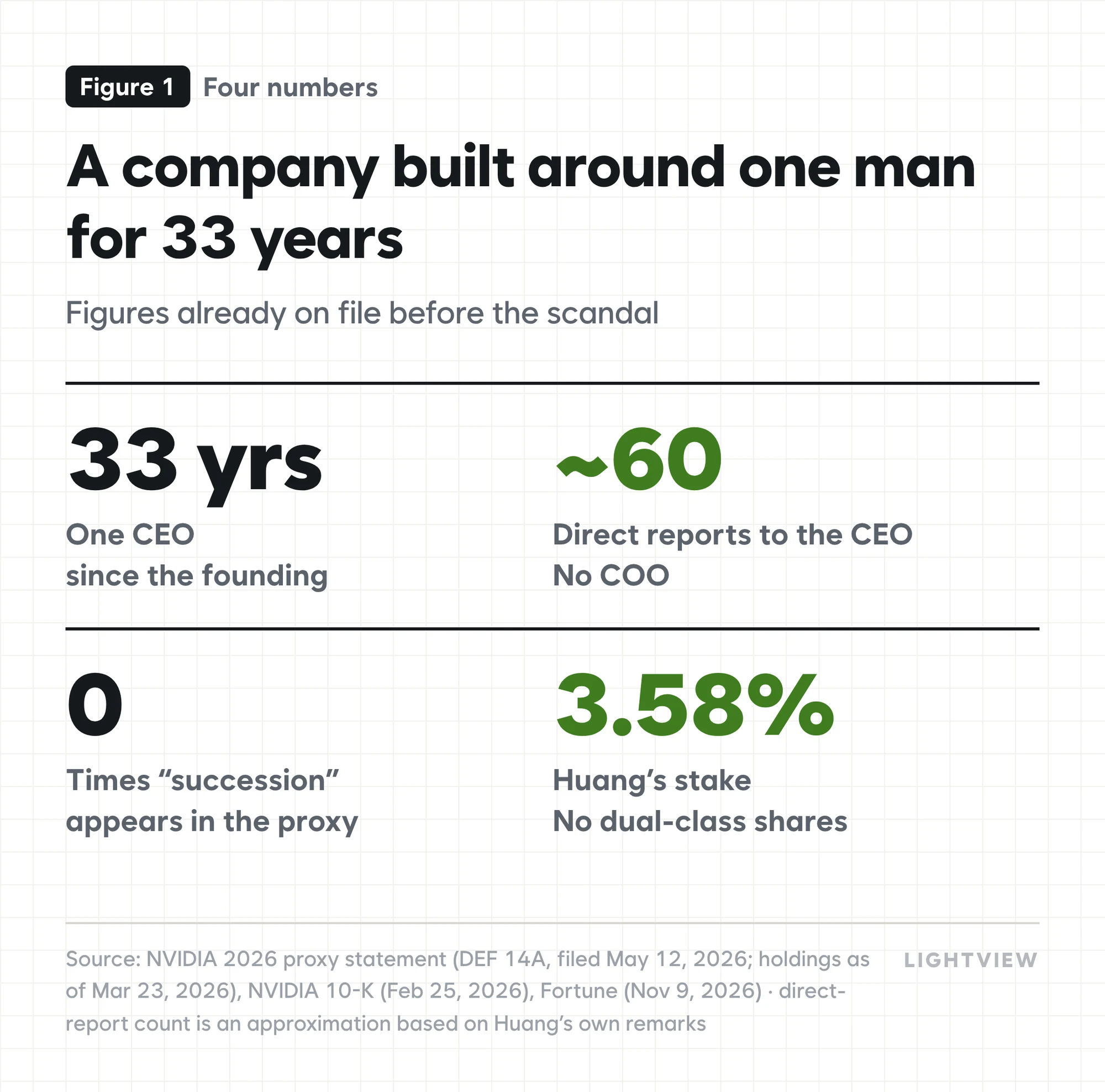
The 2026 proxy statement Nvidia filed with the SEC on May 12 runs to more than 250,000 characters. It covers everything from director elections to executive pay and shareholder proposals. Yet the word “succession” does not appear in it once.
The closest passage is a four-sentence section titled “Senior Management Development.” It says many senior managers work directly with the CEO to carry out strategy, which presents the board with a pool of excellent candidates for future promotion. The CEO picks the senior leaders who engage directly with the board, and the CEO gives the board periodic updates on management development. In effect, the job of showing the board its future leaders has belonged to Jensen Huang, CEO for 33 years.
The risk was not unknown. The annual report filed in February lists among its risk factors a heavy dependence on a longstanding executive team, warning that failure to ensure effective succession planning could hinder long-term success. The risk was written down; a plan was never made public.
This week that sentence came true. Three days after Huang admitted to an affair, reports said the board was preparing to remove him. The market is asking one question: who could best preserve the Nvidia of today? LightView weighed the six names in circulation against the same five yardsticks.
1Three days to talk of removal
It began with a New York Times report in late October about Huang’s relationship with a woman suspected of links to Chinese intelligence. In our November 9 column, LightView sorted out what could and could not be confirmed about her.
On November 8, Huang emailed employees: “I was unfaithful to my wife.” He apologized. The same day the board said a committee of independent directors, assisted by outside counsel, would run an independent investigation. It said it had no reason to believe national security or Nvidia secrets were compromised, that the inquiry would examine all available information, and that it had confidence in Huang and his team. Shares fell 4.3% on the next trading day.
Three days later the mood shifted. In a report published on the 10th or 11th, the Times said that Huang had also had a relationship with an executive who reports directly to him; neither Nvidia nor the people involved confirmed it. The Wall Street Journal reported that the board was preparing to oust him, and Reuters that the board would meet Wednesday on his future. After rising 2.9% in regular trading, the stock fell about 8.6% after hours.
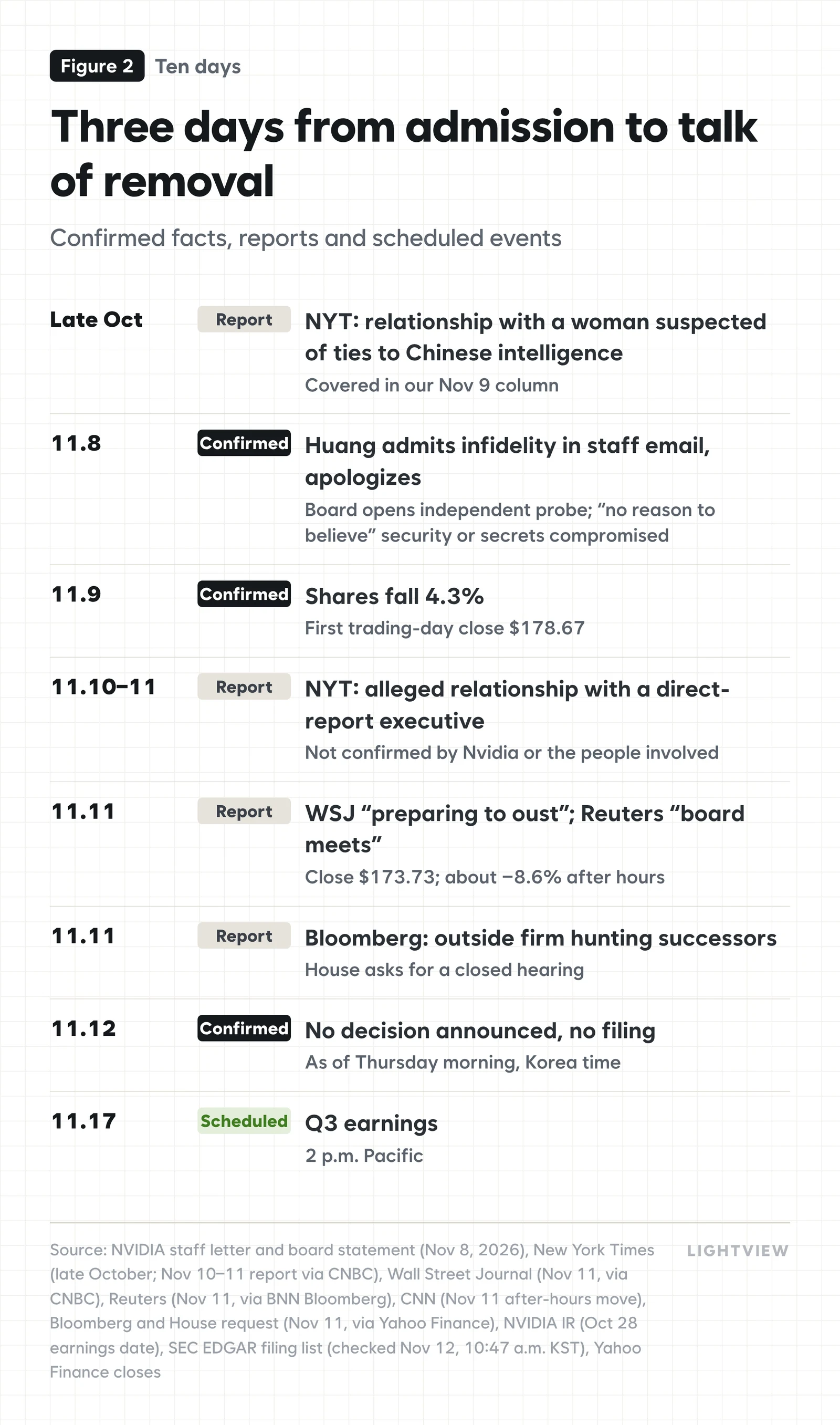
Pressure also built outside the boardroom. Bloomberg reported that Nvidia is working with an outside search firm to look for possible successors. House lawmakers asked Huang to appear at a closed hearing related to the first report and said he could be subpoenaed if he does not. Baird cut its rating to neutral, citing uncertainty over the CEO’s tenure.
As of Thursday morning in Korea, the board had announced no decision, and no filing announcing a CEO change had appeared on the SEC’s list. A source cited by Reuters said the lack of a succession plan could make an immediate removal difficult. The blank in the proxy is now tying the board’s hands.
2Eleven directors hold the key
Can Nvidia remove its founder? The answer is simple: yes, if the board decides to.
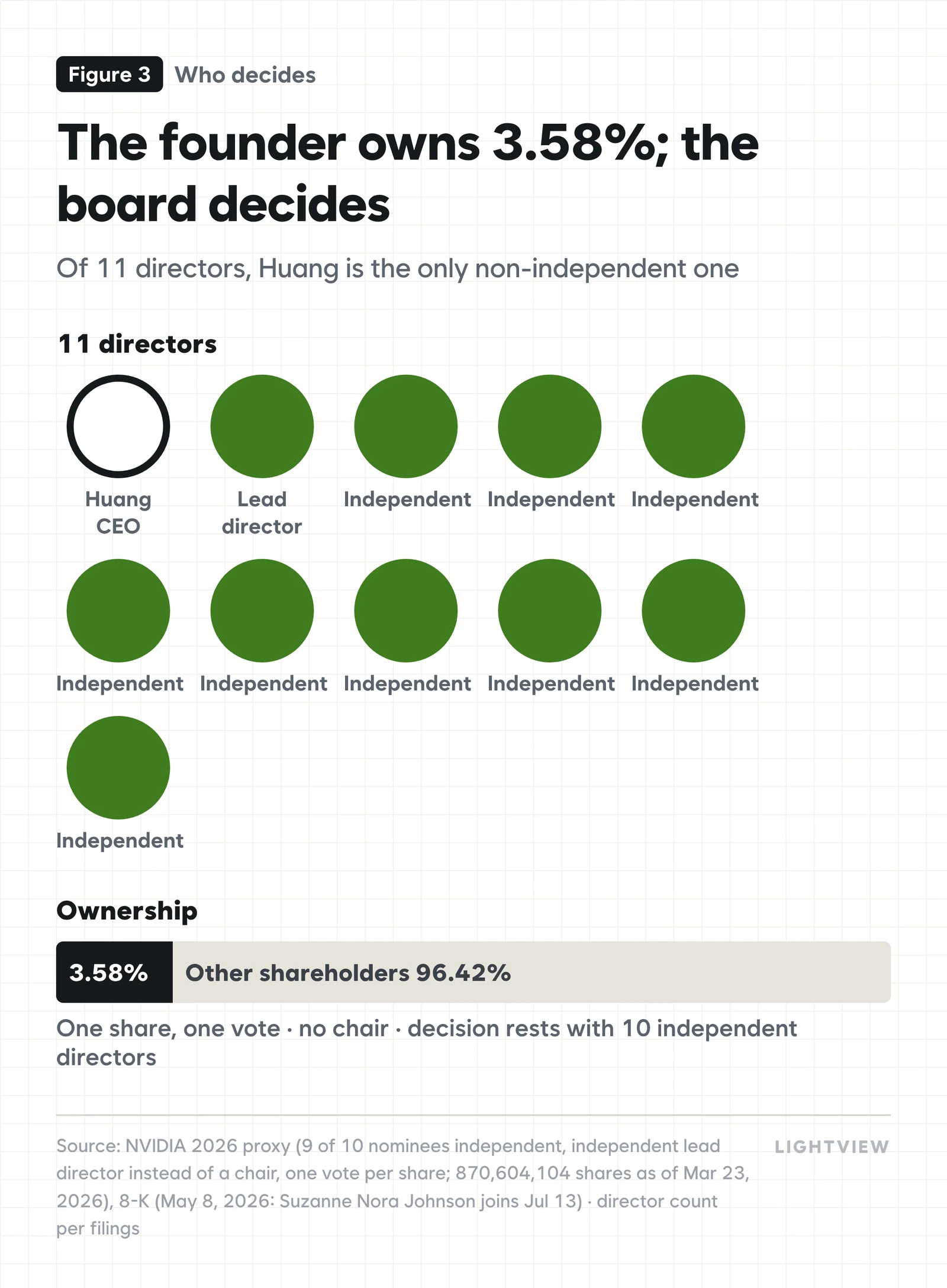
Huang owned 870.6 million shares, or 3.58%, as of March 23. Nvidia has one vote per share, with no class of stock giving the founder extra votes. That sets it apart from Meta and Alphabet, where founders hold control through dual-class shares.
The board has 11 members. Nine of the 10 nominees in the proxy were independent, and Suzanne Nora Johnson joined in July. Huang is the only insider. There is no chair; lead independent director Stephen Neal runs the board. Huang’s fate rests with 10 independent directors.
The proxy also mentions family. Huang’s daughter and son work at Nvidia and were paid about $1.23 million and $1.32 million in the last fiscal year. The company says neither is an executive officer nor reports directly to Huang. Fortune listed the two and a son-in-law among family members who come up in succession talk, but on a board dominated by independent directors that path is narrow.
3Five jobs Huang did alone
Nvidia has no chief operating officer. By Huang’s own account, about 60 people report directly to him.
LightView splits the work Huang has done in that structure into five jobs. He made the final calls on product direction and technology. He dealt directly with the chief executives of customers such as Microsoft, Google, Amazon, Meta and OpenAI. He persuaded investors every quarter and represented the company in Washington on export controls. And he was always there to do all of it.
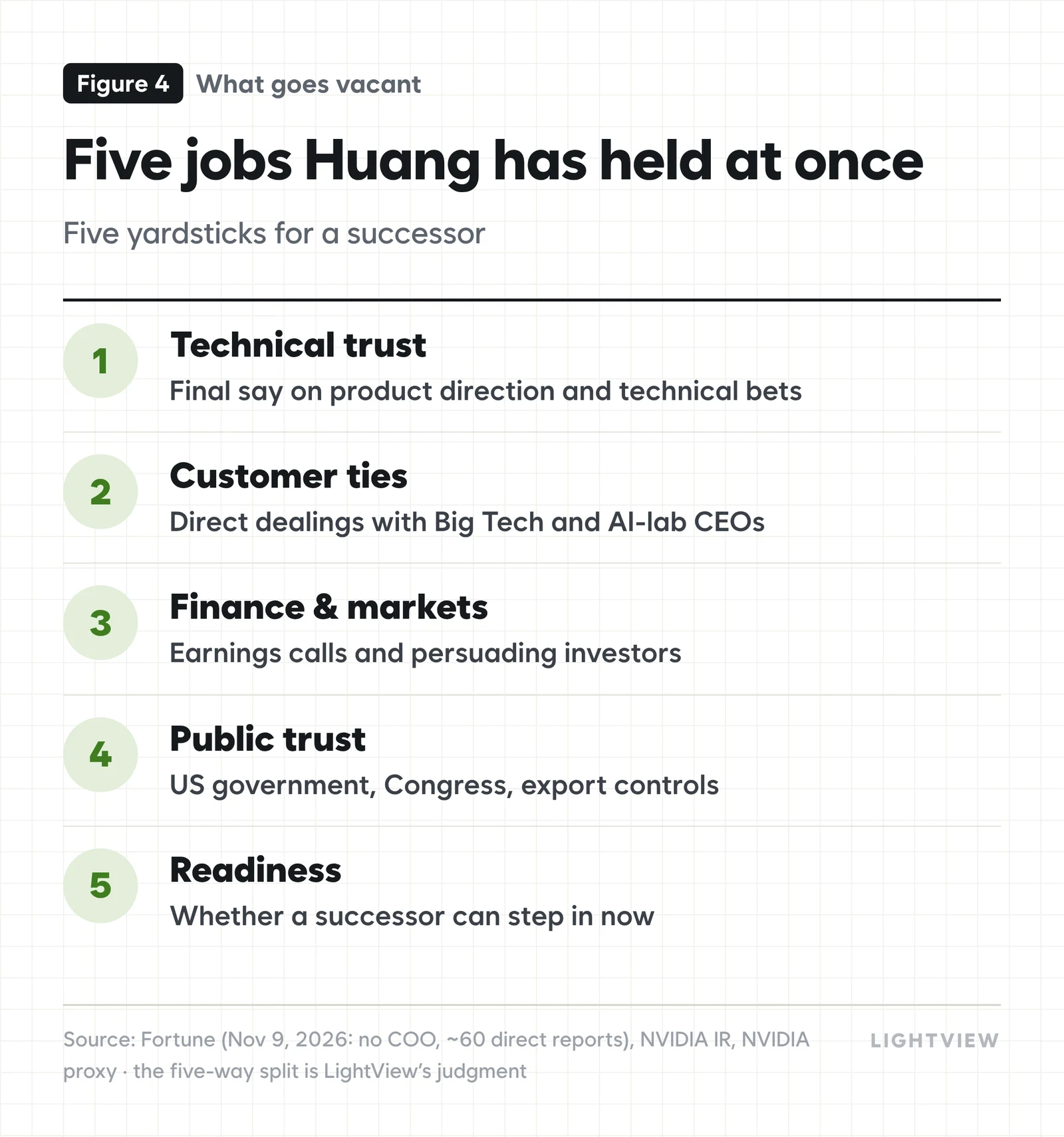
So the succession question needs rephrasing. Less “who replaces Huang?” and more “who shares these five jobs?” LightView used the five as its yardsticks: technical trust, customer ties, finance and markets, public trust, and readiness to step in now.
4The two insiders
Put the six against the five yardsticks, and no one fills every box.
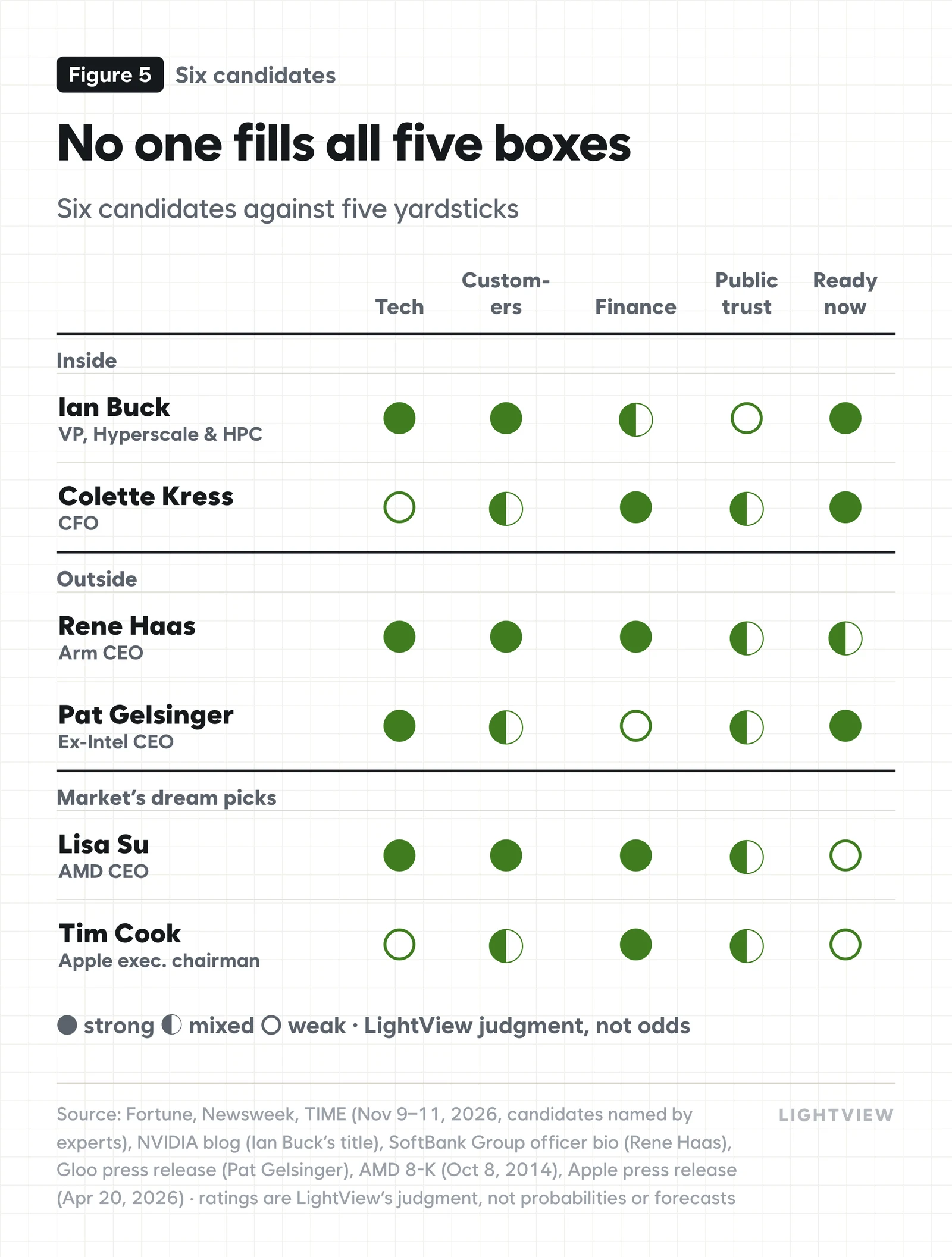
Inside, the closest to a long-term answer is Ian Buck. He joined in 2004, created CUDA, the root of Nvidia’s software ecosystem, and as vice president of hyperscale and high-performance computing runs the AI hardware and software business that serves Big Tech and AI labs. His technical and customer boxes are full. The gaps are outside: he is not on Nvidia’s published list of executive officers, and we found no record of him representing the company before investors or in Washington.
Colette Kress is the opposite. CFO since September 2013, she is the face investors know best. Ahead of the November 17 earnings, she is the only person Nvidia has named, as the author of the written commentary before the call. That is why Shawn Cole of executive search firm Cowen Partners and Georgetown’s Jason Schloetzer name her as a possible interim CEO. Without a technical background, though, LightView sees her as a bridge rather than a lasting answer.
5The two outsiders
The outside name heard most often is Rene Haas.
Haas joined Nvidia in 2006 to run its computing products business, moved to Arm in 2013 and became its CEO in 2022. He knows Nvidia from the inside and has run a listed chip company, so his boxes fill evenly. The catch is his other roles. He is CEO of Arm Holdings, a SoftBank Group director and, since April, CEO of SoftBank Group International. Coming to Nvidia would first mean untangling those ties.
Pat Gelsinger could come right away. An Intel engineer by training, he returned as Intel CEO in February 2021. Today he is executive chair of faith-tech company Gloo, which leaves him relatively free. His weakness is how the Intel chapter ended: he left in December 2024, and LightView sees his Intel turnaround as having ended before it paid off.
6The market’s dream picks
Two names often floated as dream candidates are also the furthest away.
Lisa Su became AMD’s CEO in October 2014. AMD stock, $3.28 that day, closed at $552.90 on the 11th, about 168 times higher. Her technical, customer and financial boxes are as solid as anyone’s. But she runs Nvidia’s biggest rival, and a published family tree shows she and Huang are distant relatives. AMD shares rose 23% from the November 6 close to the 11th.
In LightView’s view, Tim Cook is the model of succession after a founder. But on September 1 he handed Apple’s CEO job to John Ternus and became executive chairman. He is not a chip engineer, and LightView sees Apple’s dependence on China as a weight on the public-trust box. The reason his name still comes up lies in Apple in 2011.
7What Intel and Apple left behind
Other companies have already walked both paths open to Nvidia.
On June 20, 2018, Intel CEO Brian Krzanich resigned after an investigation found that a past relationship with an employee violated a non-fraternization policy for managers. The board named CFO Bob Swan interim CEO the same day and made him permanent seven months later. In February 2021, Intel switched again, to the engineer Gelsinger. From the finance bridge to an engineer’s return took two years and eight months.
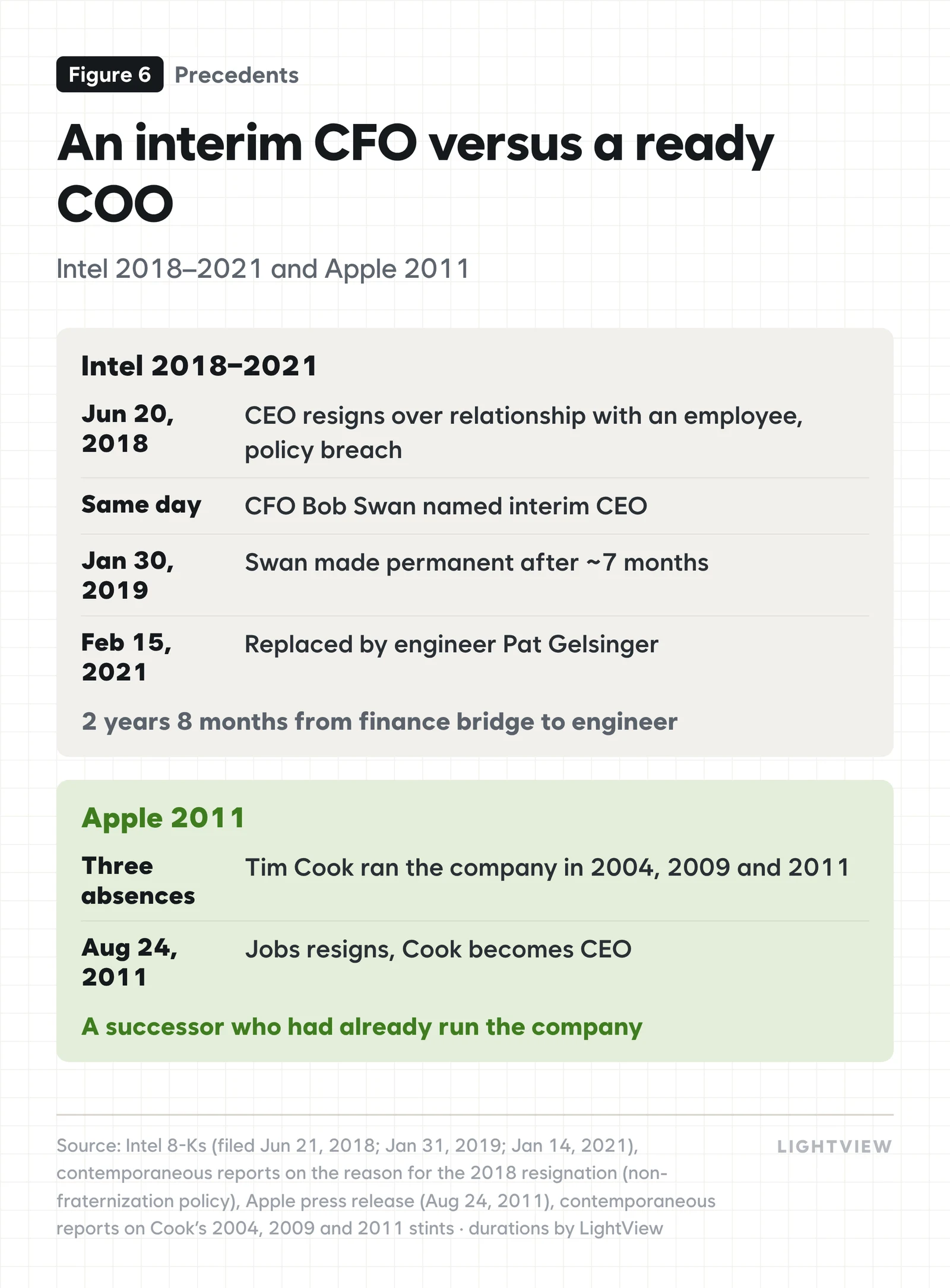
Apple went the other way. During Steve Jobs’s three absences (2004, 2009 and 2011), Tim Cook ran the company (he became COO in 2005), and when Jobs resigned on August 24, 2011, Cook became CEO at once. The successor had already run the company. Nvidia has no such COO.
An interim CEO from finance can calm markets. But a technology company that stays on that bridge too long has to endure a long gap in technical judgment. LightView sees Intel’s two years and eight months as the path Nvidia should most avoid.
8One person, or a structure?
LightView’s answer is a combination.
In the short run, Kress as a bridge is the most realistic. Investors know her, and she could step in today. The long-run engine is Buck or Haas. Buck knows Nvidia’s technology and customers best; Haas pairs experience running a listed chip company with an insider’s view of Nvidia.
Structure matters as much as the person. If 60 people keep reporting to one leader, Nvidia will again depend on a single person, whoever arrives. Whether it creates a COO, puts accountable heads over businesses such as data center, gaming and automotive, and changes how the board runs so that it owns succession planning will set the real size of this decision.
9November 17
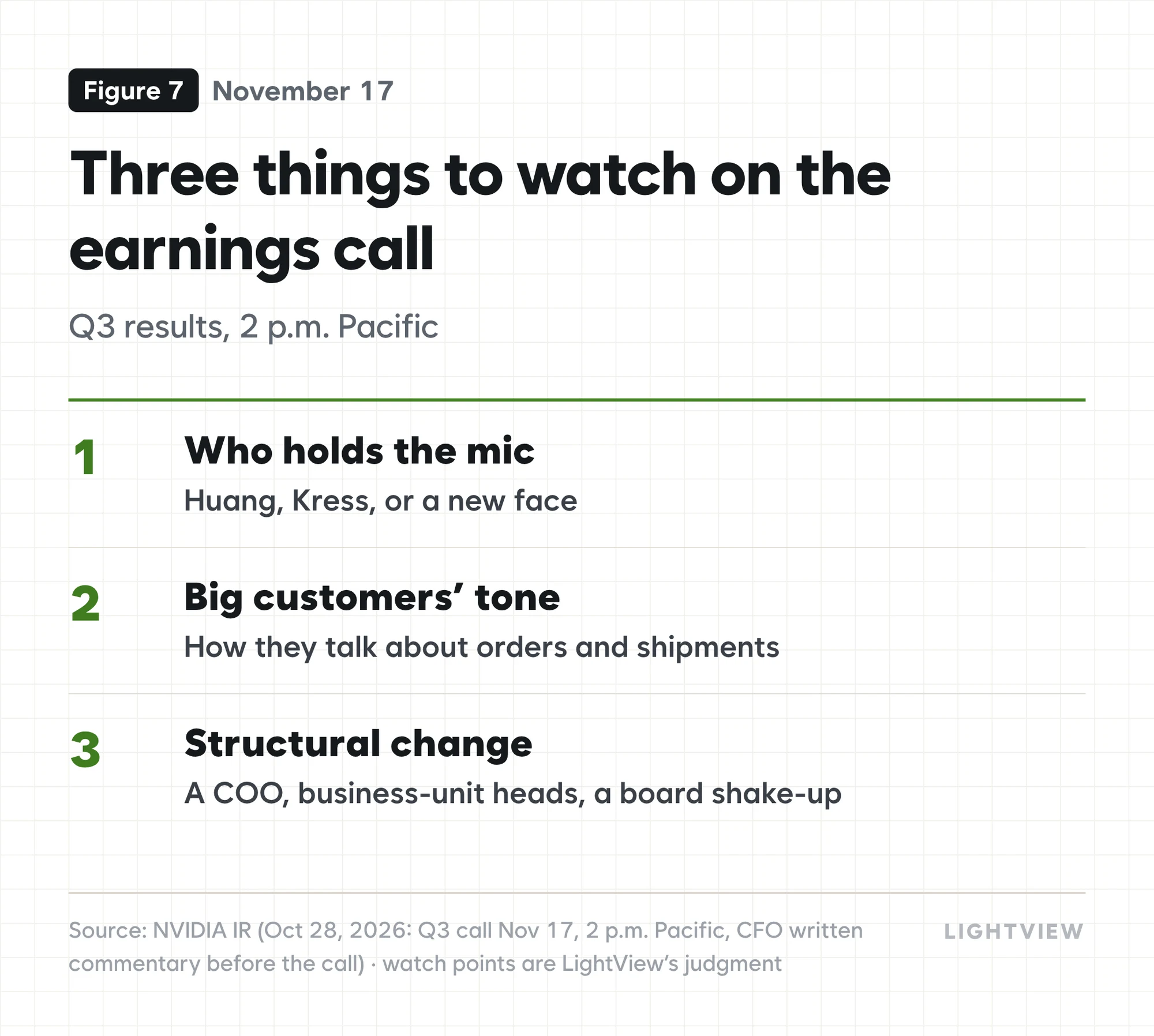
Nvidia reports third-quarter results on November 17 at 2 p.m. Pacific time.
That day, watch the people as closely as the numbers. Who holds the microphone may reveal the board’s answer first: Huang, Kress alone, or a new face. Also watch the tone in which big customers talk about orders and shipments, and whether structural changes such as a new COO or business-unit heads come with the results.
A question for readers: if you sat on Nvidia’s board, would you fill the founder’s place with one person, or with a structure?
+Terms and sources
Terms
- NVIDIA 2026 proxy statement (DEF 14A, filed May 12, 2026) · NVIDIA 10-K (filed Feb 25, 2026) · NVIDIA 8-K (May 8, 2026) · NVIDIA board statement and Jensen Huang’s message to employees (Nov 8, 2026) · NVIDIA IR Q3 earnings date (Oct 28, 2026) · SEC EDGAR filing list for NVIDIA (checked Nov 12, 2026, 10:47 a.m. KST) · Intel 8-Ks (Jun 21, 2018; Jan 31, 2019; Jan 14, 2021) · AMD 8-K (Oct 8, 2014) · Apple press releases (Aug 24, 2011; Apr 20, 2026) · SoftBank Group officer bio (Rene Haas) · Gloo press release (Mar 24, 2025, Pat Gelsinger) · NVIDIA blog author page (Ian Buck) · Yahoo Finance closing prices
- New York Times (late October; Nov 10–11, via CNBC and TechCrunch) · Wall Street Journal (Nov 11, via CNBC) · Reuters (Nov 11, via BNN Bloomberg) · CNBC (Nov 8, Nov 11) · CNN (Nov 11) · Bloomberg (Nov 11, via Yahoo Finance) · Yahoo Finance live coverage (Nov 11: House hearing request, Baird downgrade) · Fortune (Nov 12, 2024 on 60 direct reports; Nov 9, 2026; 2025 rising executives, Ian Buck) · TIME (Nov 11, Sonnenfeld et al.) · Newsweek (Nov 10) · CFO Dive (Nov 10) · Tom’s Hardware (Jul 1, 2023 family tree) · contemporaneous reports on Intel’s 2018 resignation
Official documents
Reporting and analysis
This column's topic and analytical direction are set by the editor, who reviews and revises it before publication. AI tools were used for research, drafting and infographics, and every figure was checked against its source.