1A $9 billion decision
In October 2020, SK hynix agreed to buy Intel's NAND flash business for $9bn. It was then the largest overseas acquisition by a Korean company, and a bold bet to bulk up in NAND, where SK hynix was far weaker than in DRAM.
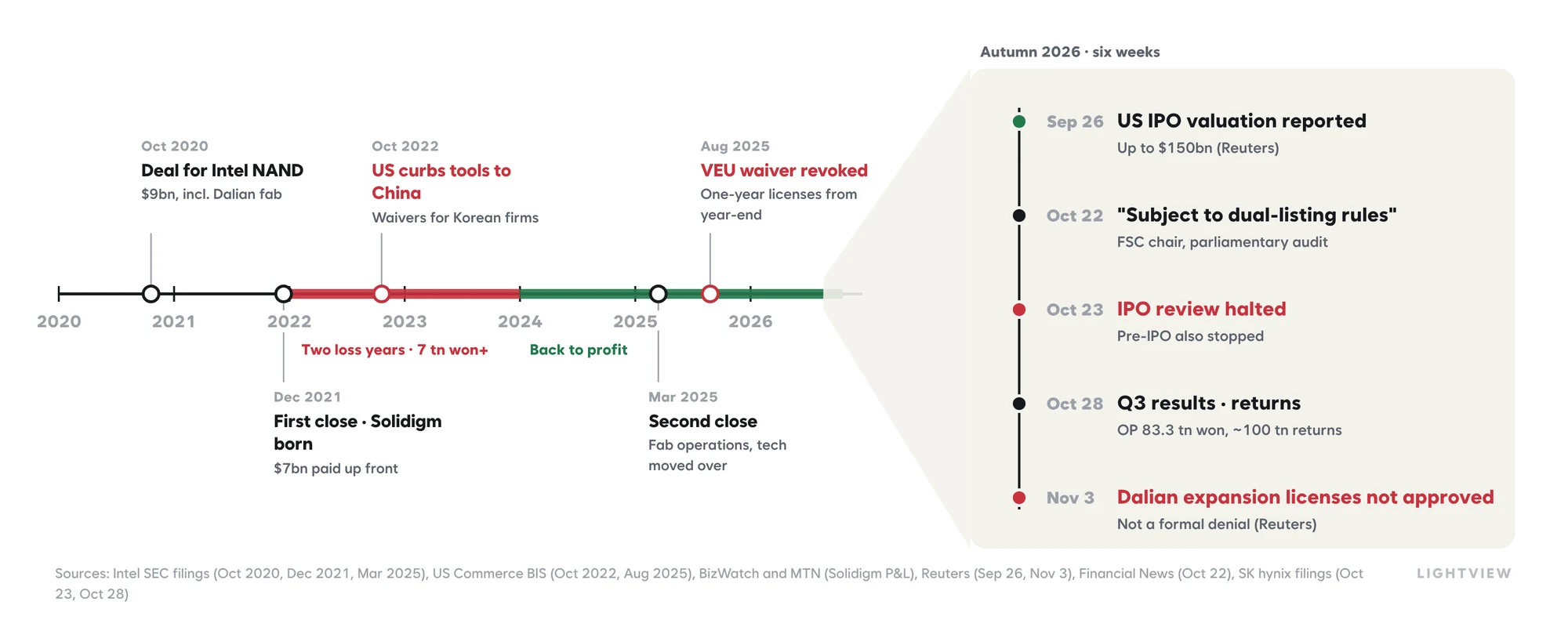
The deal closed in two stages. In December 2021, SK hynix paid $7bn for the SSD business and the Dalian fab assets, and Solidigm was launched as a US company. The balance was paid at the second closing in March 2025, which brought over fab operations and related technology. The contractual second payment was about $2.2bn, but Intel's filing shows it received about $1.9bn after adjustments, putting total payments a little under $9bn, or 12-plus tn won.
The logic was simple. Around the time of the deal (4Q 2020), SK hynix held a low-teens share of NAND revenue; adding Intel's share would lift it to around 20% and into the race for second place behind Samsung. Intel's strength in data-center SSDs and controller technology was another draw.
The timing was poor. The memory cycle turned down right after the first closing, and in October 2022 the US began restricting advanced chipmaking tools bound for China. Solidigm lost more than 7 tn won across 2022 and 2023 and became known as SK hynix's "sore finger". This autumn, though, its story moved at breakneck pace: an IPO review, a halt and a license non-approval, all within six weeks.
| Stage | When | What moved | Paid |
|---|---|---|---|
| Agreement | Oct 2020 | Whole NAND business (SSD, Dalian fab, technology) | $9bn (contract) |
| First close | Dec 2021 | SSD business, Dalian fab assets → Solidigm launched | $7bn |
| Second close | Mar 2025 | Dalian fab operations, NAND wafer technology and staff | ~$1.9bn (after adjustments) |
| Total | ~$8.9bn · 12-plus tn won |
Sources: Intel SEC filings (Oct 2020, Dec 2021, Mar 27 2025) · the contractual second payment was about $2.2bn
2From drag to star
AI data centers turned things around. As AI data exploded, demand for high-capacity enterprise SSDs (eSSDs) to replace hard drives grew fast, and Solidigm, which had staked out early ground in QLC drives that store four bits per cell, found itself at the front of the wave. Net income swung from a loss of more than 4 tn won in 2023 to a profit in 2024, and in the first half of this year it earned 5.8 tn won on 12.25 tn won of revenue (a 47.7% net margin).
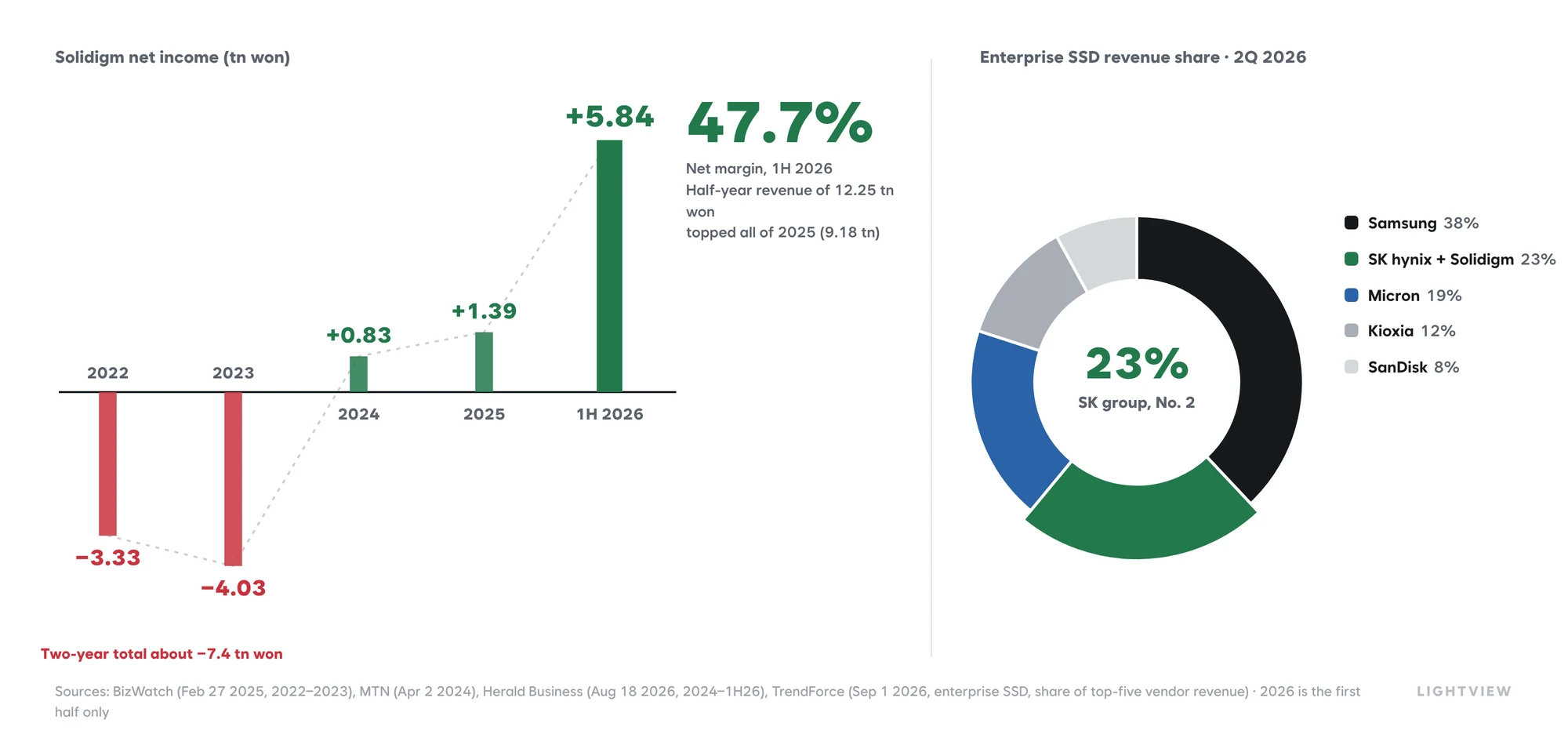
This turnaround did not come from market share. By TrendForce's count, the SK group's share of NAND revenue slipped from 20.2% at the time of the deal (4Q 2020) to 18.1% in the second quarter. What changed was the center of gravity: in enterprise SSDs alone, the group holds 23% of top-five vendor revenue, second only to Samsung (38%). Solidigm's value has grown as a channel for the most expensive NAND going into AI servers.
| Company | 4Q 2020 | 2Q 2026 | Change |
|---|---|---|---|
| Samsung | 32.9% | 29.3% | −3.6pt |
| SK hynix + Solidigm | 20.2% | 18.1% | −2.1pt |
| Kioxia | 19.5% | 13.6% | −5.9pt |
| Micron | 11.2% | 15.1% | +3.9pt |
| WD·SanDisk | 14.4% | 11.4% | −3.0pt |
Sources: TrendForce (Mar 3 2021, Aug 18 2026) · 2020 SK figure combines SK hynix and Intel NAND; some shares computed from vendor revenue
3A finished building with empty bays
Intel opened the Dalian fab in 2010 and later converted it to NAND; today it is Solidigm's only NAND production site. TrendForce estimates it accounts for 35–40% of SK hynix's total NAND output.
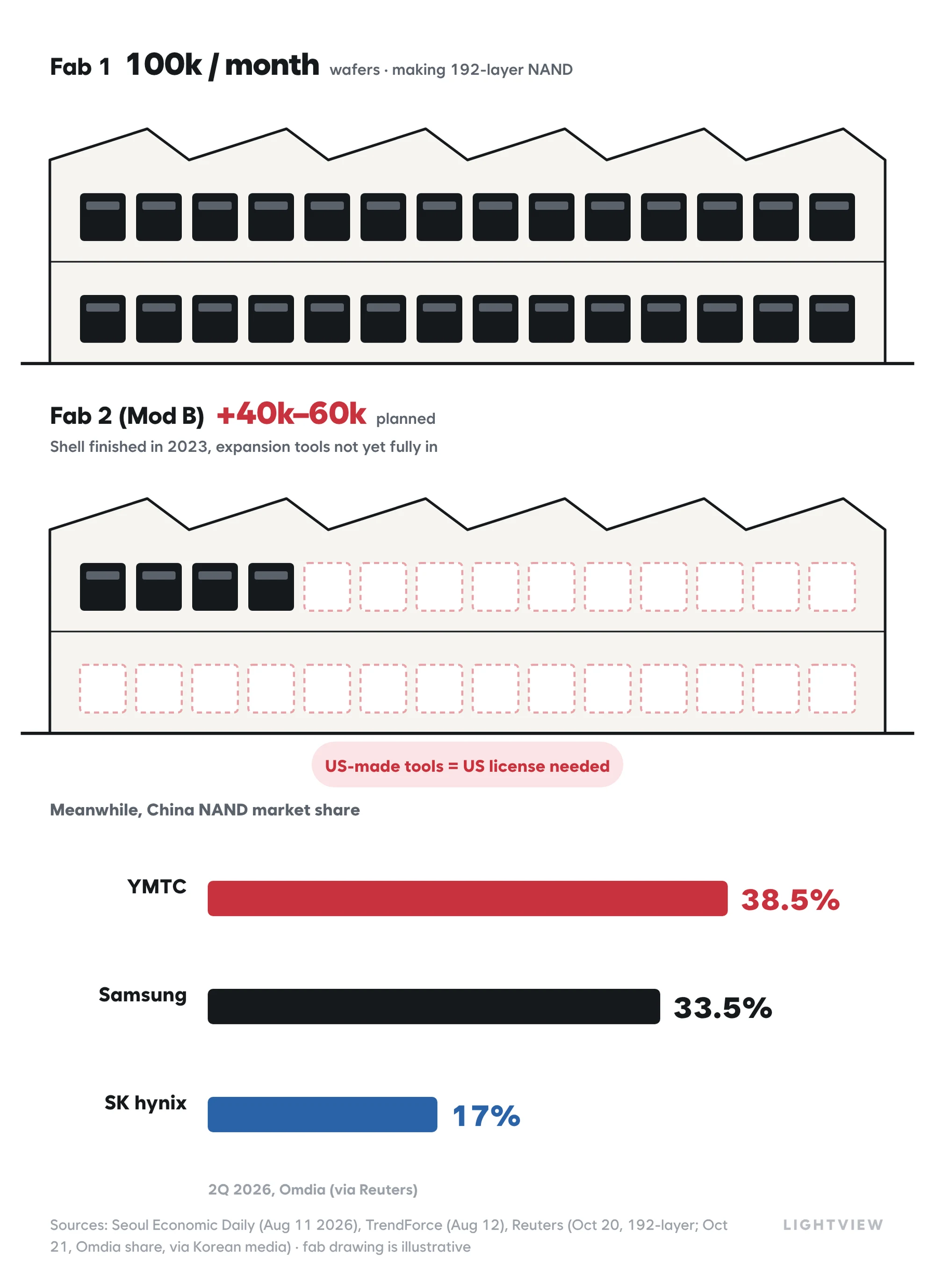
Fab 1 runs at about 100,000 wafers a month and, according to Reuters, makes 192-layer NAND. The Fab 2 (Mod B) shell next door was completed in 2023, but it has waited for tools ever since. According to Korean reports, the company planned to start moving tools in this November and add 40,000–60,000 wafers a month from the first half of 2027.
The obstacle is where the tools come from. Many of the etch, deposition and inspection tools in a NAND fab are made by US companies such as Lam Research, Applied Materials and KLA, and shipping them to China requires a US license. Meanwhile YMTC has grown fast on the same soil: by Omdia's count it held 38.5% of China's NAND market in the second quarter, ahead of Samsung (33.5%). Empty bays buy time for rivals.
Samsung faces the same rules. Its Xi'an fab, which makes about 40% of its NAND, sits under the same licensing regime, but Samsung's larger production base in Korea gives it more breathing room. SK hynix, which relies on one Chinese fab for nearly half its NAND, is naturally more exposed.
| Item | Detail | Source |
|---|---|---|
| Fab 1 | 100,000 wafers a month · 192-layer NAND | Seoul Economic Daily, Reuters |
| Fab 2 (Mod B) | Shell finished 2023 · plan for +40,000–60,000 wafers a month (1H27 target) | Seoul Economic Daily, TrendForce |
| Weight | About 35–40% of SK hynix NAND output | TrendForce |
| Obstacle | Every US tool shipment needs a US license · expansion licenses not approved (Nov 3 report) | Reuters |
4A door that narrowed every year
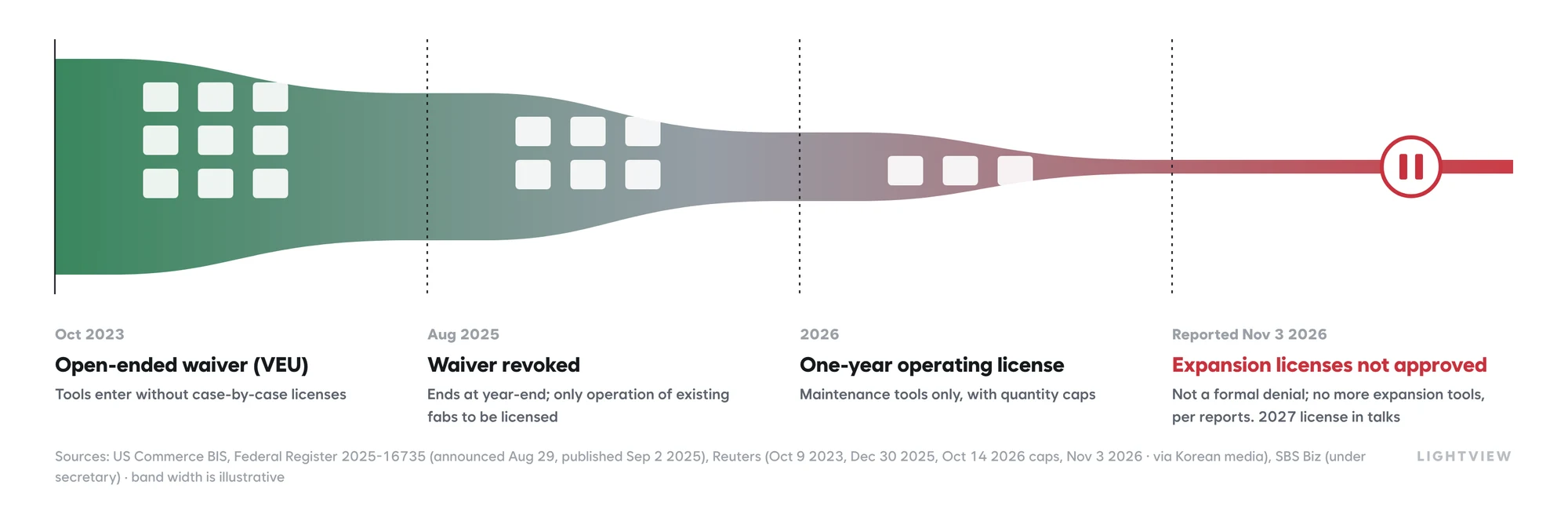
When the US blocked advanced chip tools bound for China in October 2022, it gave Korean companies' China fabs one-year grace periods. In October 2023 it went further, designating Samsung's and SK hynix's China fabs as "validated end users" (VEU) so they could bring in tools without case-by-case licenses. At that point the door was wide open.
The door began to close in late August 2025. The Commerce Department said it would revoke the VEU status at year-end and license only the operation of existing fabs; from this year, one-year operating licenses allow only maintenance tools, within set quantities. Then on November 3, Reuters reported that the US had not approved new licenses for tools needed to expand and upgrade the Dalian fab.
Even so, the plan to fill Fab 2 appears to have hit a wall. And these licenses were tied to Solidigm's US listing and US fab plans.
| Stage | When | What can come in | License |
|---|---|---|---|
| One-year grace | Oct 2022– | Korean fabs in China import without licenses for a year | Waived |
| Open-ended waiver (VEU) | Oct 2023–Dec 2025 | Tools enter without case-by-case licenses | Not needed |
| One-year operating license | 2026 | Maintenance tools, within quantity caps | Annual license |
| Expansion licenses | Reported Nov 3 2026 | Tools for expansion and upgrades not approved | Not a formal denial |
5Three links across three countries
Talk of a Solidigm listing began with August reports of a pre-IPO and Nasdaq listing push, and on September 26 Reuters reported the valuation could reach $150bn. Market talk then put the valuation at $100–150bn and the raise at $10–15bn.
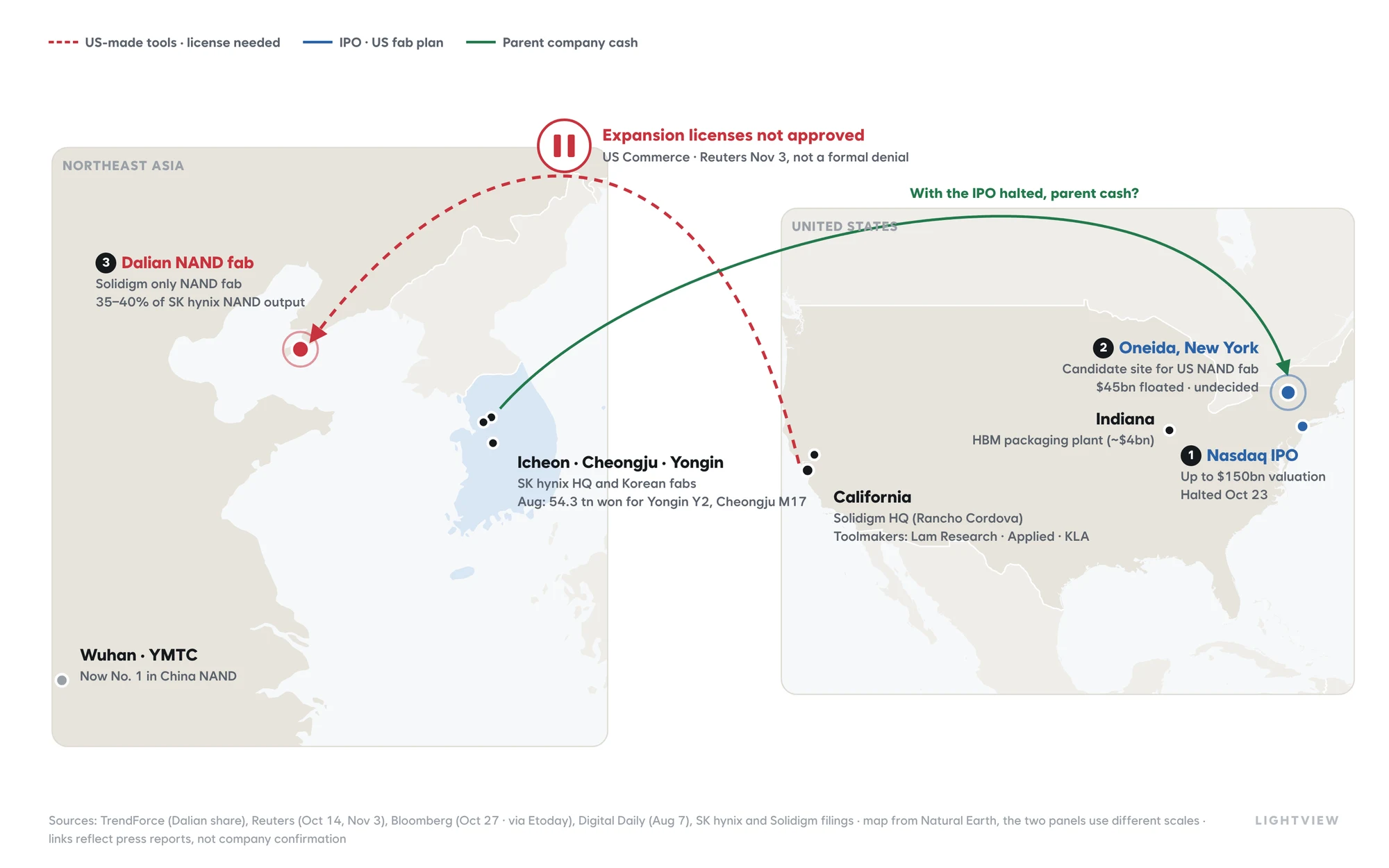
Piecing the reports together, the logic was this: raise money on a US exchange, build a NAND fab in America, and use that investment as leverage to win tool licenses for Dalian. The idea that IPO proceeds would fund the US fab, however, is an interpretation stitched together from several reports, not something the company has confirmed. Reuters reported on October 14 that a US fab investment was being discussed alongside the Dalian licenses, and Bloomberg reported that a $45bn (about 60 tn won) fab in New York State, up to roughly $100bn over time, was under consideration.
Right now, all three links have stalled. The IPO review was halted on October 23, and Solidigm says "no decision has been made" on a US fab. Some in the industry say directly linking Dalian and the US fab reads too much into it. Still, Oneida County, the candidate site in New York, expects an answer within weeks, and since the 35% US investment tax credit requires construction to start by year-end, the decision cannot be put off forever.
The scale is not small either. The $45bn floated is about five times Solidigm's first-half revenue this year, too much for Solidigm to shoulder alone without outside money from a listing. Halting the IPO effectively shifted the weight of the US fab plan onto the parent.
6The dual-listing row and the halt
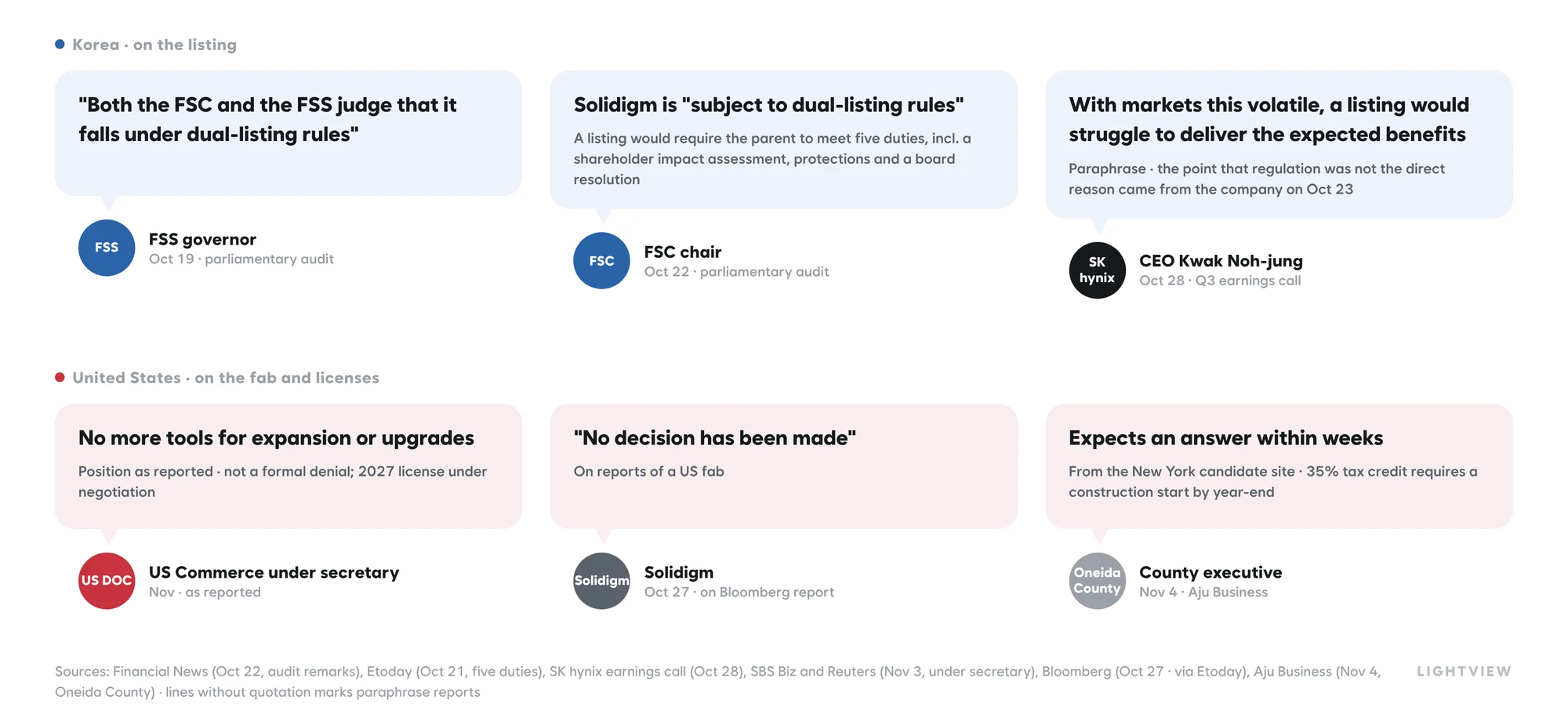
What tripped up the listing was at home: the old "dual-listing" problem, where a subsidiary's separate listing dilutes the parent's shareholders. On October 19, the head of the Financial Supervisory Service told a parliamentary audit that both the FSS and the Financial Services Commission judged a Solidigm listing to fall under dual-listing rules. Three days later the FSC chair said that even an overseas listing was "subject to dual-listing rules", meaning the parent would face five obligations, including a shareholder impact assessment, protection measures and a board resolution.
Behind that reaction lies Korean investors' long experience with the holding-company discount. When a prized subsidiary lists separately, its value tends to be reflected less in the parent's share price; the weak parent share price after a battery unit, split off in 2020, listed in 2022, is often cited as a case in point.
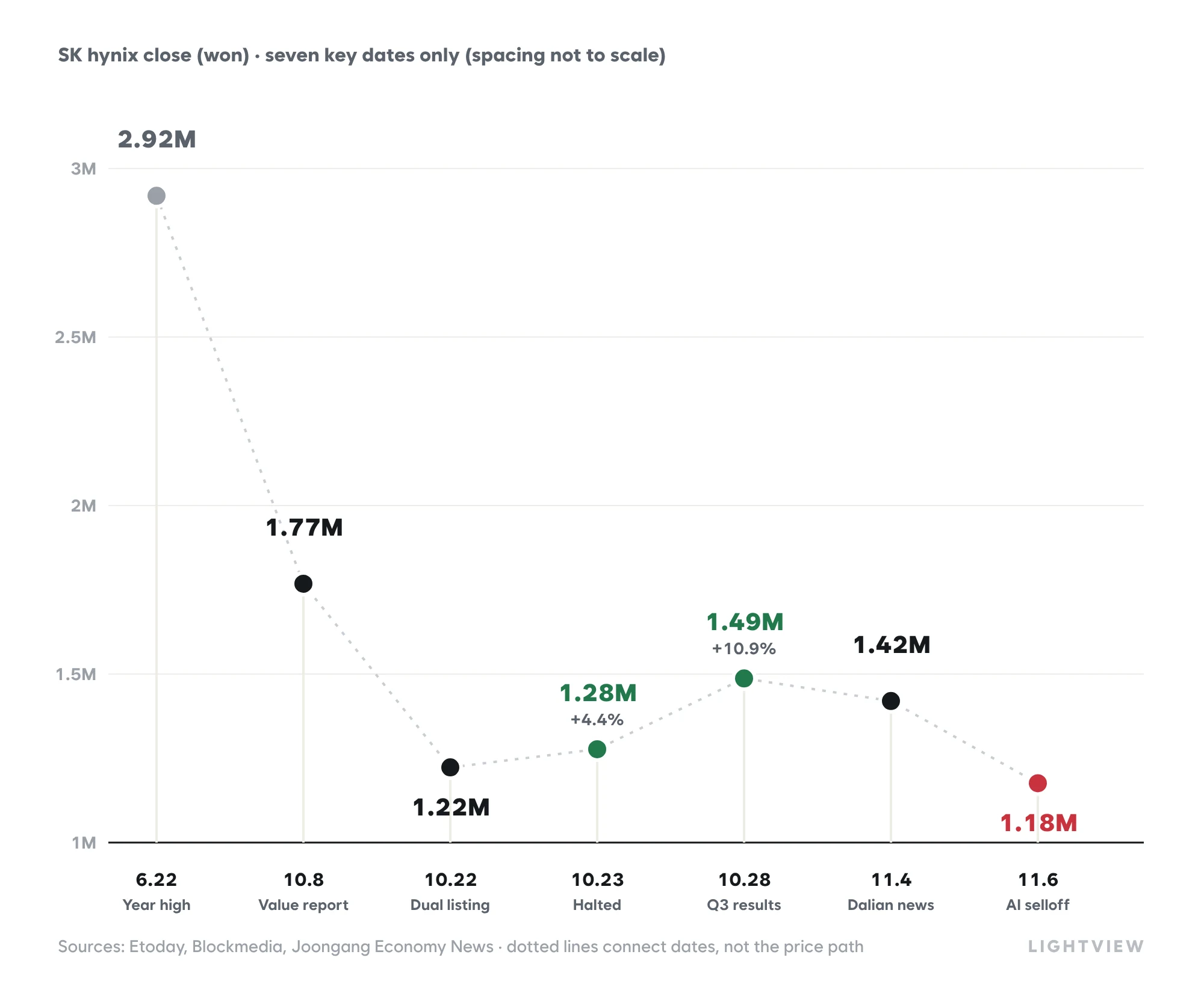
About 3,000 minority shareholders also campaigned against the plan. On October 23, before the open, SK hynix disclosed that it was halting its pre-IPO and IPO review, citing capital market conditions, and the stock rose 4.4% that day. The company said regulation was not the direct reason, and CEO Kwak Noh-jung said on the earnings call that, with markets volatile, a listing would struggle to deliver the expected benefits. Five days later, when Q3 results and the return plan came out, the stock climbed another 10.9%, but an AI selloff in November pushed it back to around 1.18 million won.
7Money from the same wallet
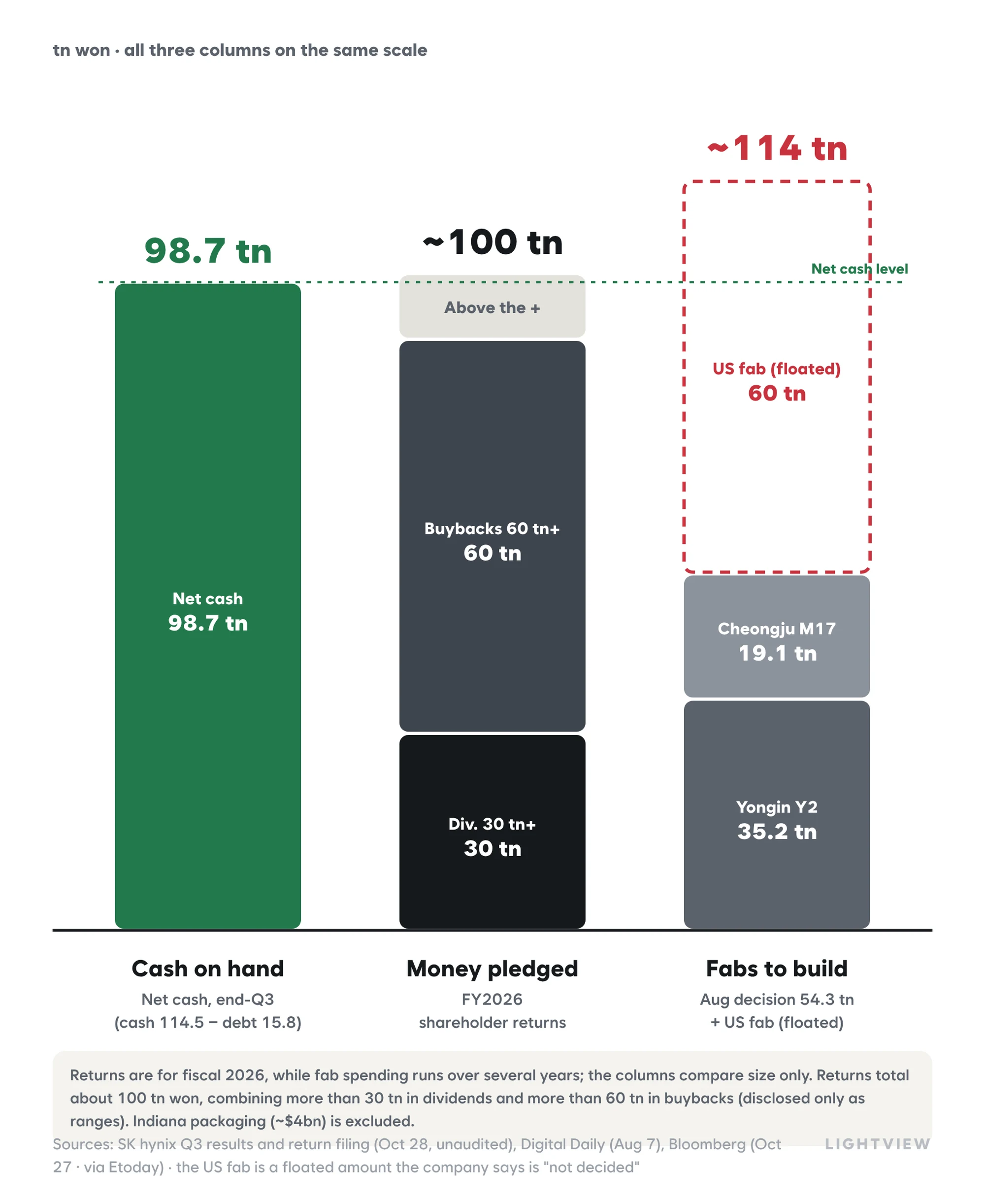
With the IPO halted, the money for Solidigm's US fab is more likely to come from the parent's cash and earnings. Fortunately, that wallet is thick. SK hynix earned 104.6 tn won in revenue and 83.3 tn won in operating profit in the third quarter alone, and ended the quarter with 114.5 tn won in cash, or 98.7 tn won after subtracting 15.8 tn won of debt.
But that cash already has claims on it. The company has pledged to return about 100 tn won to shareholders for fiscal 2026, including more than 30 tn won in dividends and more than 60 tn won in buybacks and cancellations, and large investments are lined up, including the 54.3 tn won approved in August for Yongin Y2 (35.2 tn won) and Cheongju M17 (19.1 tn won). Add a US fab floated at around 60 tn won, and even with strong annual earnings the company has to decide what comes first. That is likely why it says investment and funding will be "aligned with corporate and shareholder value".
The earnings base is solid. The company says it has long-term supply agreements with 14 customers covering more than half of its 2027–2028 capacity, and has flagged a significant increase in capex next year. In the third quarter it also announced a dividend of 20,000 won per share and a new 20 tn won buyback (10 tn won for cancellation and 10 tn won for employee compensation).
| Item | Amount | Item | Amount |
|---|---|---|---|
| Revenue | 104.6 tn won | Cash, end-Q3 | 114.5 tn won |
| Operating profit | 83.3 tn won (80% margin) | Debt | 15.8 tn won |
| Net income | 39.8 tn won | Net cash | 98.7 tn won |
| Q3 dividend per share | 20,000 won (10,000 special) | New buyback | 20 tn won (10 cancel, 10 staff pay) |
8Three paths and six signals
The company says nothing has been decided, so based on filings and reports so far we sketch three paths. In the first (A), SK hynix invests in a US fab itself and uses that pledge to renegotiate the Dalian expansion licenses. In the second (B), Dalian stays at its current level within its operating license, and new output moves to fabs in Korea or another site.
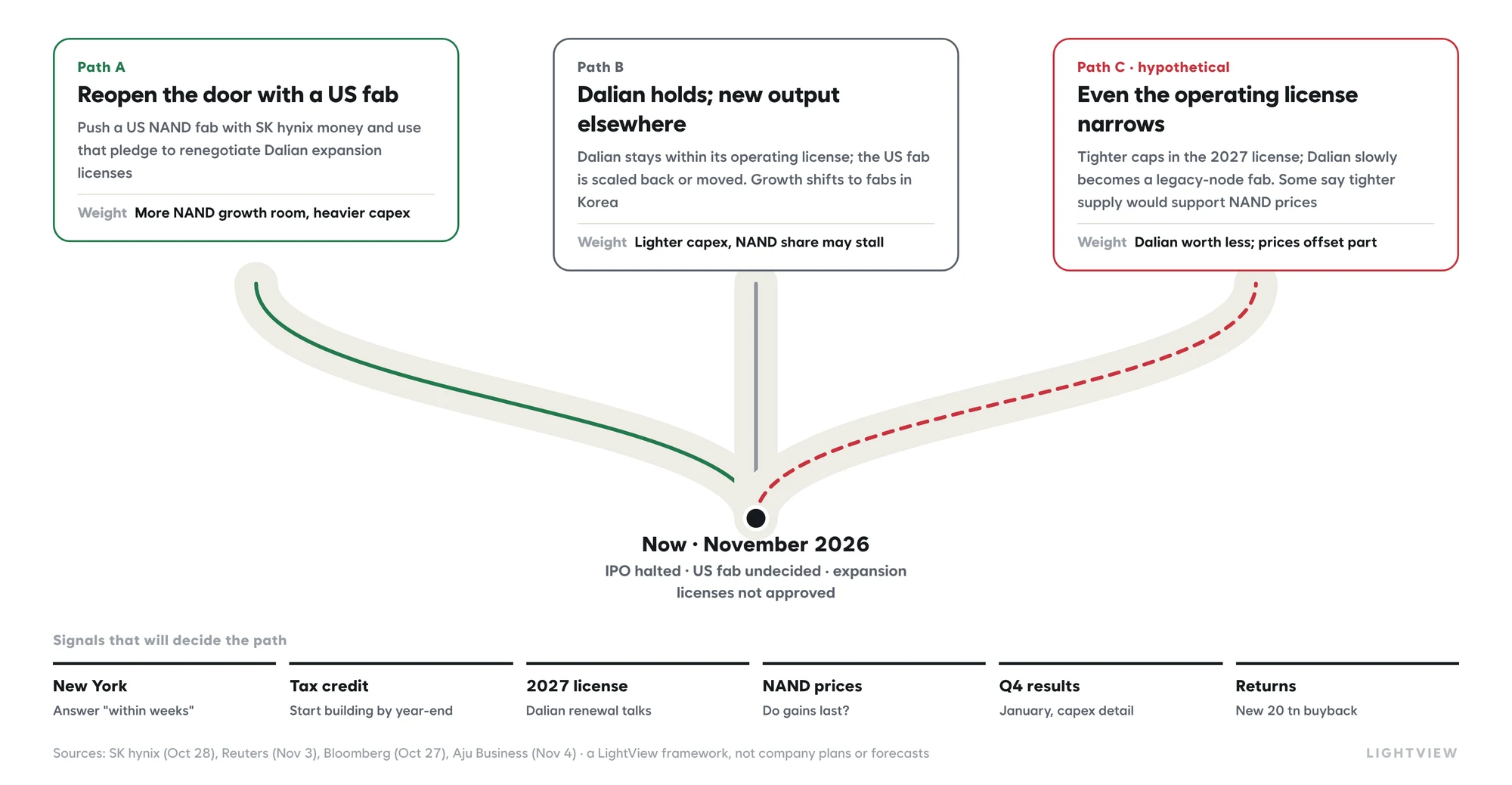
In the third (C), even the 2027 operating license narrows and Dalian gradually becomes a legacy-node fab; for now this is closer to a hypothesis. Interestingly, some argue that even this case could support NAND prices as industry supply tightens. The pace would differ by path, but Dalian's share could shrink slowly as the center of NAND production moves toward Korea and the US.
The near-term checkpoints are New York's decision, the year-end expiry of the tax credit and the talks on Dalian's 2027 operating license. Six years after it was bought, Solidigm has become the company that ties down SK hynix's next move. How that knot is untied will likely shape the next decade of its NAND business.
+Terms and sources
Glossary
- SK hynix filing (Oct 2020 Intel NAND acquisition) · Intel SEC filings (Dec 2021 and Mar 27 2025 closings, payments) · SK hynix annual reports (Solidigm results, payments) · SK hynix 2026 half-year report (Solidigm revenue, net income)
- TrendForce (NAND revenue share 4Q20 and 2Q26, eSSD share 2Q26, Dalian output share) · Seoul Economic Daily (Aug 11 2026, Dalian Fab 1 and 2) · Reuters (Oct 21, Omdia China NAND share, via Korean media)
- US Commerce BIS, Federal Register 2025-16735 (announced Aug 29, published Sep 2 2025) · Reuters (Oct 9 2023 VEU; Dec 30 2025 annual license; Oct 14 2026 quantity caps and US fab link; Nov 3 2026 non-approval) · SBS Biz (under secretary remarks) · News Tomato (Nov 4), Economist Korea (Nov 4), HuffPost Korea (company position)
- Korea Economic Daily (Aug 5 pre-IPO push) · Reuters (Sep 26 valuation) · Bloomberg (Oct 7 valuation, via Blockmedia) · Bloomberg (Oct 27 US fab, via Etoday) · Aju Business (Nov 4 Oneida County, tax credit) · Financial News (Oct 22 audit) · MTN (Oct 21 shareholders) · SK hynix filing (Oct 23 IPO review halted)
- SK hynix Q3 results and shareholder return filing (Oct 28, unaudited) · Digital Daily (Aug 7, Yongin Y2 and Cheongju M17 decision) · Etoday, Joongang Economy News (share prices)
Deal and results
Export controls and licenses
IPO and US fab
SK hynix results, returns, investment
This column's topic and analytical direction are set by the editor, who reviews and revises it before publication. AI tools were used for research, drafting and infographics, and every figure was checked against its source.