1A story that began with one photo
June 2024, a tech event in Taipei. A woman sat beside Jensen Huang; the caption named her as Megaspeed’s chair. When the New York Times ran that photo on October 29, it took on an entirely different meaning.
The NYT reported that US intelligence officials had concluded the woman in the photo, Alice Huang (黃樂, Huang Le), was passing information to China. Nvidia first shrugged it off, saying Huang meets thousands of customers a year. Ten days later, on November 8, Huang told employees he had been “unfaithful to my wife” and that “there is no excuse for what I did. I am deeply sorry.” The same day the board opened an independent review.
Had it been only a CEO’s private life, the story might have ended there. But three threads Nvidia shareholders cannot ignore run through it: the founder leading a company worth about $4.5 trillion (November 6, reported), the AI chips Washington closely guards from China, and a customer that bought those chips in volume. All three meet in one person. So who is she?
2An impressive résumé, little of it confirmed
Search for Alice Huang and an impressive career appears: Chinese state TV reporter, private banking at a global bank, executive at a major Chinese brokerage. None of it has been independently verified.
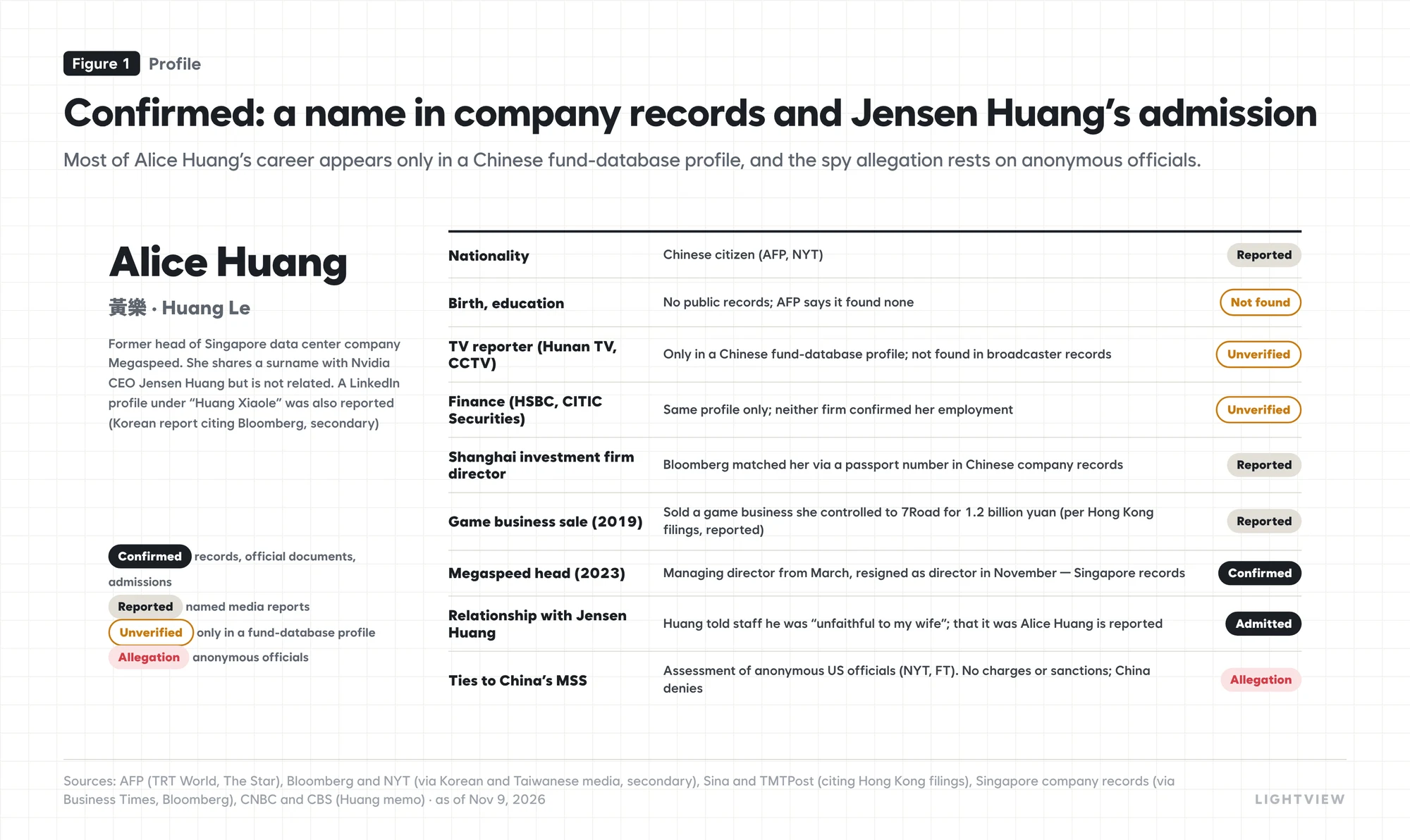
Those roles appear in a Chinese private-fund database profile and company materials. CBS and Bloomberg describe her as a former TV journalist, but the NYT said it could not independently verify that career and AFP said it could not verify the profile. According to Chinese media (Sina), HSBC and CITIC Securities did not confirm her employment, and broadcaster records did not show her as a Hunan TV or CCTV reporter. We could find no public record of her birth or education. What is firmly on record is the title “head of Megaspeed” in Singapore company filings. Jensen Huang admitted being “unfaithful to my wife,” and reports say he acknowledged the relationship with her to the board.
All those blanks cut both ways. They feed suspicion, and they make it easy for unverified stories to spread as fact. That is why this column keeps what is confirmed, what is reported and what is alleged separate throughout.
3From game entrepreneur to head of Megaspeed
Stitch the public records together and her changing role since 2019 comes into view.
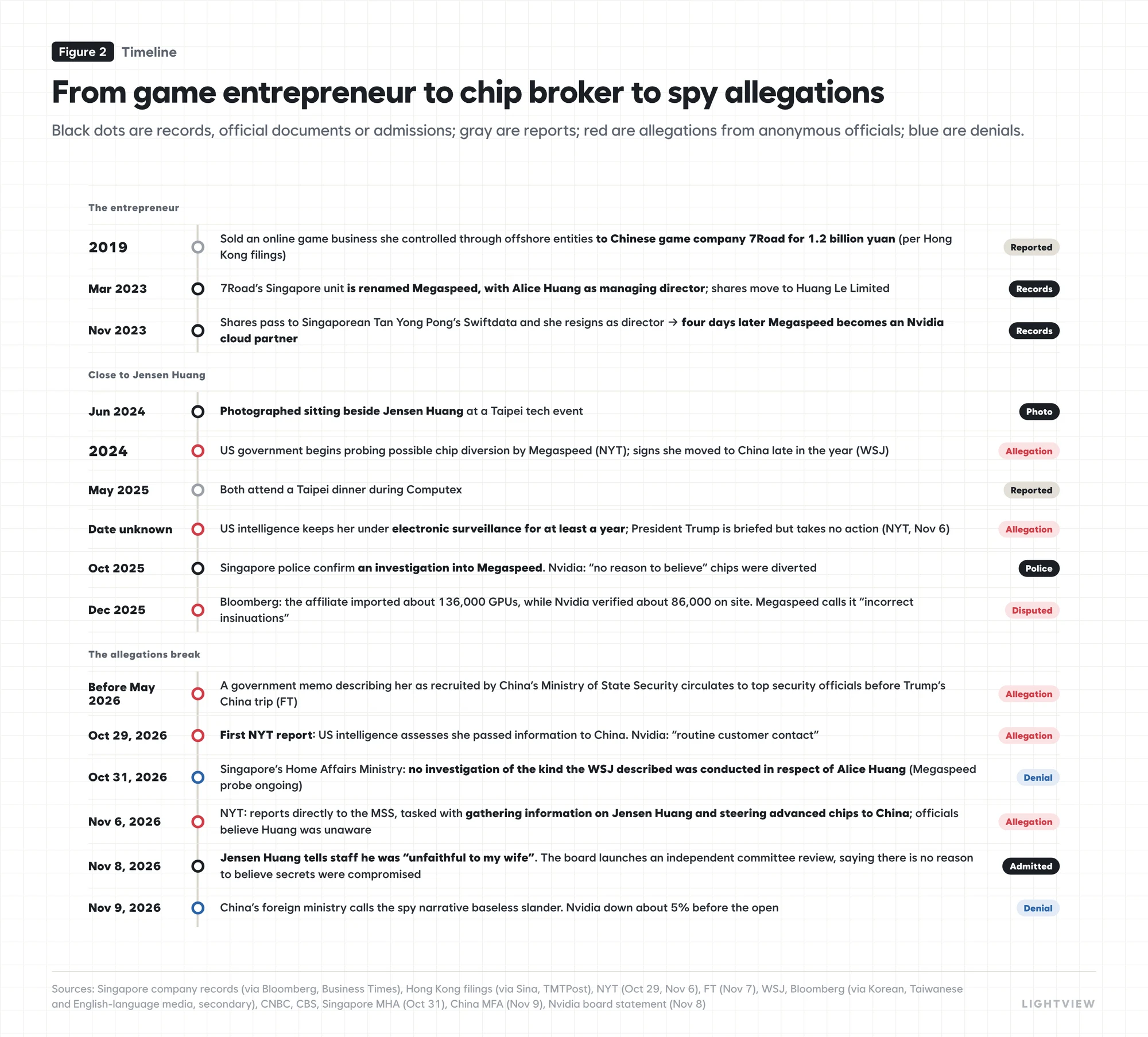
It starts with games. According to reports citing Hong Kong filings, in 2019 she sold an online game business she controlled through offshore entities to Chinese game company 7Road for 1.2 billion yuan. In March 2023, 7Road’s Singapore unit renamed itself Megaspeed and made her its head, a few months after the Biden administration restricted advanced AI chip exports to China. A game company’s overseas unit had turned into a cloud company renting out AI computing power.
In November that year the shares passed to a company owned by Singaporean Tan Yong Pong and she stepped down as director. According to Bloomberg, four days later Megaspeed became an Nvidia cloud partner. She was still introduced as Megaspeed’s chair afterward, but whether she kept any real influence over the company after resigning is not confirmed. She appeared with Jensen Huang at a June 2024 Taipei event and a May 2025 Computex dinner. Around this time, the NYT reports, the US government began looking into Megaspeed.
4$4.8 billion of equipment, and a 50,000 gap
According to the NYT and others, the US began its probe because large volumes of Nvidia chips went to the company and some may have been diverted to China.
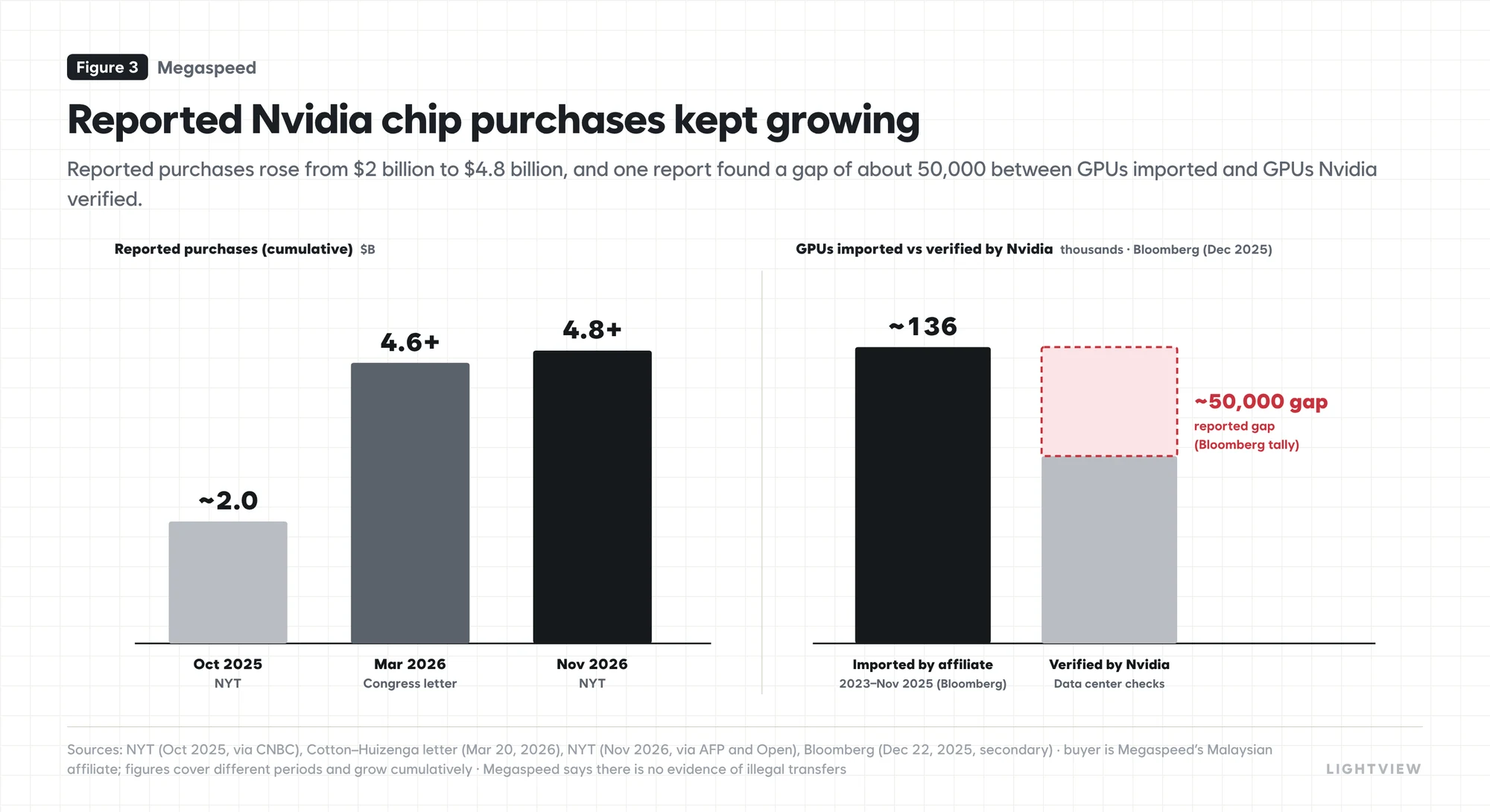
The numbers grew with each report. The NYT put purchases at about $2 billion in October 2025; a March 2026 letter from Senator Tom Cotton and Representative Bill Huizenga said more than $4.6 billion; and in November the NYT said a Malaysian affiliate bought at least $4.8 billion of equipment containing Nvidia chips between June 2024 and February 2026. According to reports citing Bloomberg (original not reviewed; 2023 to November 2025), the affiliate imported about 136,000 GPUs while Nvidia verified about 86,000 at data centers. Bloomberg pointed to that gap of nearly 50,000.
But conclusions should wait. What Singapore police have confirmed is an investigation of Megaspeed for suspected breaches of local law; diversion to China is an allegation raised by US media and lawmakers. In October 2025 Nvidia said it had “no reason to believe” chips were diverted after its own review, and Megaspeed said inspections by the US Bureau of Industry and Security, Malaysia’s government and Nvidia found no evidence of illegal transfers.
One small change came on November 8: a report said Megaspeed no longer appeared on Nvidia’s preferred cloud partner page (citing The Information, secondary); the reason is not known. Senator Cotton has called Megaspeed a spin-off of a Chinese government-owned cloud company, but within what LightView could find, parent 7Road’s Hong Kong filings show no state ownership.
5The weight of the word “spy”
The word that made this story explosive is “Chinese spy.” Yet no public official document backs it up.
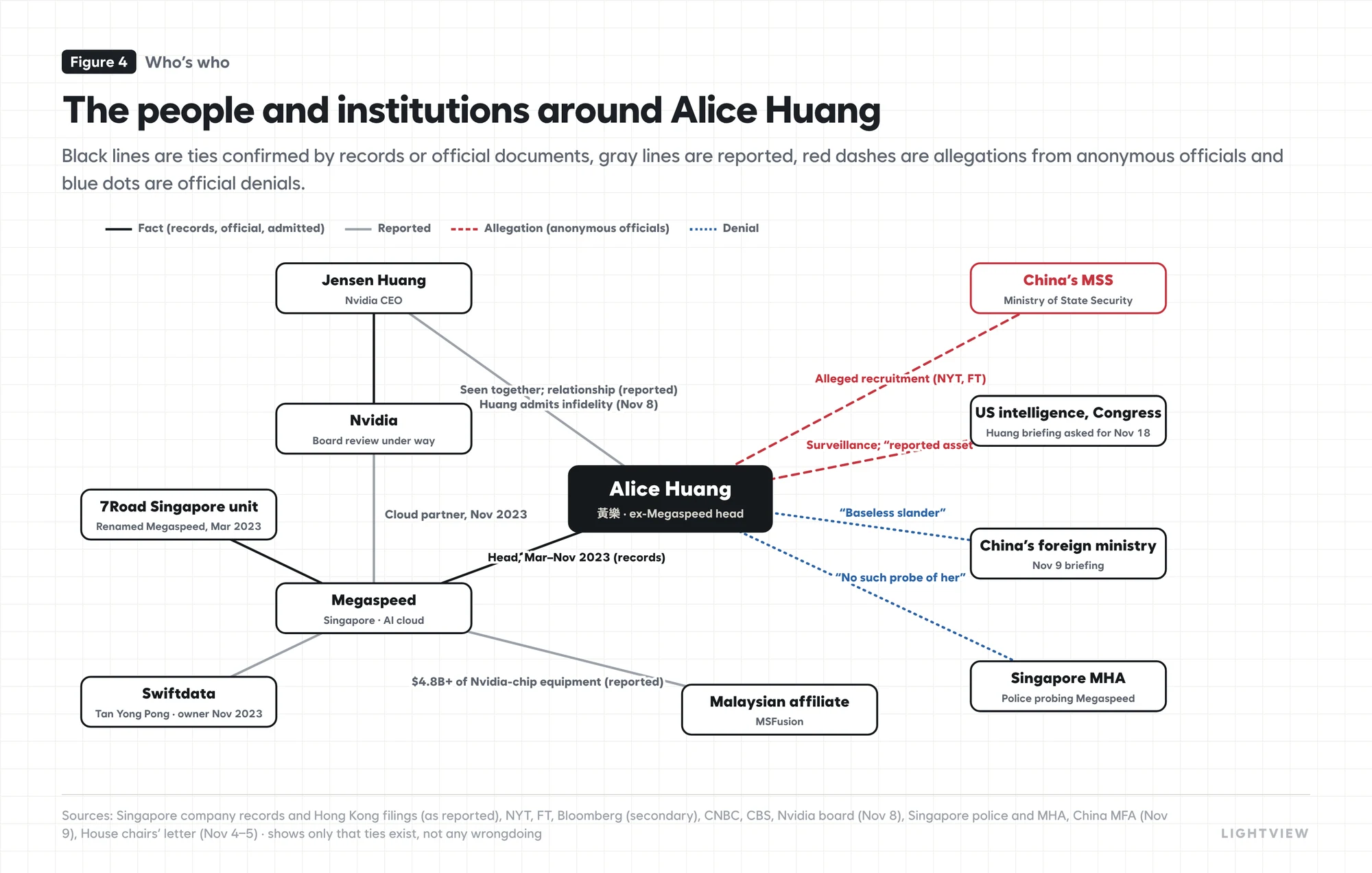
The basis is press reporting. In a November 6 follow-up, the NYT said US officials believe she reported directly to China’s Ministry of State Security (MSS) and was tasked with gathering information on Jensen Huang and influencing the supply of Nvidia’s advanced chips to China. The same officials believed Huang was unaware. The FT reported a government memo with this assessment. All of it comes from unnamed officials, and what she is said to have passed on, and on what evidence, has not been disclosed.
| Confirmed | Alleged (reported) | Denied or disputed |
|---|---|---|
| Jensen Huang admits being “unfaithful to my wife” (Nov 8) | US intelligence assesses MSS recruitment (NYT, FT; anonymous) | China’s foreign ministry: baseless slander (Nov 9) |
| Board review; no reason to believe secrets were compromised (Nov 8) | At least a year of electronic surveillance (NYT) | Singapore MHA: no investigation of the kind the WSJ reported (Oct 31) |
| Three House chairs request a closed briefing for Nov 18 | Government memo circulated to top security officials (FT) | Nvidia: the government would have told us of a genuine threat |
| Singapore police investigating Megaspeed | Megaspeed chip diversion (Commerce and Justice probes, reported) | Megaspeed: inspections found no violations |
What is missing is telling. Within what LightView could confirm, the FBI, the Justice Department and the Commerce Department have issued no official statements, and there is no record of Alice Huang or Megaspeed being charged or sanctioned. The most direct congressional language, the House China committee’s “publicly reported Chinese intelligence asset,” also rests on media reports. Her own position is not known (the FT said it could not reach her), and Megaspeed said it was surprised by claims that a former executive acted as an intelligence asset. For investors, “spy” should for now be read as an assessment, not an established fact.
6Not new information, just newly public
Many readers will ask: why now? Tracing how long this information existed changes the question somewhat.
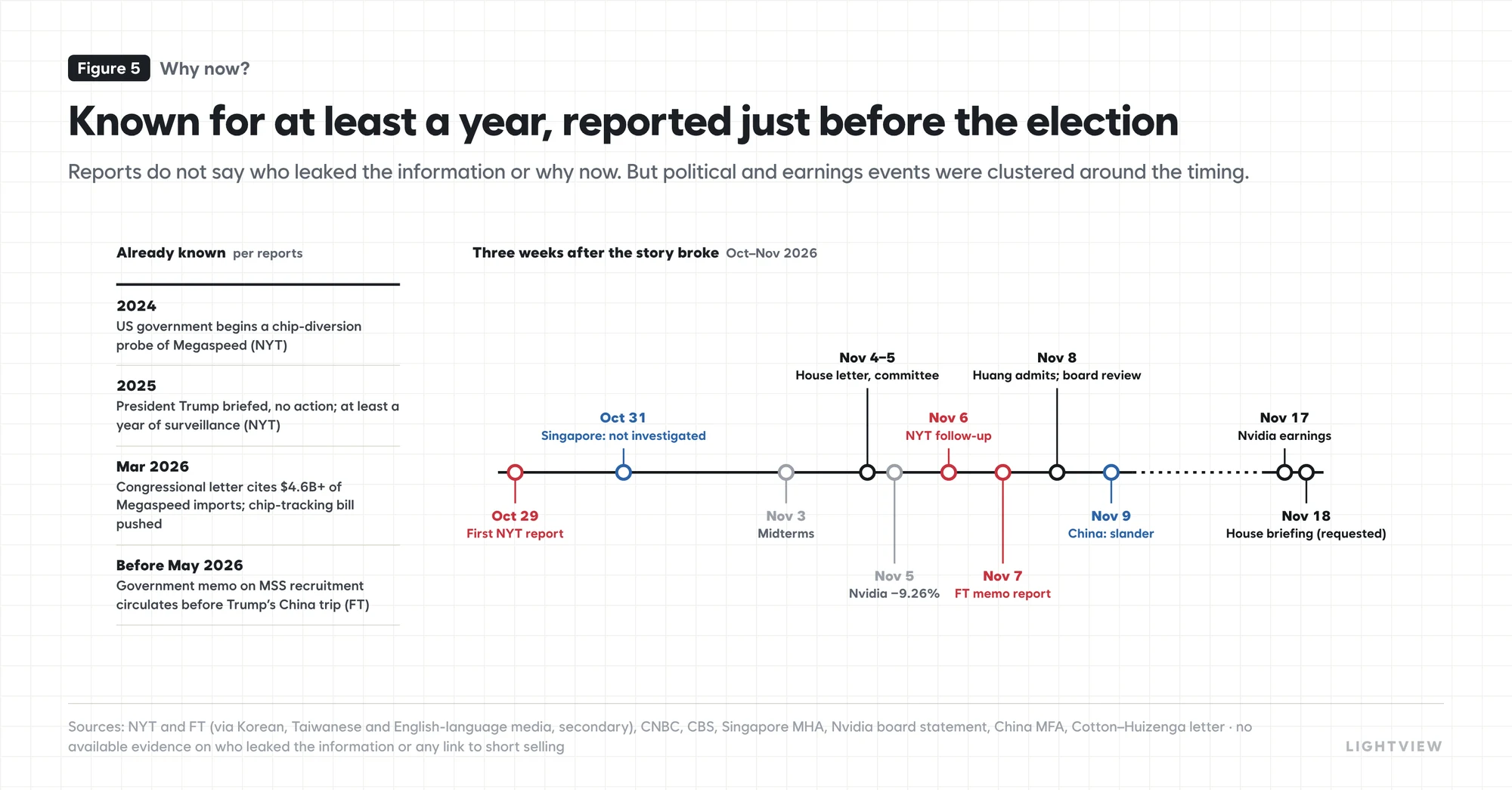
According to the NYT, the US chip-diversion probe of Megaspeed began in 2024, intelligence agencies kept her under electronic surveillance for at least a year, and President Trump was briefed in 2025 but took no action. The FT said a memo with the MSS assessment had circulated to top security officials before Trump’s May 2026 China trip. If the reports are right, officials had known for at least a year.
The story broke on October 29, five days before the November 3 midterms. Over the next three weeks came the election, House letters, Huang’s admission, then Nvidia’s November 17 earnings and a briefing requested for November 18. Underneath is a long tug-of-war over Nvidia’s China sales: Nvidia has been seeking licenses for China-bound chips, while some in Congress push a law requiring chip-location tracking.
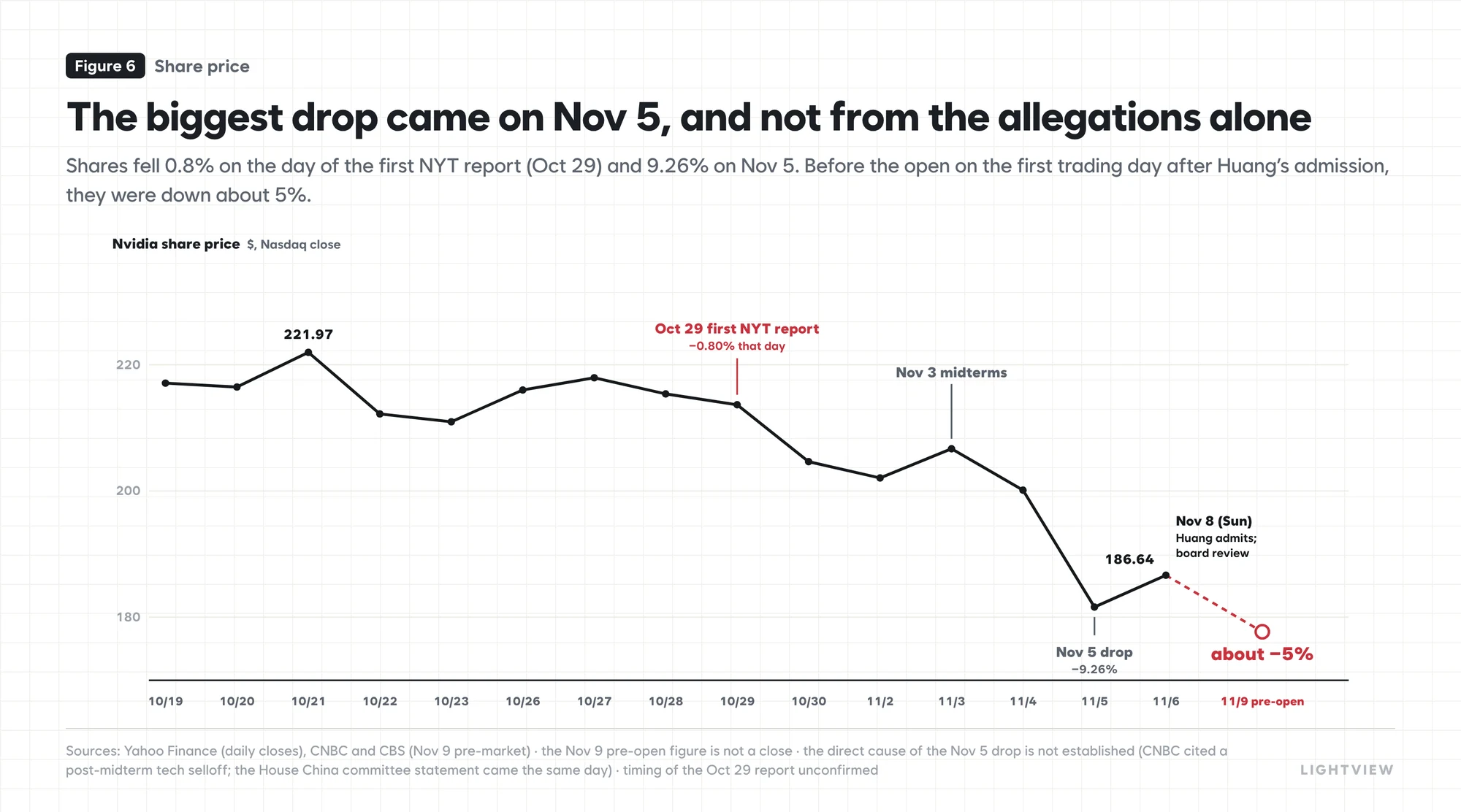
The timing invites interpretation, but we found no evidence showing who made it public or why, or any link to AI short sellers, and the share price alone cannot settle it. Nvidia fell just 0.8% on the day of the first report (timing of the report unconfirmed), and its biggest drop, −9.26% on November 5, came a week later. That day’s direct cause has not been established either: CNBC described a broad post-election tech selloff and a reassessment of data center buildouts, and the House China committee’s statement came the same day. What can be confirmed is that Congress is handling the matter alongside the fight over chip exports to China. For Nvidia, that may prove a longer-lasting issue than any short-term move in the stock.
7What Nvidia shareholders should really worry about
The hit shown in the share price is limited so far. Before the open on November 9, the first trading day after Huang’s admission, Nvidia was down about 5%. Reports that TSMC and SK Hynix rose in Asia the same day suggest the market may see this as a question of Nvidia’s management rather than AI demand.
Wall Street sees it similarly. Bernstein’s Stacy Rasgon kept his rating and $400 target, calling the spy allegations “more form than substance” but a “(very) bad look.” Dan Ives called it a “black eye moment.” Several, though, voiced one warning: Yale’s Jeffrey Sonnenfeld put Huang’s chances of staying at “about 50-50,” and investor Gary Black noted there is “no natural successor.”
That warning is the real weight of this episode. Nvidia has no disclosed succession plan, and about 60 executives report directly to Huang (Bernstein). Even if the spy allegation proves false, the episode has shown that one man’s judgment and private life can become political risk for the whole company.
| Scenario | If this happens | What it means for Nvidia |
|---|---|---|
| Contained | The board review finds no leak of secrets and the congressional briefing goes smoothly | The stock returns to earnings and AI demand; calls for governance fixes such as a disclosed succession plan remain |
| Drawn out | Congressional inquiries drag on and the Megaspeed probe reaches conclusions | Nvidia stays at the center of debates over China export licenses and chip-tracking legislation |
| Worst case | Diversion is confirmed or formal charges are filed, and pressure mounts on Huang | Export-control penalties (precedent: Seagate’s $300 million in 2023) and the risk of losing an irreplaceable CEO |
| Company (year) | Share reaction | Outcome |
|---|---|---|
| HP (2010) | About −8% next trading day | Mark Hurd resigned |
| Intel (2018) | About −1.5–2% early (sources differ) | Brian Krzanich resigned |
| McDonald’s (2019) | Up to −2.9% intraday | Steve Easterbrook fired |
| Nvidia (2026) | About −5% pre-open (Nov 9) | Still CEO, board review under way; the only case found with national-security allegations |
| When | What |
|---|---|
| November 17 | Nvidia Q3 earnings — China revenue and management’s explanation |
| November 18 (requested) | Closed House briefing; whether Huang attends |
| TBD | Board review findings; conclusion of Singapore’s Megaspeed probe |
Exactly who the woman in the photo is remains half unanswered. But the question this episode leaves Nvidia shareholders is clear: how much does a $4.5 trillion chip company depend on one man’s judgment, and how will the board reduce that risk? The answer will shape Nvidia’s next year more than the truth of the spy rumors.
+Terms and sources
Terms
- Nvidia board statement (Nov 8, 2026, Nvidia newsroom) · Jensen Huang memo (as reported by CNBC, CBS) · Singapore MHA clarification (Oct 31, 2026) · Singapore police confirmation (CNBC, Oct 10, 2025) · China MFA briefing (Nov 9, 2026, via The Paper) · Cotton letter (Oct 13, 2025) and Cotton–Huizenga letter (Mar 20, 2026; via summaries and reports) · House chairs’ letter (Nov 2026, via CNBC) · BIS Seagate penalty (2023)
- NYT (Oct 29, Nov 6), FT (Nov 7), WSJ, Bloomberg (Dec 2025, Nov 2026) — confirmed via CNBC, CBS, AFP (TRT World, The Star), The Week, Irish Examiner, Open, Yonhap, Hankook Ilbo, UDN, Newtalk, PTS rather than the originals (secondary) · Sina, TMTPost (citing Hong Kong filings and Singapore records) · Yahoo Finance (prices) · Bernstein view (Investing.com summary)
Official documents and statements
Reporting
This column's topic and analytical direction are set by the editor, who reviews and revises it before publication. AI tools were used for research, drafting and infographics, and every figure was checked against its source.