1The week AI stocks crashed
Anthropic filed its registration statement (S-1) with the SEC on October 26 and a first amendment with third-quarter results on November 2. In the very week its IPO preparations reached the final stretch, the AI stock market was badly shaken.
On Thursday, November 5, the Nasdaq Composite fell 5.52%, its biggest one-day drop since April 2025, and the Philadelphia Semiconductor Index lost more than 12%. Nvidia fell 9.26%, and AMD, Micron and Marvell dropped 16–17%. After Democrats won Congress in the November 3 midterms, worries about data center regulation and construction delays grew, and weak guidance from Qualcomm the same day added to the pressure.
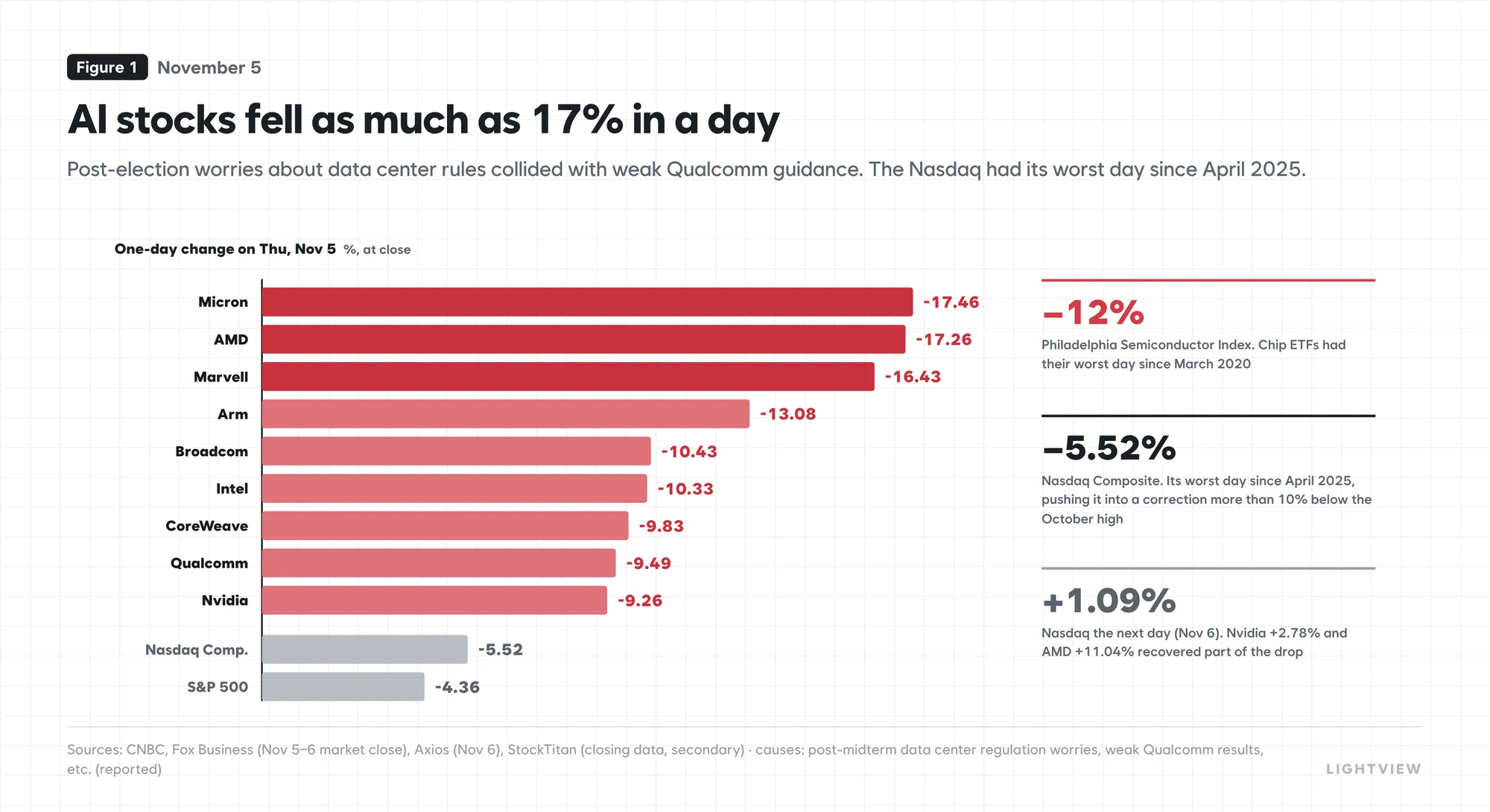
UBS estimated that about 30% of data center capacity planned for 2028 could be at risk, and one strategist said the market read the election as a sign that AI infrastructure will be built more slowly and at higher cost (reported). The Nasdaq rose 1.09% the next day, recovering part of the loss, but it remains in a correction more than 10% below its October high. It is hard to call this a good time to price an AI company at over $1 trillion.
The politics of data centers are shifting too. The day after the rout, OpenAI announced it would pay the full electricity and infrastructure costs of new data centers and stop signing confidentiality agreements with local governments, and Meta’s president said data centers will be harder to build after the election (reported). Compute may arrive later and cost more, a direct problem for Anthropic, which has promised to buy enormous amounts of it.
Expectations for Anthropic’s valuation came down with the market. In August, the FT reported that existing investors hoped for $2 trillion or more, and the NYT reported that underwriters described an offering above $100 billion. But on October 15 Reuters reported that expectations had fallen to $1.5 trillion because third-quarter growth slowed from the second quarter.
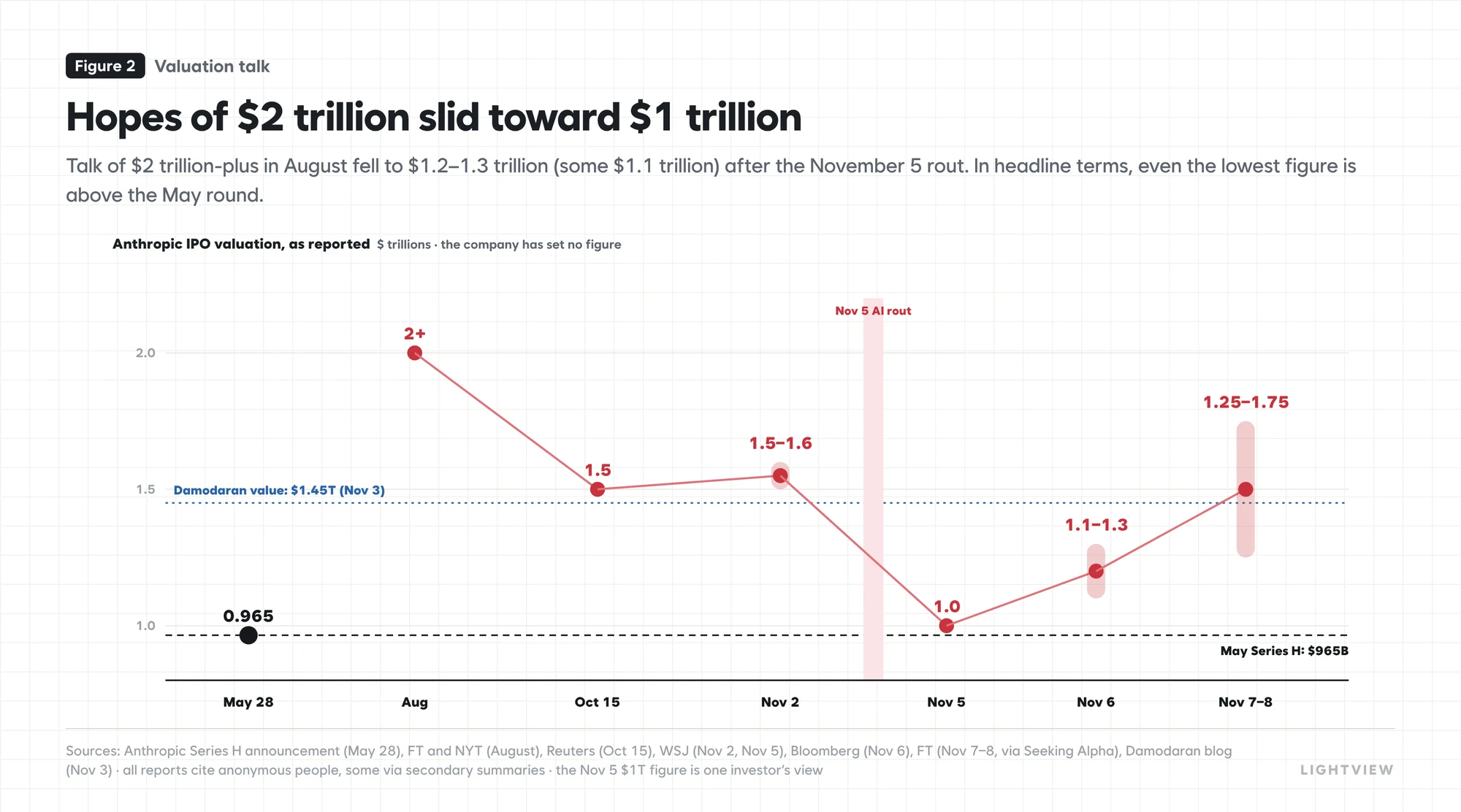
On November 6, the day after the rout, Bloomberg reported that investors were discussing $1.2–1.3 trillion (some $1.1 trillion), and one investor quoted by the WSJ mentioned something near $1 trillion. The company has not set a price range, and as of November 9 no amended filing with a price had been made. Every number in circulation comes from reports citing anonymous people.
Investors are pricing it lower for two reasons. One is growth: Q3 revenue of $16.96 billion was 47% above Q2, but Q2 revenue had jumped to 2.4 times Q1. The other is that the November 5 rout lowered expectations for AI stocks across the board.
Even so, Anthropic is not delaying. The FT reported that it has already begun marketing to institutional investors and is willing to accept a lower valuation in a falling market. The reported plan is a listing before Thanksgiving (November 26) raising $80–100 billion. One investor raised the possibility of a delay, but prediction markets’ odds of a listing before December fell to about 50% during the rout and climbed back above 80% around the FT report (on Kalshi).
That leaves one question. Why go public now, even after cutting the valuation from $2 trillion toward $1 trillion? There are three answers: a bill that must be paid, a scale of money private markets cannot reach, and the math that makes waiting more expensive.
2Reason one: an $895 billion bill
The first answer is in the filing. Anthropic has committed to spend a total of $895.4 billion on compute and infrastructure.
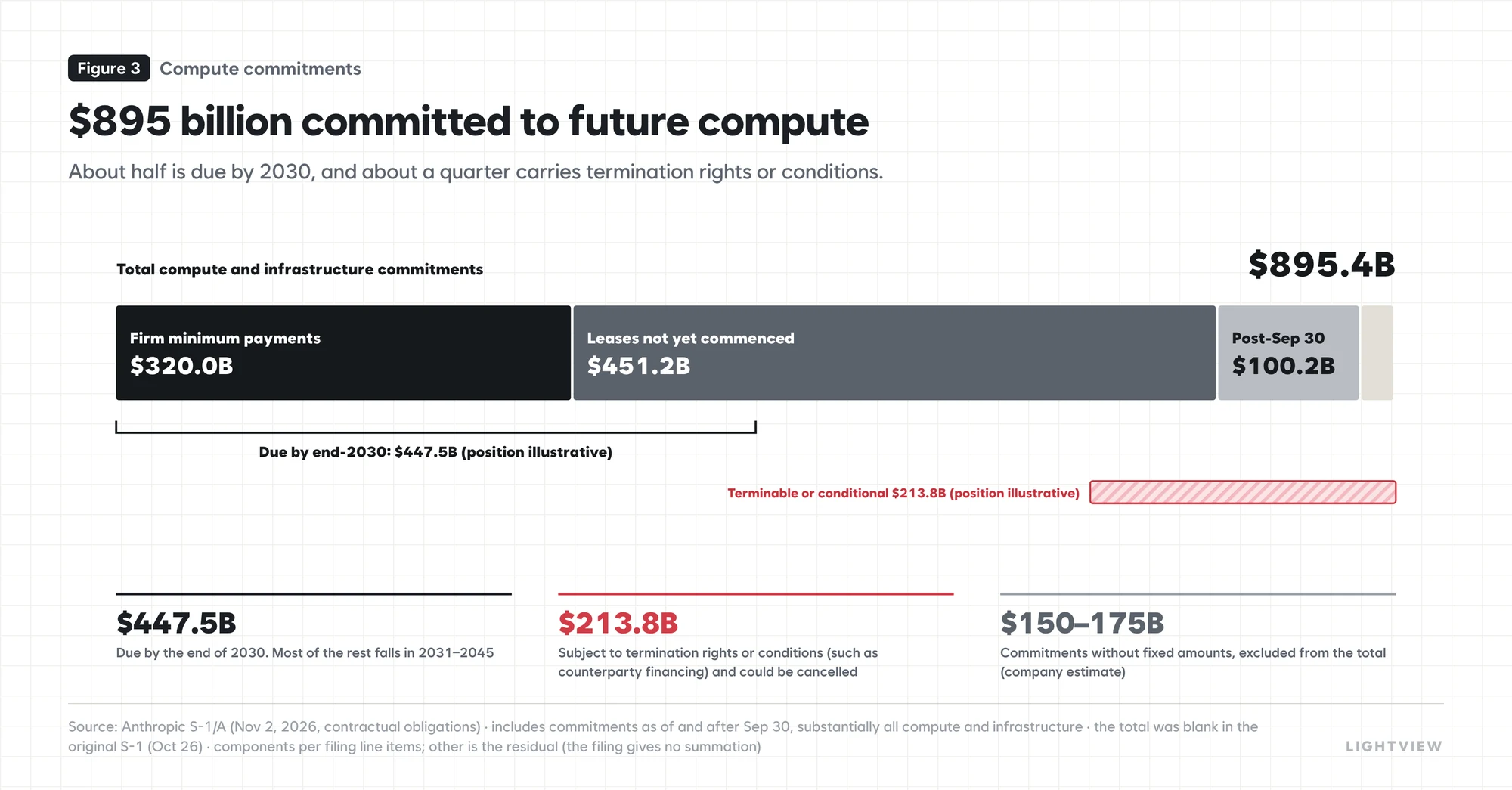
Of that, $447.5 billion is due by the end of 2030, and about $69.8 billion in the next 12 months alone. In its risk factors the company describes these as substantial fixed obligations that must be paid regardless of actual use. The bigger issue is a mismatch: revenue is mostly consumption-based and not locked into long-term contracts, while the commitments are fixed for years.
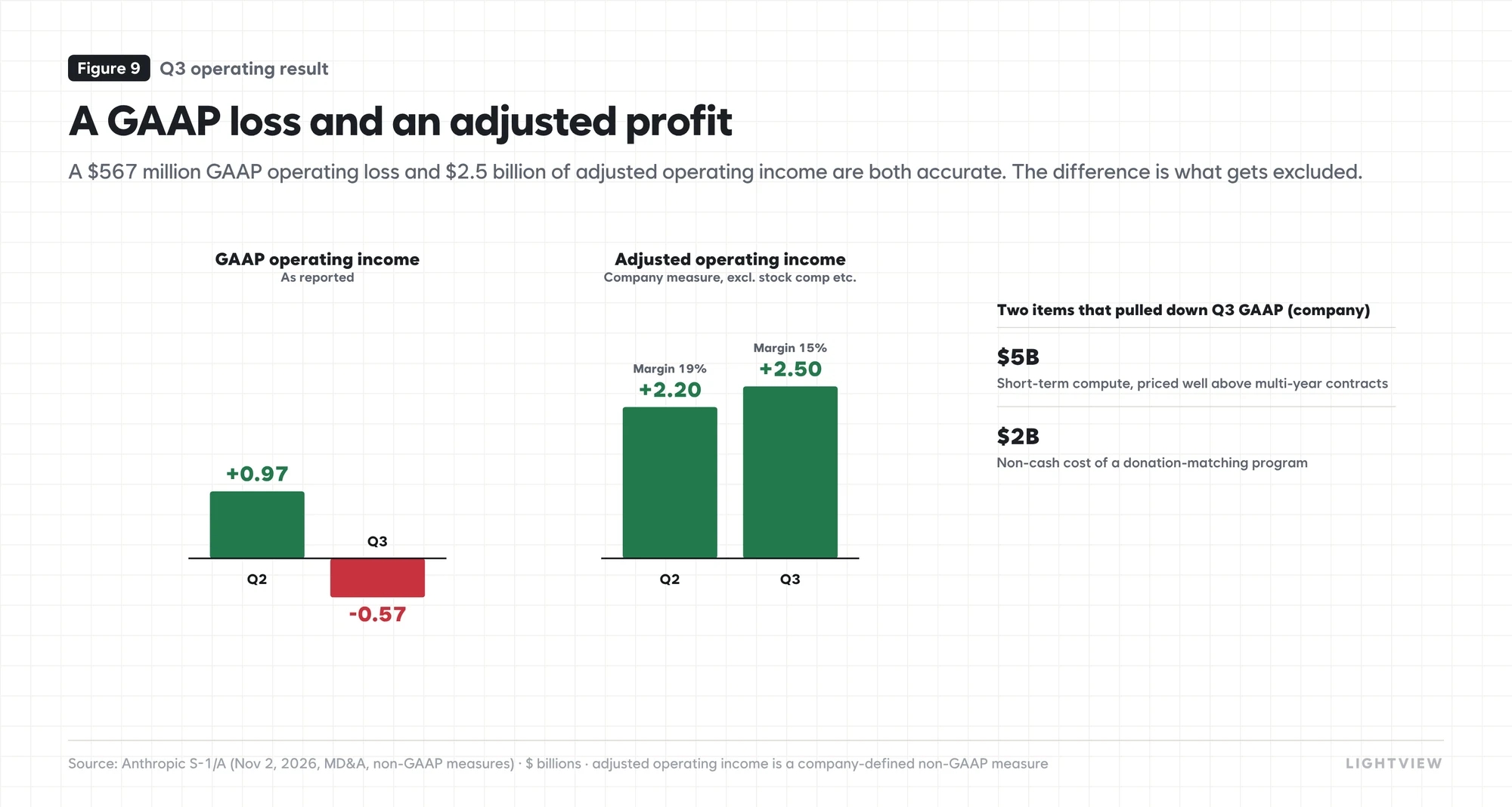
The company also says it has significantly underestimated its compute needs in the past, leaving it capacity constrained. Too little means buying expensive short-term compute ($5 billion in Q3 alone); too much means paying for idle capacity. And the filing states plainly that if it cannot raise additional capital on acceptable terms, it may be unable to meet these obligations. A cross-default clause means a default on a commercial contract could force repayment of its credit agreement and convertible notes at once.
Some counterparties appear in the filing. In March 2026 Anthropic signed an AI accelerator equipment lease with Broadcom; it also entered an agreement allowing it to issue up to $42 billion of convertible notes to Broadcom and others, and $6.2 billion of convertible notes issued to Amazon remain outstanding. The companies supplying compute are also investors, so if Anthropic wobbles, their books wobble too.
Anthropic is not short of money today. At the end of September it had about $146.7 billion in cash, short-term investments and credit lines, and operating cash flow turned positive at $6.57 billion in the first nine months.
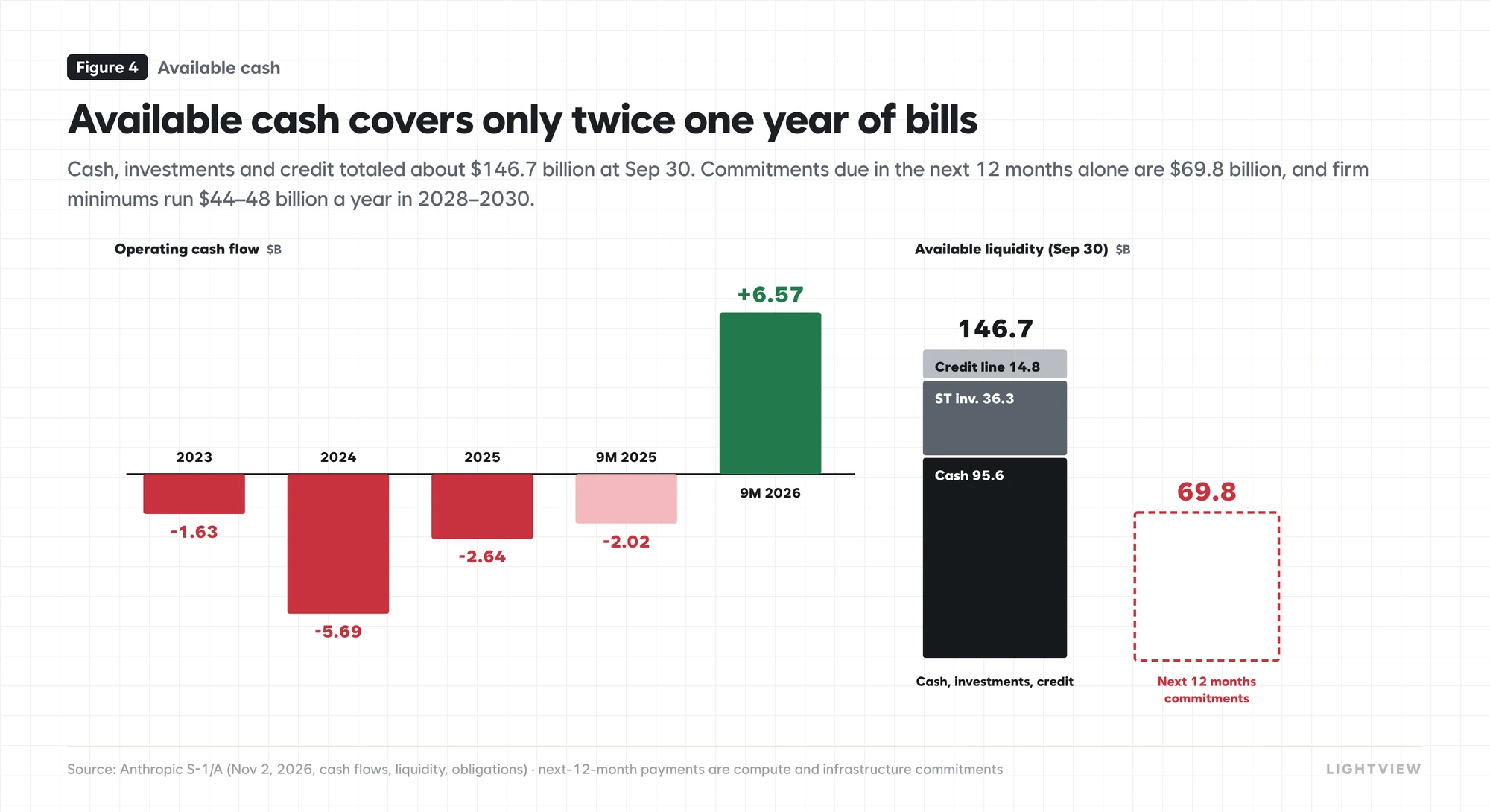
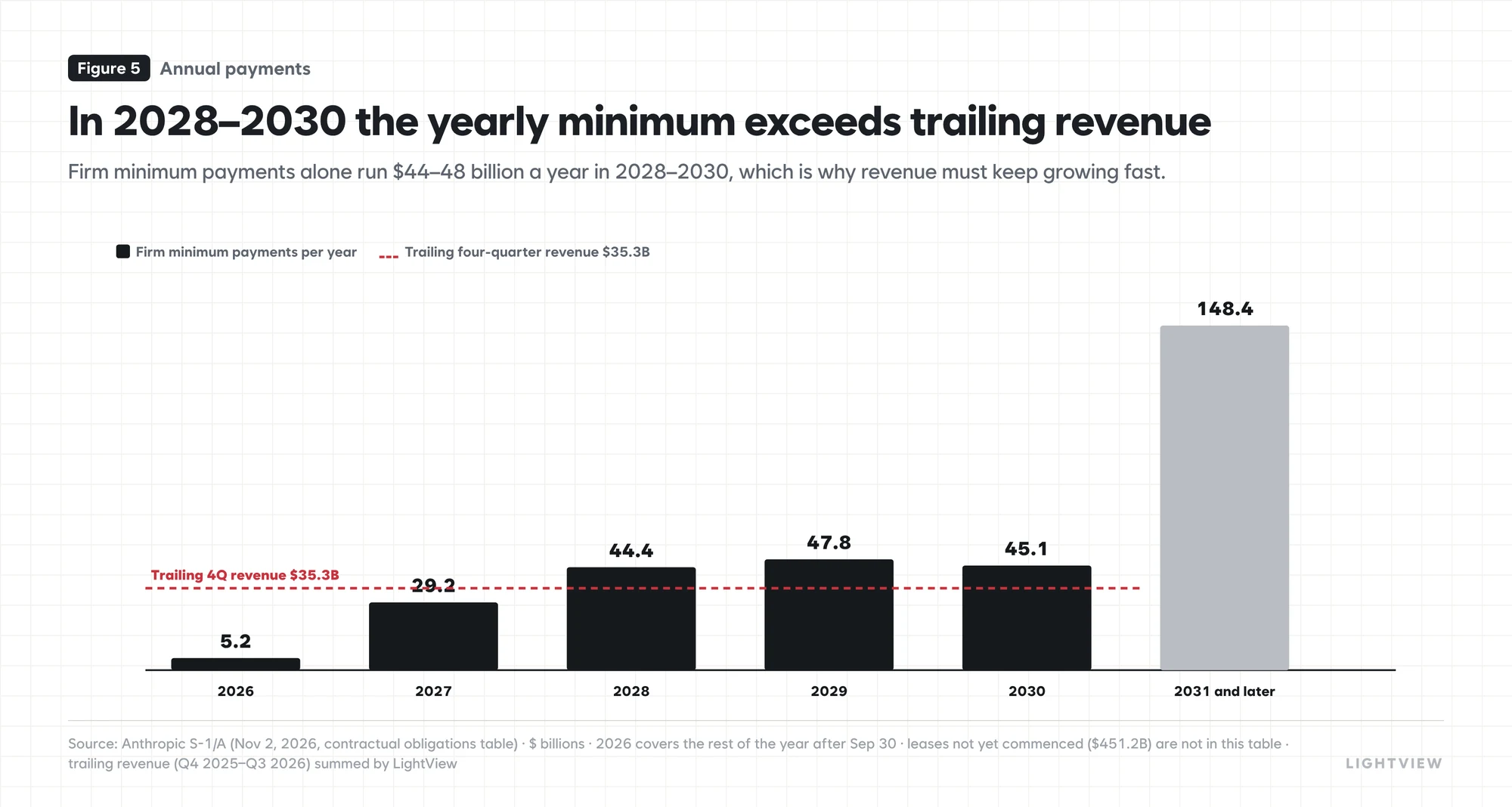
The problem is what comes next. Firm minimum payments alone run $44–48 billion a year in 2028–2030, more than trailing four-quarter revenue ($35.3 billion). If revenue keeps growing this fast, that is manageable, but if funding dries up even once along the way, the commitments become a real risk. The first purpose the filing lists for the offering is increasing capitalization and financial flexibility, with proceeds going to compute and infrastructure and to hiring. The IPO builds a funding channel that can carry this bill for years.
3Reason two: money private markets can’t reach
The second answer is scale. As a private company, Anthropic can no longer raise money this large.
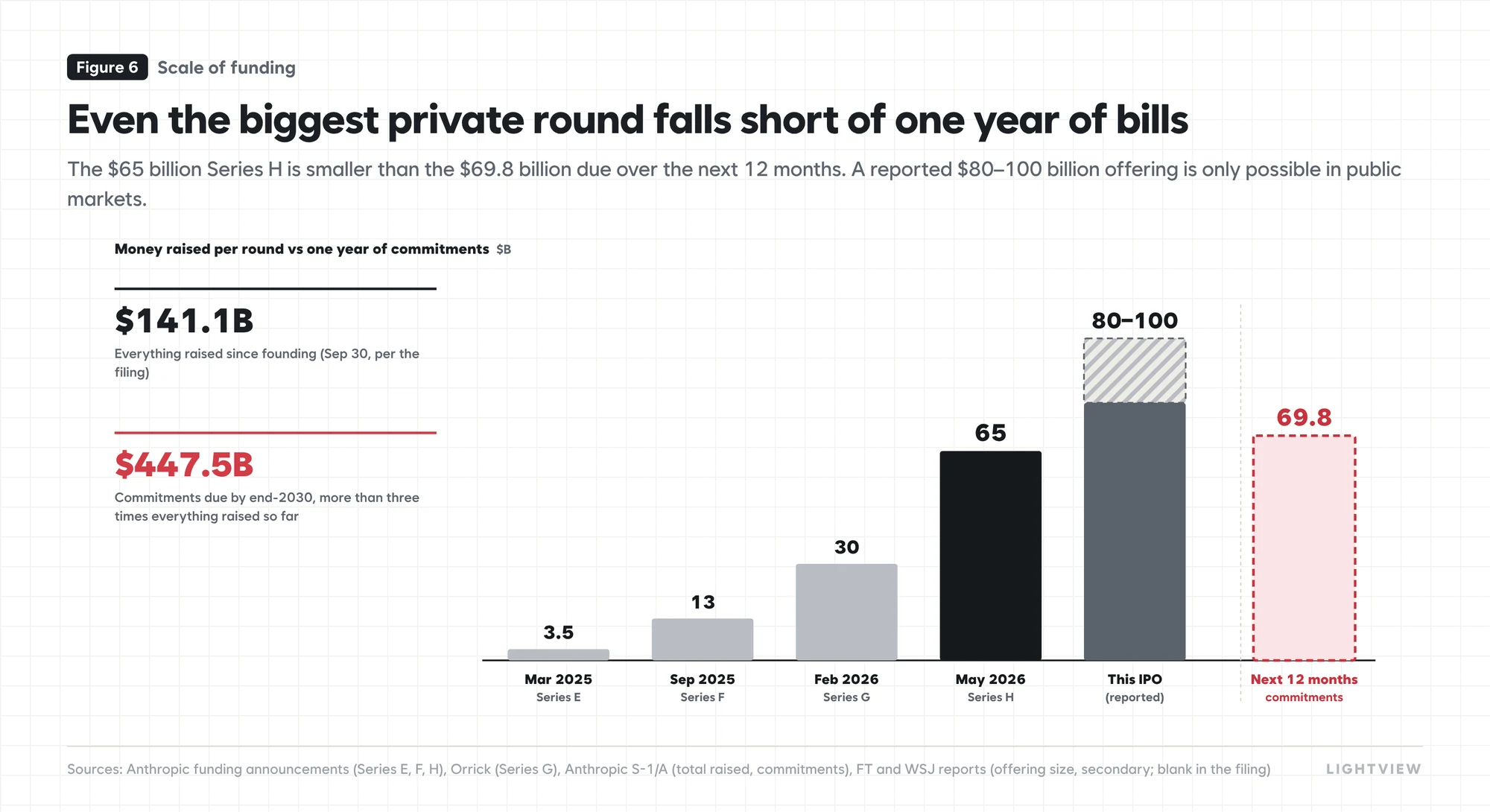
Its rounds grew from $3.5 billion in March 2025 to $13 billion in September, $30 billion in February 2026 and $65 billion in May, and it has raised $141.1 billion in total. Yet one year of commitments is $69.8 billion. Only public markets can supply $80–100 billion at once (including shares sold by existing holders; the company’s share is smaller), and a listed company can keep raising money later through stock or bond issues. Damodaran noted that its cash will exceed $200 billion after the IPO, which sets it apart from AI infrastructure company CoreWeave.
| Company | Offering | Valuation | Status |
|---|---|---|---|
| SpaceX | About $75B ($86B with greenshoe) | About $1.77T at IPO price | Listed June 2026, +19% day one, below IPO price in July |
| Anthropic | $80–100B (reported) | $1.0–1.75T (reported) | Aiming to list before Thanksgiving (reported); no price range yet |
| OpenAI | — | Last private round $852B (secondary; some say $1.25T) | President: could be “IPO-ready” in 2027 (Nov 4) |
Competition adds urgency. Asked on November 4 whether OpenAI could be ready for a 2027 IPO, president Greg Brockman said yes. In LightView’s reading, whoever lists first may gather the money of investors looking for “the AI stock” and set the benchmark for whoever follows; analysts have said a weak Anthropic debut could prompt OpenAI to rethink its timing and valuation. Still, SpaceX rose 19% on its first day in June but slipped below its IPO price within a month.
Employees are another reason. According to reports, the intrinsic value of employee stock options reached $98.2 billion at the end of June, and RSUs conditioned on a listing settle only after the IPO. Part of the proceeds will cover taxes on that settlement. For about 5,300 employees, the IPO is when pay becomes real.
4Cutting the price still pays; waiting costs more
Isn’t cutting the valuation from $2 trillion to around $1 trillion a loss? For existing investors, not necessarily.
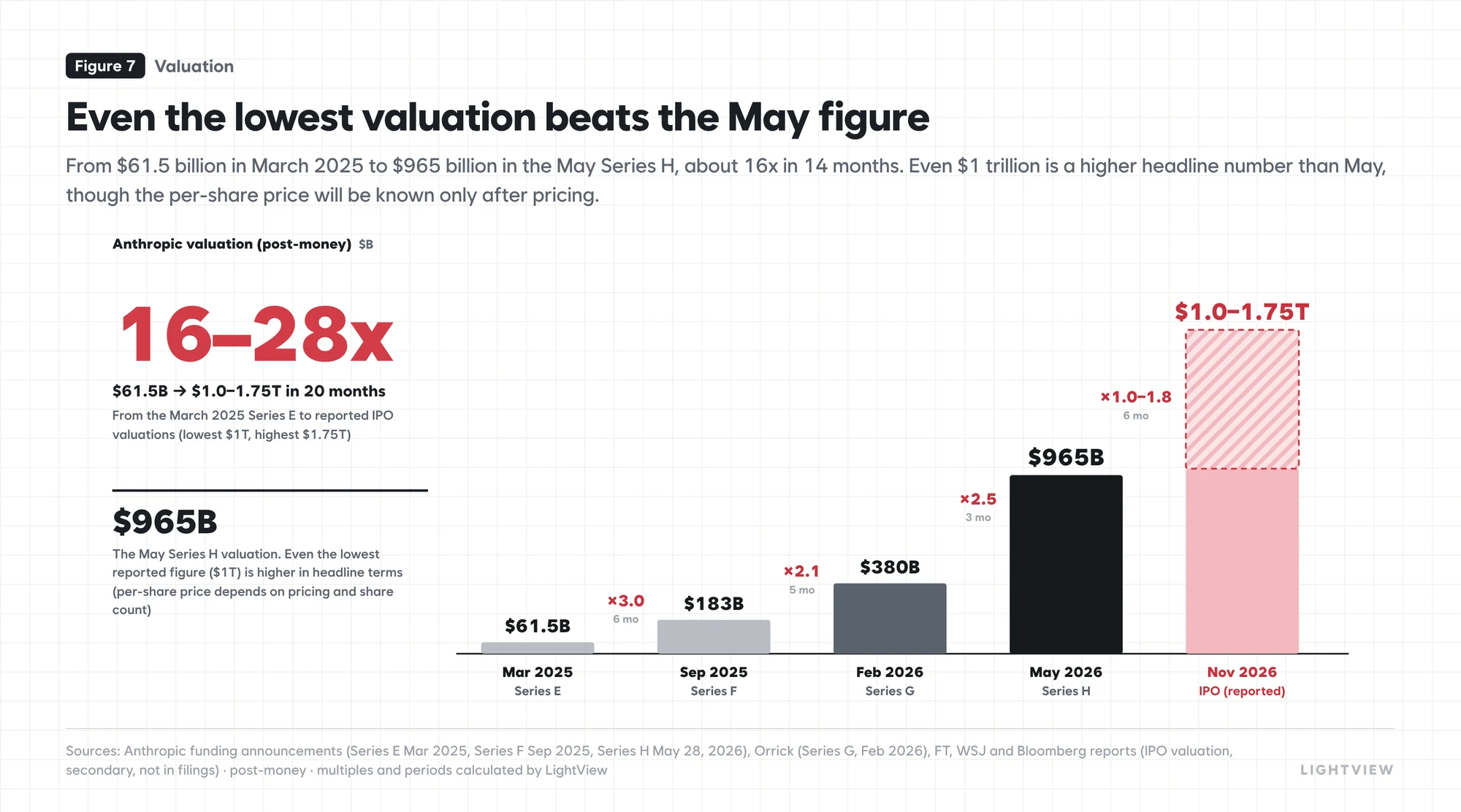
The May Series H valued Anthropic at $965 billion. Even the lowest reported figure, $1 trillion, is higher in headline terms and more than 16 times the March 2025 Series E ($61.5 billion). But an IPO valuation mixes in new money from the offering and shares added since May, so whether the per-share price beats the Series H ($589.01 a share) will be known only once the price and share count are set. One tally puts Amazon’s Q2 pre-tax gain, largely from revaluing its Anthropic stake, at $53.4 billion (secondary). For earlier investors, a lower valuation mostly shrinks the size of the gain. On Q3 revenue annualized ($67.8 billion), $1 trillion is about 15 times and $1.5 trillion about 22 times.
It is not free, though. The offering includes both new shares from the company and shares sold by existing holders, and the company does not receive proceeds from the latter. A lower valuation means issuing more new shares to raise the same amount, diluting existing holders further. In LightView’s view, the biggest cost is that dilution. Raising less would reduce it, and reports say the offering could shrink from $100 billion to $80 billion. For holders selling shares, the lower price itself is the cost.
Waiting may carry the bigger risk. One chief investment officer called it a “damned if you do, damned if you don’t” situation. A delay could read as a bearish signal for the whole AI sector, and so could a weak debut after pushing ahead. Others argue a delay would avoid near-term valuation risk (secondary). Anthropic appears to have accepted the risk that worsening markets push the valuation lower still. A lower IPO price leaves room for a first-day gain, which could in turn lift sentiment across AI stocks. As Damodaran puts it, an IPO is priced by the market on the day, not valued. In his October 28 post he said he would sit out if the price were well above his estimate ($1.475 trillion), which he trimmed to $1.45 trillion on November 3. His readers’ collective estimate was about $1 trillion, not far from what the market is now discussing.
5What the IPO changes for the AI industry
This is not just one company’s listing. It is the first time the AI industry goes on public trial.
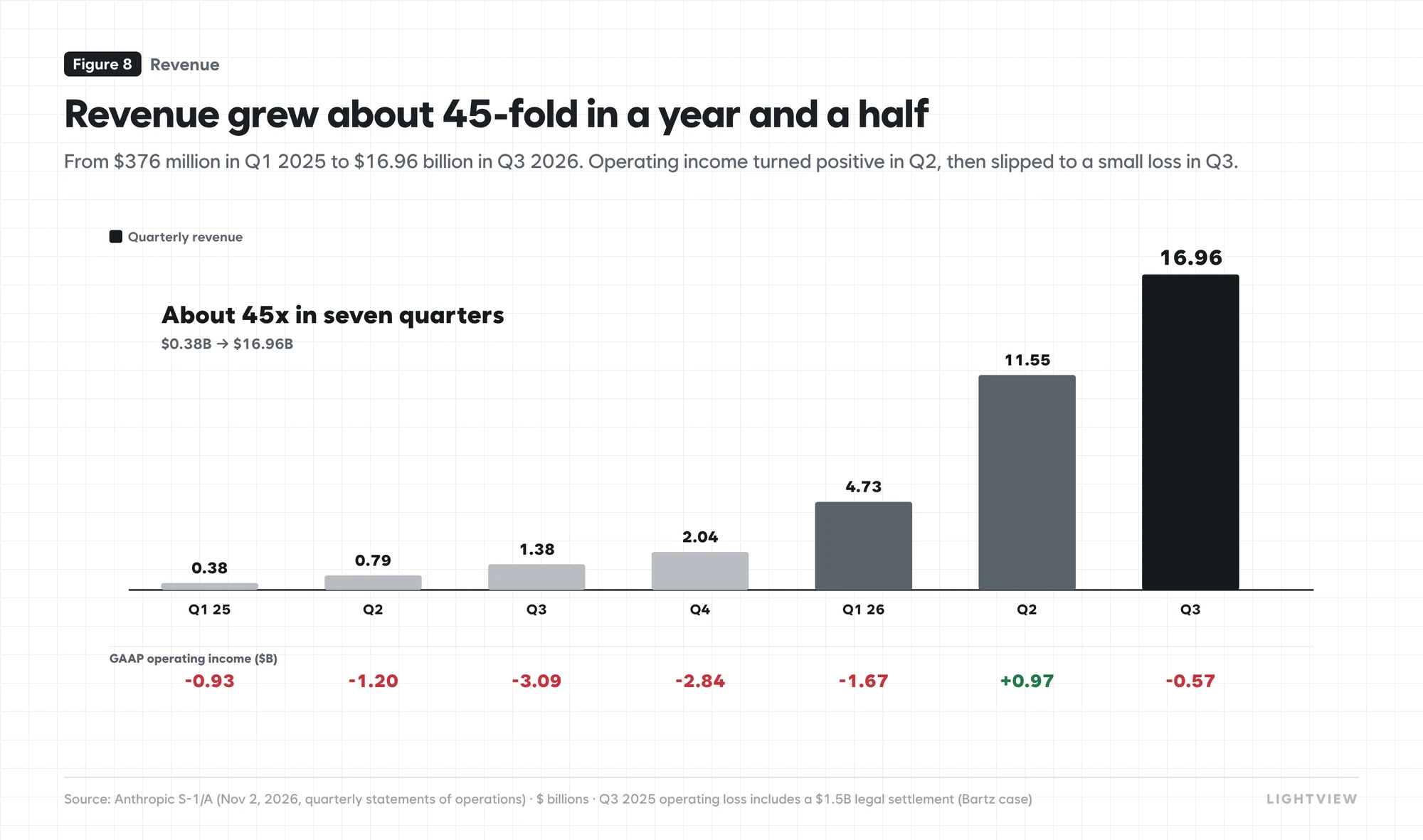
First, a leading AI lab’s results become public every quarter. Revenue grew about 45-fold in a year and a half, yet Q3 brought a $567 million GAAP operating loss alongside $2.5 billion of adjusted operating income. Every quarter will now show how much results swing with the price of short-term compute.
Second, valuations get a benchmark. One venture investor said Anthropic will become the AI bellwether and that private AI companies will be repriced. Analysts also say a weak debut could prompt OpenAI to rethink its listing timing and valuation.
Third, the supply chain is seen differently. The $895.4 billion of commitments is, from the other side, future revenue for cloud and chip companies. Beyond Broadcom (equipment deal and up to $42 billion of convertible notes) and Amazon, Google invested $10 billion in the Series H. Anthropic’s share price will become a gauge of how solid those companies’ AI revenue is. One fund manager went as far as to say the Anthropic IPO is the only thing that matters for the rest of the year. Nvidia reports on November 17.
6Who gains, and who carries the burden
The same listing looks different depending on where you stand.
The scenario markets fear is clear. One venture investor warned that a weak debut could make the whole AI trade look like a “house of cards,” while adding that he does not expect long-term demand to fall short, comparing the situation to the 1990s fiber-optic overbuild. Meanwhile, an equity analyst said investors expect pricing at least at the low end of earlier expectations. In the end, how low the IPO is priced may decide whether it succeeds.
| Party | Upside | Burden |
|---|---|---|
| Company | A capital channel to carry its commitments; settling employee pay and keeping talent | Quarterly pressure; the mismatch between commitments and revenue growth fully exposed |
| Existing investors | Higher headline valuation than May even at $1T; large gains for early investors | A low price also lowers the benchmark for their book gains |
| IPO investors | A chance to buy in cheaper thanks to the selloff; Q3 revenue up 12x in a year | Founders’ fixed 50.1% vote and public-benefit structure; commitment and cross-default risk; 2027 lockup supply |
| AI industry | AI profitability becomes transparent; a valuation benchmark appears | A weak debut could make AI investment look like a house of cards (analyst view) |
| When | What |
|---|---|
| This week (reported) | Roadshow launch; amended filing with price range and share count → actual valuation and deal size |
| November 17 | Nvidia earnings — AI stock sentiment and offering demand |
| Before Thanksgiving (reported) | Listing date, first trade, move versus the IPO price |
| 2027 | OpenAI IPO preparations; Anthropic lockup expiry (tied to results, or 180/365 days) |
In short, Anthropic is rushing to list at a discount not because the market is good but because it cannot afford to wait. A bill of about $70 billion in the next year alone needs the public market as a funding source, and there is also a calculation to open that door before rivals line up. The remaining question is whether the market, seeing that bill, will still pay more than $1 trillion, and the coming price range will give the first answer.
+Terms and sources
Terms
- Anthropic S-1 (Oct 26, 2026) · S-1/A Amendment No. 1 (Nov 2, 2026; use of proceeds, risk factors, contractual obligations) — SEC EDGAR, filing list checked Nov 9 (no amendment with a price range) · Funding announcements: Series E (Mar 2025), F (Sep 2025), H (May 28, 2026); Series G per Orrick (Feb 2026)
- CNBC, Fox Business (Nov 5–6 close), Axios (Nov 6), StockTitan (closing data, secondary) · FT, NYT (August), Reuters (Oct 15), WSJ (Nov 2, Nov 5), Bloomberg (Nov 6), FT (Nov 7–8, via Seeking Alpha) — some via secondary summaries · CNBC (Oct 26, Nov 6), Yahoo Finance (Nov 6–8) · TechCrunch (Nov 5, Brockman) · SpaceX IPO: CNBC, CBS (June), Wikipedia (secondary) · Damodaran blog (Oct 28, Nov 3)
Filings and company announcements
Markets, reporting and analysis
This column's topic and analytical direction are set by the editor, who reviews and revises it before publication. AI tools were used for research, drafting and infographics, and every figure was checked against its source.