1Forty of 41 measures went against data centers
Our previous column, on the blue wave, looked at the AI selloff two days after the election and compared valuations with 2000. This one examines the data center issue cited as one trigger of that selloff, because after chips and power, the new bottleneck for AI infrastructure has turned out to be votes.
On November 3, voters in ten states decided 41 local ballot measures on data centers. Ballotpedia counts 27 approved and 14 defeated: all 27 approved measures limited or opposed data centers, and 13 of the 14 defeated ones would have favored them. In all, 40 of the 41 outcomes restricted development. The lone exception was Harwood, North Dakota, a small city that rejected extra review of industrial projects.
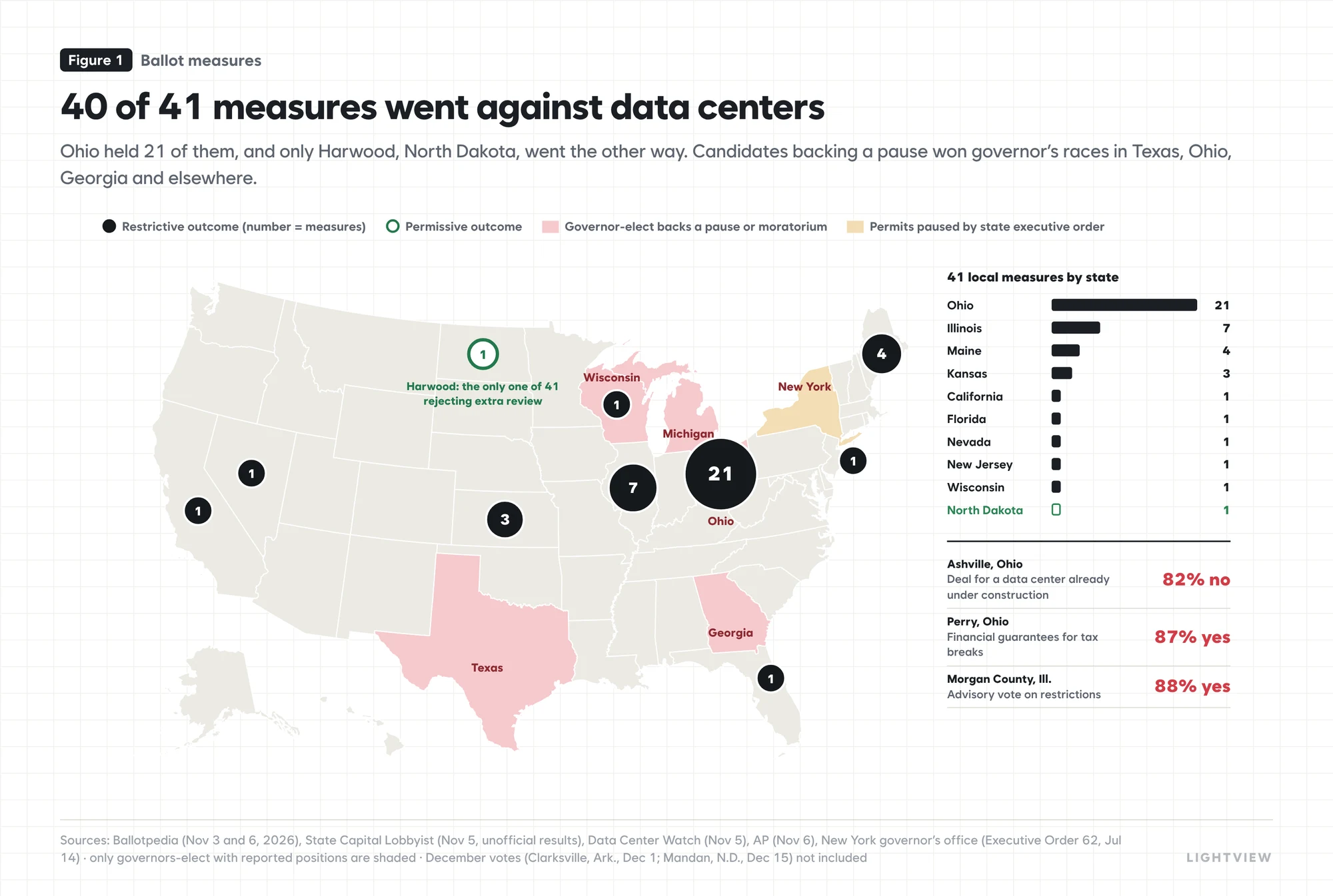
The margins were wide. In Ashville, Ohio, 82% voted against a deal for a data center already under construction, and 88% in Morgan County, Illinois, backed restrictions in an advisory vote. Governors’ races moved the same way: in a preliminary count, Data Center Watch finds 12 of 34 winners backing a ban or moratorium and 20 backing regulation or conditional development. With winners in Texas, Ohio and Georgia all promising a pause, this suggests the issue has moved beyond local complaints into state policy.
The measures also went beyond protest votes. Of the 27 approved, five banned data centers outright, 12 imposed partial bans based on size, such as over 25 MW, and three in Maine set six-month moratoriums. Others required a public vote for large projects or financial guarantees for tax breaks. More votes are scheduled in Arkansas and North Dakota in December, which will show whether this is a one-off or a trend.
2The power bill moved first
The main reason voters turned is the electricity bill. In PJM, which runs the grid for 13 states and Washington, D.C., and where data center demand has concentrated, prices in the capacity market, where utilities buy future generating capacity in advance, have soared.
The clearing price rose from $28.92 per MW-day for 2024/25 to $269.92 the next year, about 9.3x, and from 2026/27 it has hit the regulator-approved cap three years in a row. PJM said nearly 5,100 MW of the roughly 5,250 MW increase in forecast peak load for 2027/28 came from data centers. The cost lands on household bills: the 2025/26 increase added about $18 a month in western Maryland and $16 in Ohio, and PJM’s market monitor attributed 63% of that increase to data centers.
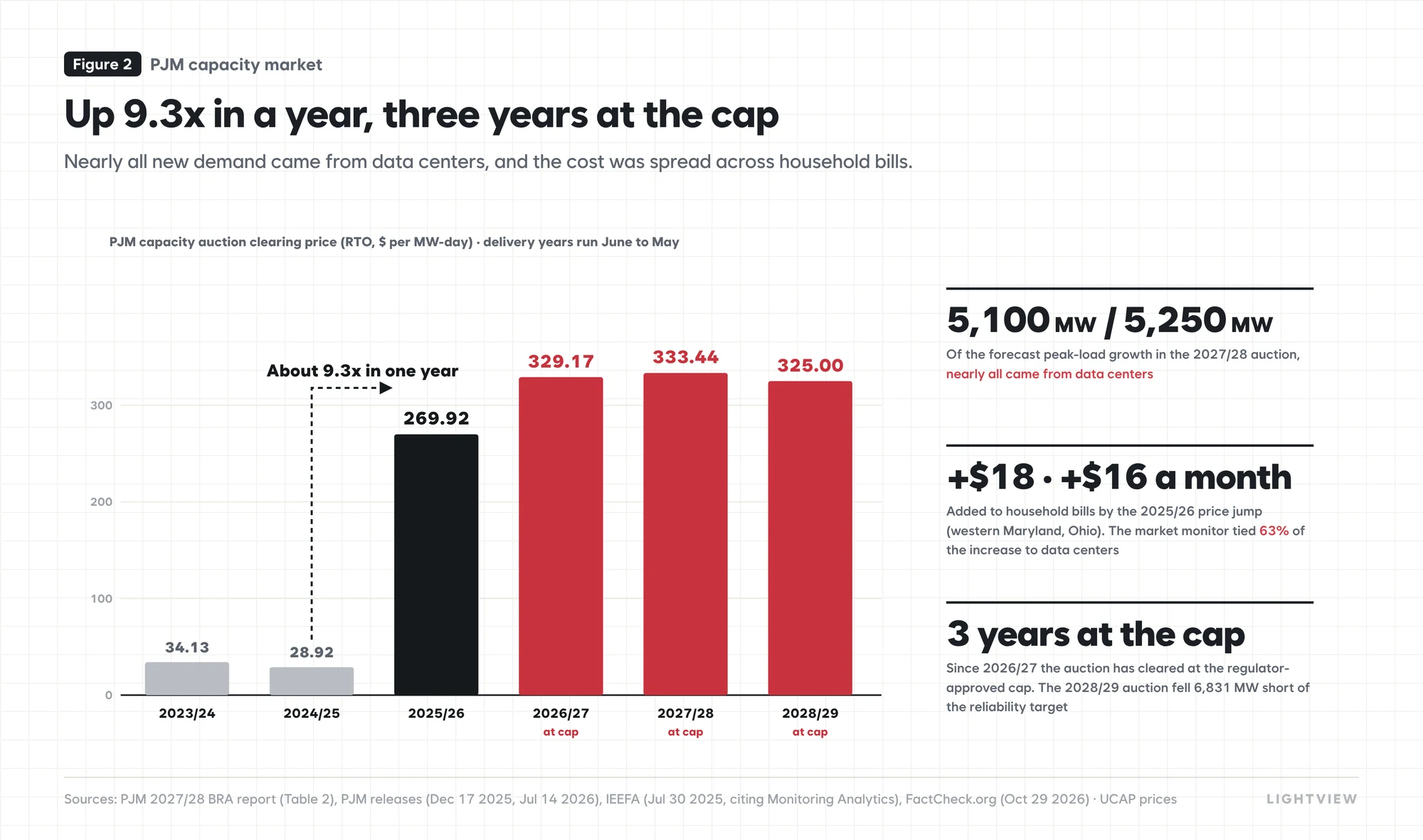
High capacity prices are also a sign of shortage. The 2028/29 auction in July fell 6,831 MW short of the reliability target, meaning new generation is not keeping pace with data center growth. In its January report the market monitor estimated data centers add $7.3 billion in capacity charges for that delivery year and $6.5 billion for the next (as cited by FactCheck.org). The sense that data centers use the power while the whole region shares the cost came back as votes against them.
Actual bills have risen faster in PJM states too. EIA data show residential rates rose 49% in Maryland, 42% in New Jersey and 40% in Pennsylvania from 2019 to 2025, well above the US average of 32%.
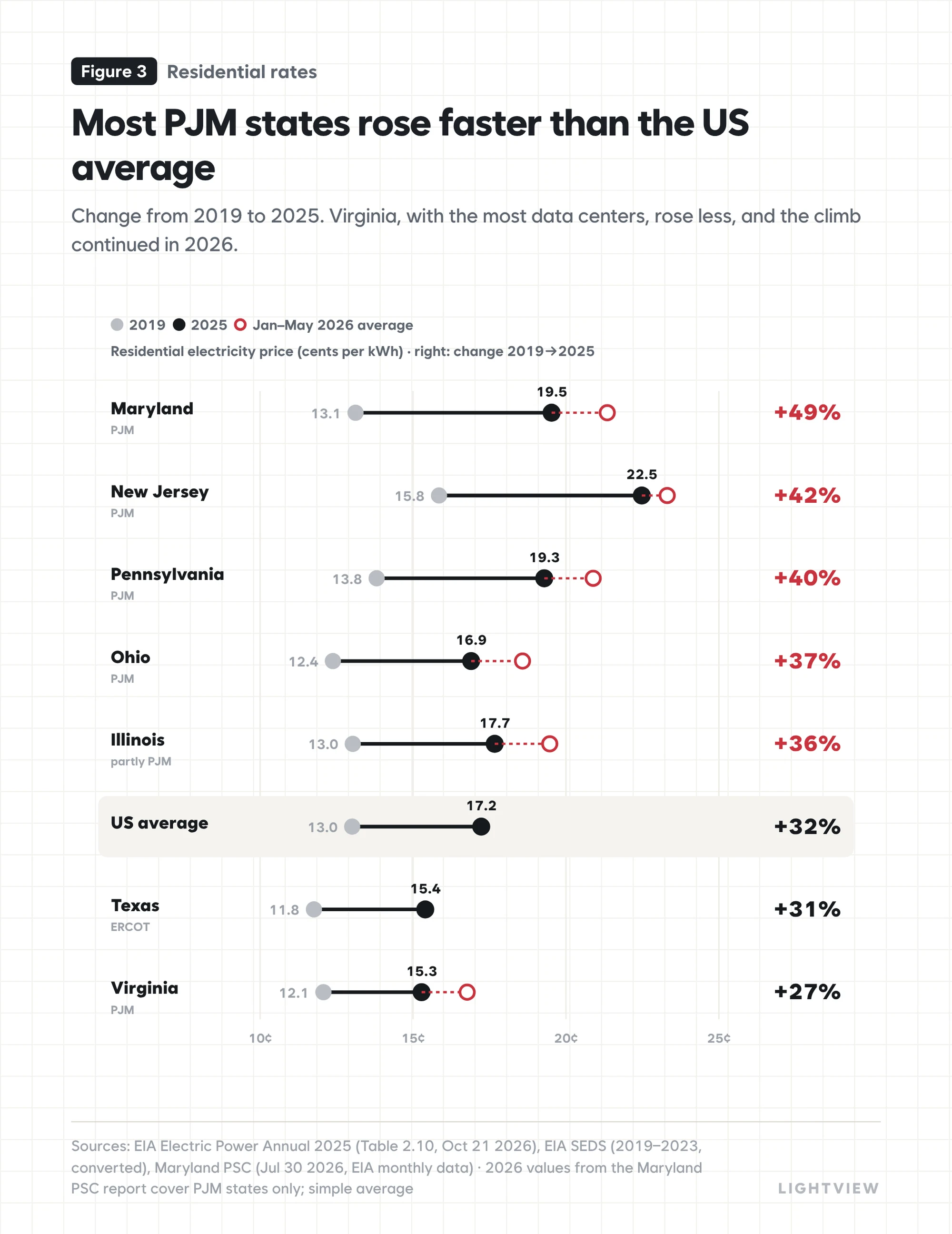
Rates kept rising this year: Maryland averaged more than 21 cents per kWh from January to May. Virginia, home to the most data centers, rose only 27%, which suggests data center counts alone do not set the pace. Studies disagree as well. MIT’s energy policy center estimates data center entry raised retail rates 2.7% over 2010–2024, while an EPRI preprint, from a group largely funded by utilities, finds average US rates fell slightly over 2015–2024, and about 6% for customers in areas with average data center growth.
Water and taxes added fuel. In September Texas ordered large water users to report their use, with penalties, and in several states sales-tax breaks for data centers drew criticism as too generous for the jobs they bring. Texas governor-elect Gina Hinojosa promised to end the breaks and tax the electricity data centers use; local reporting puts the exemption at more than $1 billion a year. With governors of both parties offering similar responses, these grievances appear to reach beyond any one camp.
32027 is being built; 2028 has not broken ground
Which part of the buildout does the vote touch? It depends on the stage. Projects under construction with grid agreements will mostly proceed, while unstarted ones must meet whatever conditions new governors and legislatures set.
SemiAnalysis estimates about three-quarters of the 33.8 GW due in 2027 in the top 20 states is under construction. Most of the 62.2 GW of 2028 US net additions has not started, and 43.5 GW (70%) is in 13 states that held November elections. It put 2028 exposure at ~30 GW if pause candidates won everywhere, 5.7 GW if less restrictive ones did.
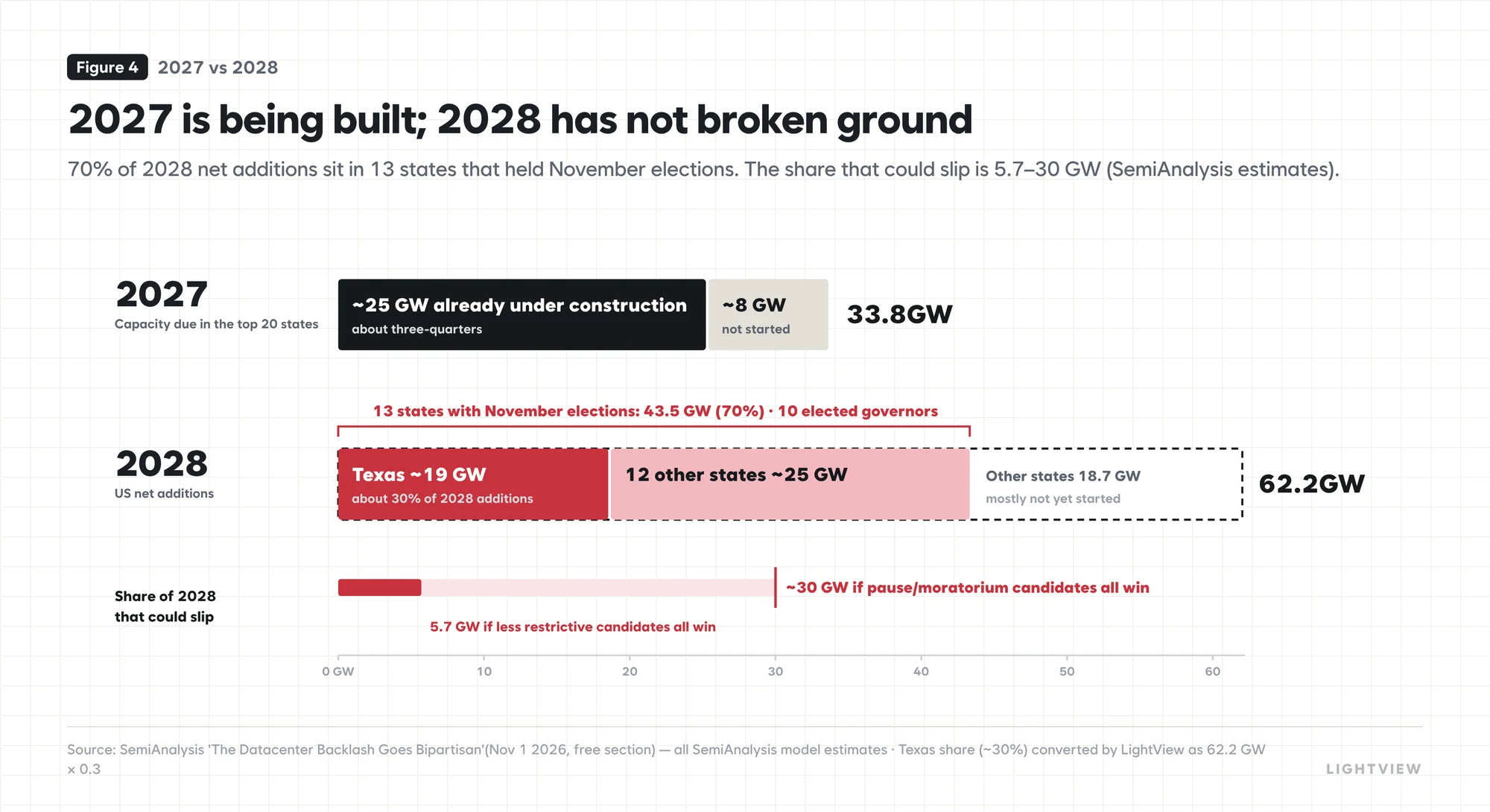
The result lies between those extremes: pause candidates won in Texas, Ohio and Georgia, but some would allow projects that meet conditions. Exposure means a project could slip, not that it is cancelled; in September SemiAnalysis saw only 1.5 GW of about 20 GW under local rules at risk of delay. Northern Virginia, a leading hub, held no state election this year and is outside this count, though that does not mean it is free of regulatory risk. How far schedules move matters more than the exposed total.
| Capacity | Size | Effect of new rules |
|---|---|---|
| 2027, under construction | ~25 GW (top 20 states) | Mostly proceeds; grid-cost conditions may be added |
| 2027, not started | ~8 GW | Some delay possible |
| 2028, 13 states | 43.5 GW (Texas ~19 GW) | Must meet conditions set by new governors and legislatures |
| 2028, other states | 18.7 GW | Existing rules; capacity may shift here |
4Texas is the swing factor
Texas is the largest single variable. Wells Fargo estimates 27% of planned US data center capacity is in Texas, and SemiAnalysis puts the state at about 30% of 2028 US additions. Permitting there was frozen before the vote.
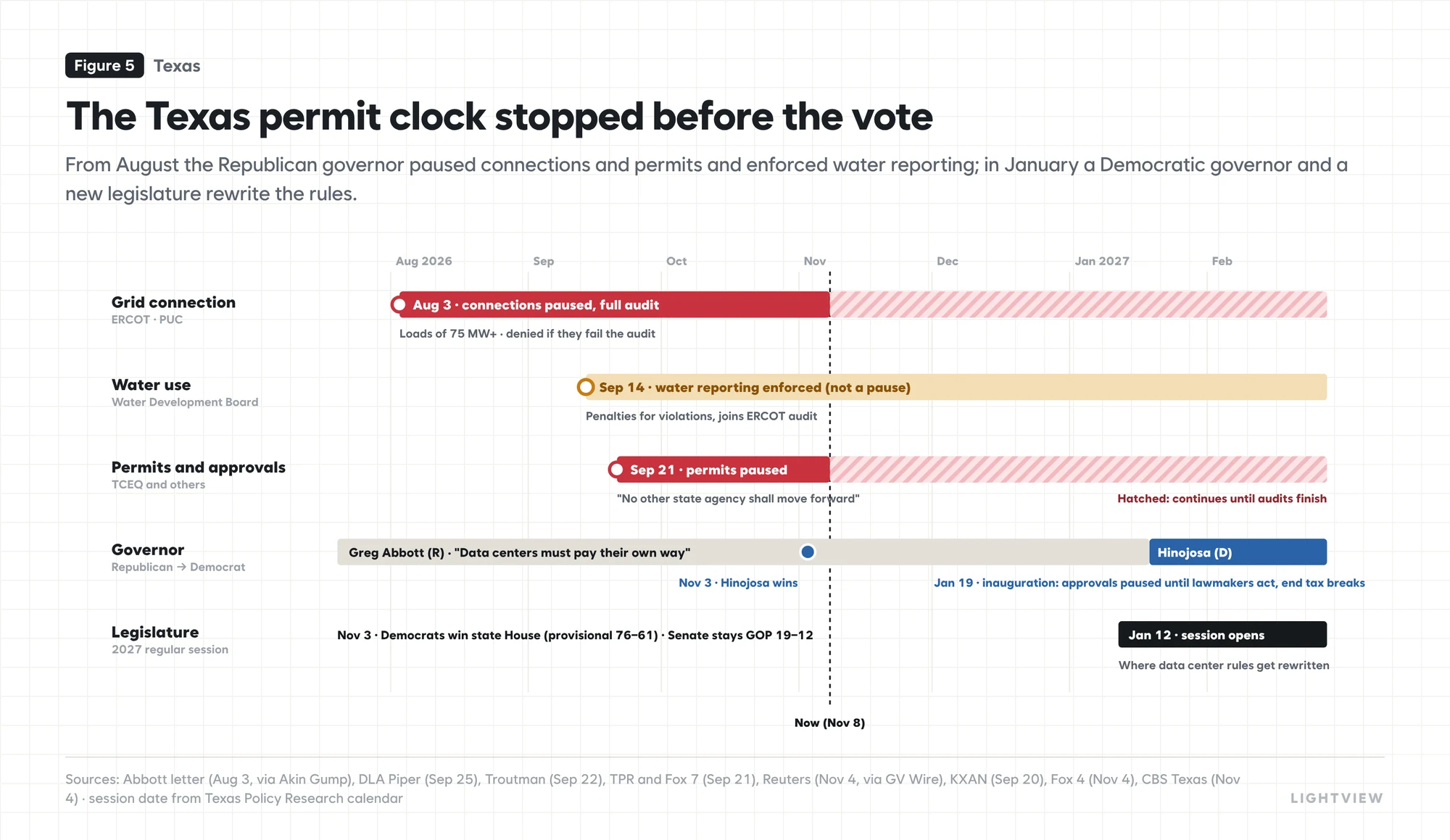
On August 3, Governor Greg Abbott (R) ordered ERCOT to audit every data center in the connection queue and pause their progress until the audit is done. In September he enforced water reporting and told agencies to stop issuing data center permits, saying data centers “must pay their own way.”
His successor, Gina Hinojosa (D), pledged to halt approvals until the Legislature passes protections. Democrats provisionally won the state House while Republicans keep the Senate 19 to 12, so Texas is likely to spend early next year in a “pause, then new rules” phase.
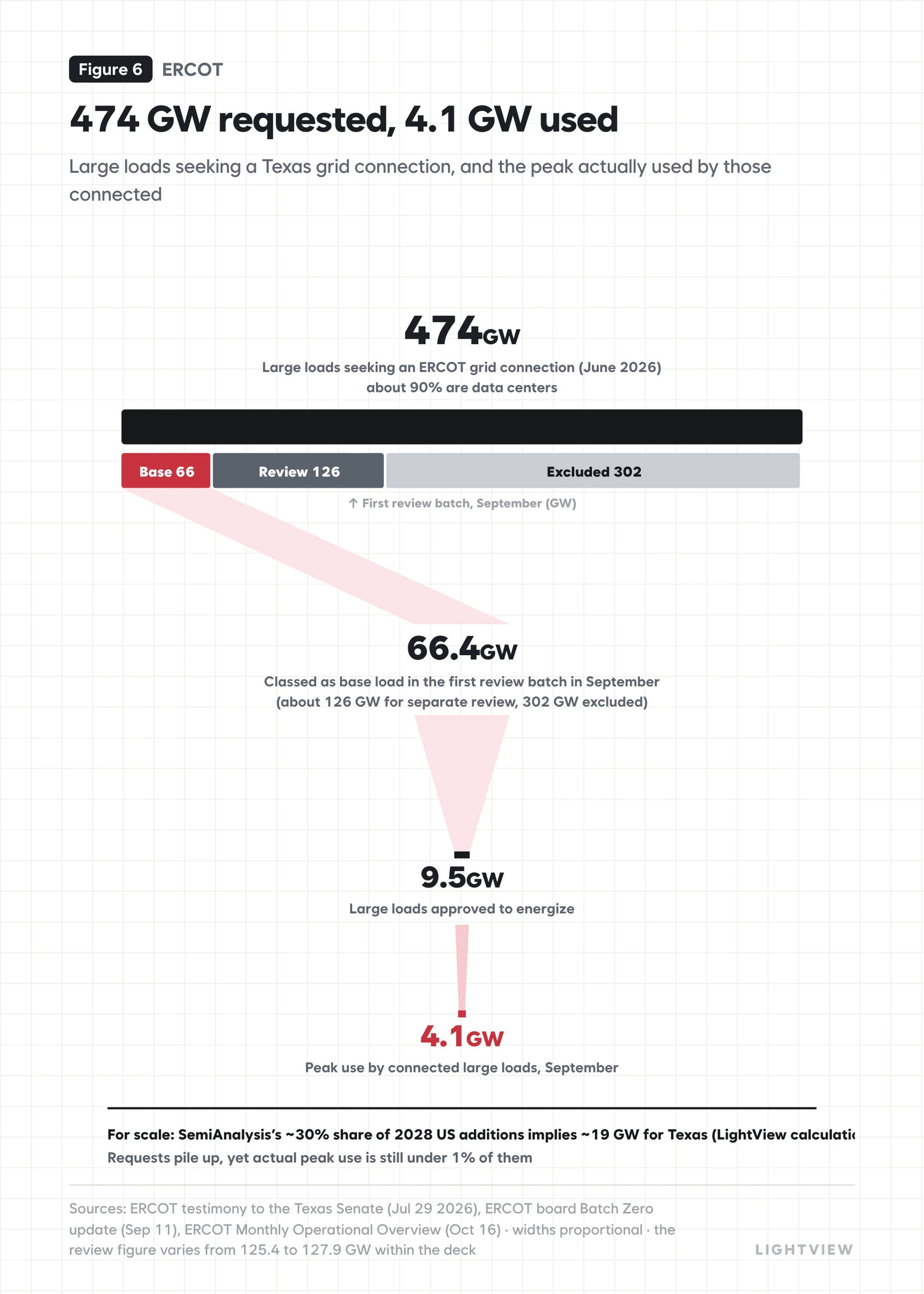
The audit has a lot to sort through. Large loads seeking connection total 474 GW, yet connected large loads peaked at 4.1 GW in September (Figure 6). New rules may slow buildout while separating real projects from requests that only hold a place in line.
5Those with sites, and those who must build
When permits become scarce, those already holding land, power and capital gain the edge. The market’s first reaction after the vote showed exactly that split.
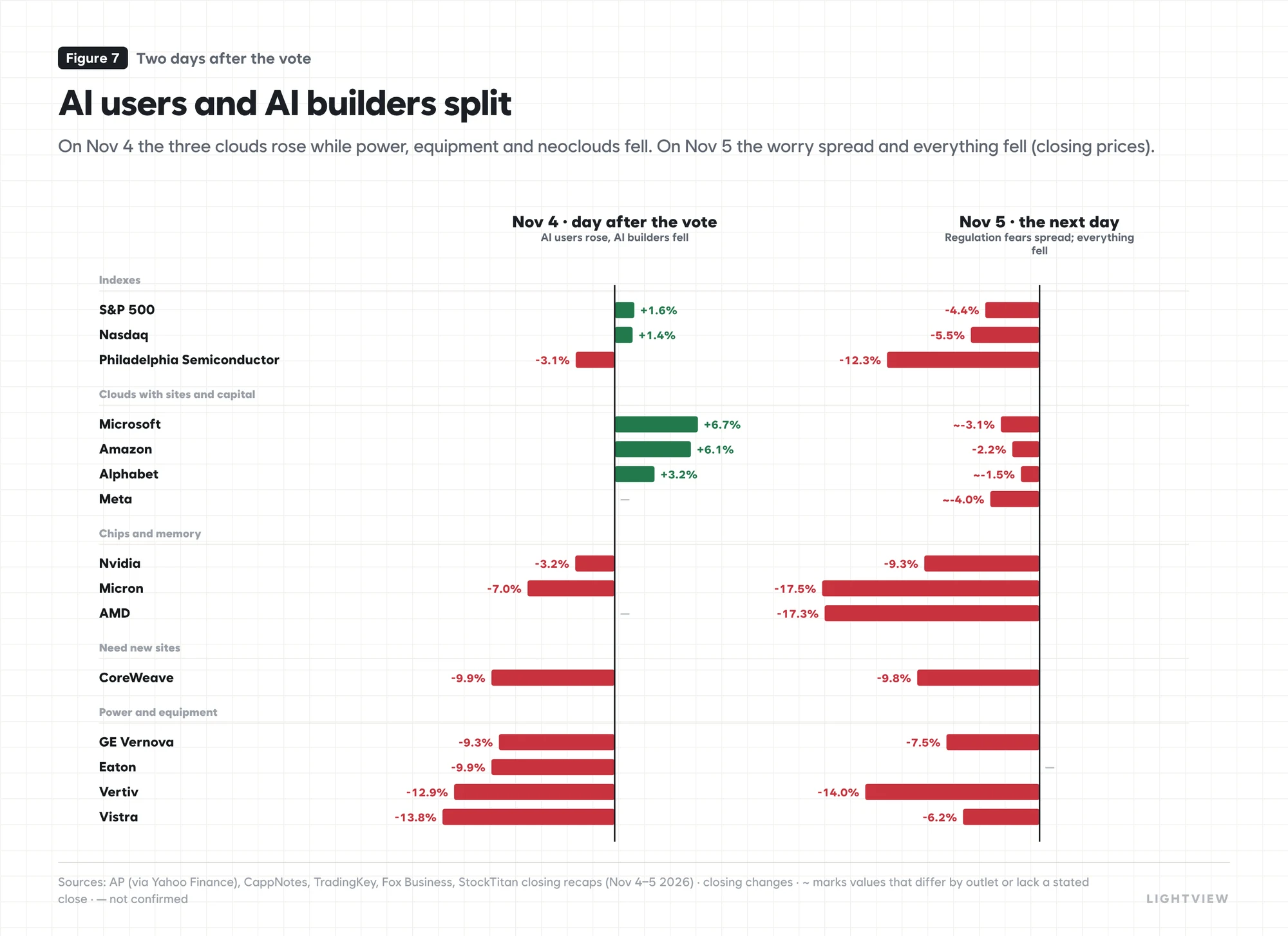
On November 4, Microsoft (+6.7%), Amazon (+6.1%) and Alphabet (+3.2%) rose, while power producer Vistra (−13.8%), cooling and power-equipment maker Vertiv (−12.9%) and GPU-rental neocloud CoreWeave (−9.9%) fell sharply. Secured sites became scarce assets; growth needing new sites and power looked riskier. The next day the worry spread across AI: the Philadelphia Semiconductor Index fell 12.3%, Micron and AMD more than 17%, and the three clouds also declined.
| Group | Why it is affected | Direction |
|---|---|---|
| Hyperscalers | Secured sites become scarce assets; capital to meet cost conditions, though spending may slip | Relatively favored |
| Neoclouds | Rely more on developing or leasing new sites, so they feel permit delays first | Unfavorable |
| Power and equipment | New load may arrive more slowly; a longer power shortage would support prices | Mixed |
| Chips and memory | Data center build speed sets chip deployment | Pressure from 2028 |
| Data center REITs | Operating sites gain value; new builds face the same rules | Mixed |
| Korean grid equipment | Solid backlogs, but US delays could slow new orders | A 2028+ variable |
The hyperscalers did not make deep cuts in the results just before the vote. Their 2026 capex plans sum to about $730 billion at the midpoints, and Amazon and Alphabet signaled big increases for 2027.
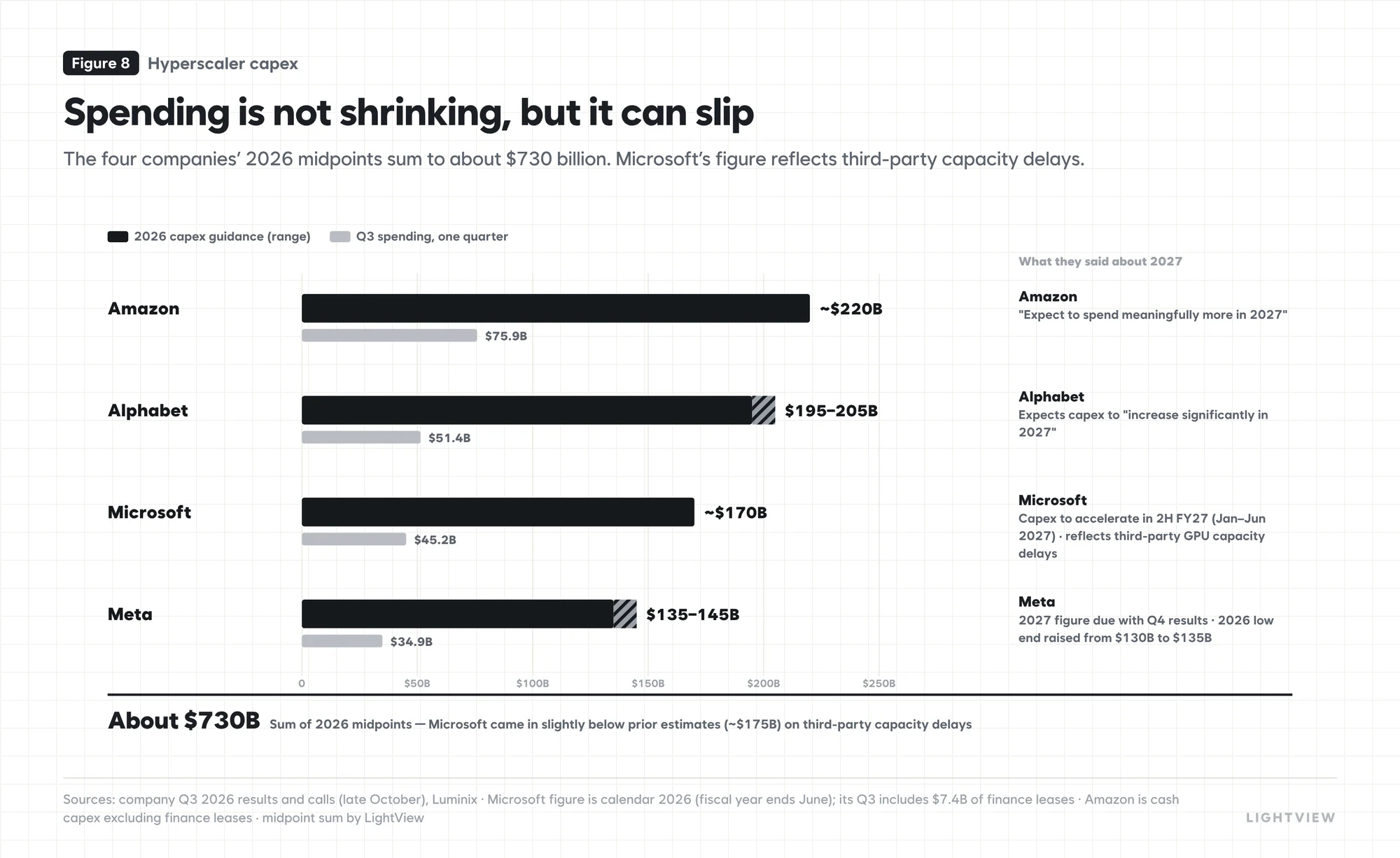
Whether the money can be spent on time is another matter. Microsoft said some third-party GPU capacity slipped into the second half of its fiscal year; that was a supply-timing issue, not permits, but it shows outside delays move the timing of spending before the total. Korean grid-equipment makers are exposed too: on November 5, as the KOSPI fell 5.3%, LS ELECTRIC dropped 13.9% and HD Hyundai Electric 8.4%.
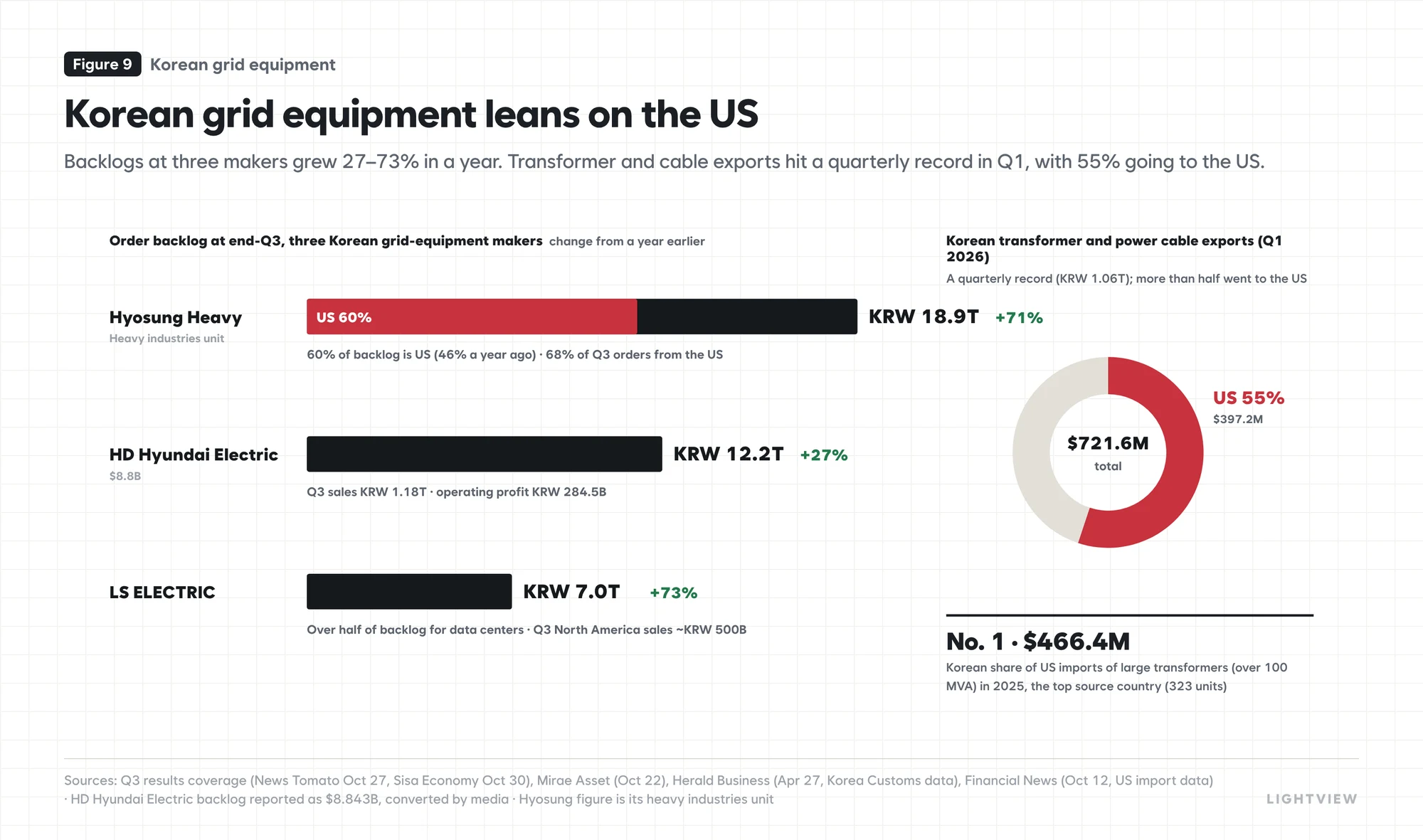
With one to three years of orders in backlog, though, any US delay is more likely to show first in the pace of new orders from 2028 than in existing ones.
6A ban, or build if you pay?
The likeliest outcome looks closer to “build if you pay” than an outright ban, because the demands overlap strikingly across camps.
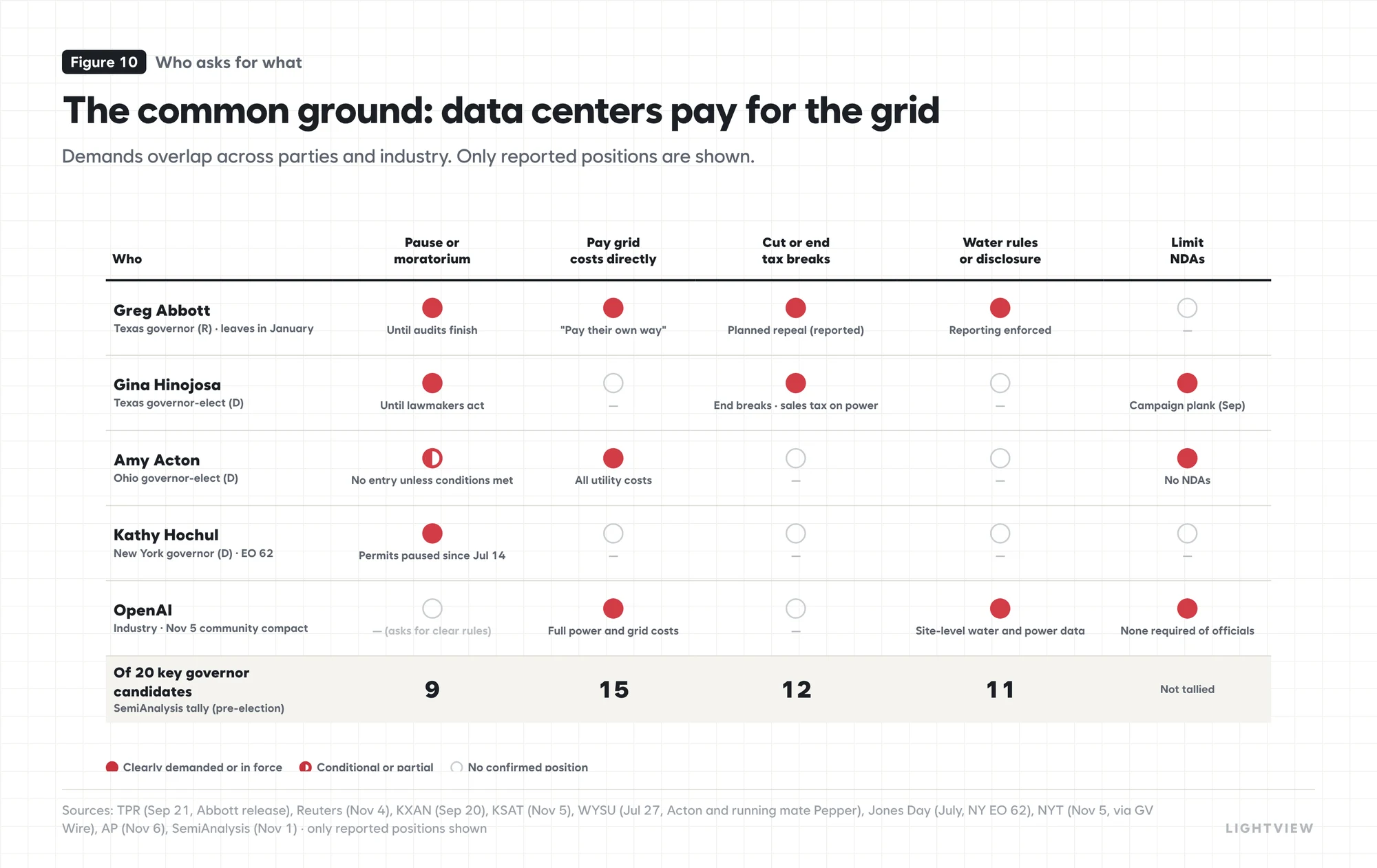
Republican Abbott said data centers must pay their own way; Democrat Acton’s campaign set conditions including paying all utility costs and no NDAs, and told developers that do not meet them to stay out of Ohio. In industry, OpenAI responded right after the vote with a community compact to pay full power and grid costs and publish water and power use by site. That points to buildout that slows and gets costlier rather than stops, and, as Morgan Stanley warned, a country split into areas open and closed to data centers.
| When | What | Watch for |
|---|---|---|
| Dec 1 · Dec 15 | Bond votes in Clarksville, Ark.; Mandan, N.D., ban on 25 MW+ projects | Whether the restrictive trend continues |
| Jan 12 · Jan 19, 2027 | Texas Legislature opens; Hinojosa takes office | Scope and length of the pause, tax breaks, cost rules |
| Jan–Feb 2027 | Hyperscaler Q4 results | 2027 capex figures, comments on delays |
| Jul 2027 | One year of New York’s executive order | Extension or conditional lifting (no end date set) |
There is a counterview: with so much already under construction, the post-election drop may have overshot, and regulation could favor large players and their pricing power. In the end, how much later and costlier 2028 capacity becomes is likely to decide the next one to two years of AI infrastructure investment.
+Terms and sources
Terms
- Ballotpedia News (Nov 3 and 6, 2026) · State Capital Lobbyist (Nov 5, unofficial results) · Fast Company (Nov 4) · Renewable Energy World (Nov 6) · AP (Nov 6, via OPB and ABC) · Data Center Watch (Nov 5) · CBS Texas (Nov 4) · Fox 4 (Nov 4)
- Abbott letter (Aug 3, via Akin Gump) · DLA Piper (Sep 25) · Troutman (Sep 22) · TPR and Fox 7 (Sep 21) · Reuters (Nov 4, via GV Wire) · KXAN (Sep 20) · KSAT (Nov 5) · WYSU (Jul 27) · Atlanta Journal-Constitution (Sep) · Jones Day (July, NY Executive Order 62) · NYT (Nov 5, via GV Wire, OpenAI)
- PJM 2027/28 BRA report and releases (Dec 17 2025, Jul 14 2026) · IEEFA (Jul 30 2025) · FactCheck.org (Oct 29 2026, citing MIT CEEPR, EPRI, LBNL and Brattle) · EIA Electric Power Annual 2025 (Oct 21 2026) and SEDS · Maryland PSC (Jul 30 2026) · ERCOT (Jul 29 Senate testimony, Sep 11 board, Oct 16 operational overview)
- SemiAnalysis, “The Datacenter Backlash Goes Bipartisan” (Nov 1, free section) · Wells Fargo estimate (cited by Fortune, Nov 5) · company Q3 results (late Oct) and Luminix · AP, CappNotes, TradingKey, Fox Business (Nov 4–5 closes) · Etoday (Nov 5, KOSPI) · News Tomato (Oct 27), Sisa Economy (Oct 30), Mirae Asset (Oct 22) · Herald Business (Apr 27, customs data) · Financial News (Oct 12)
Elections and ballot measures
State actions and pledges
Power prices and grids
Buildout and markets
This column's topic and analytical direction are set by the editor, who reviews and revises it before publication. AI tools were used for research, drafting and infographics, and every figure was checked against its source.