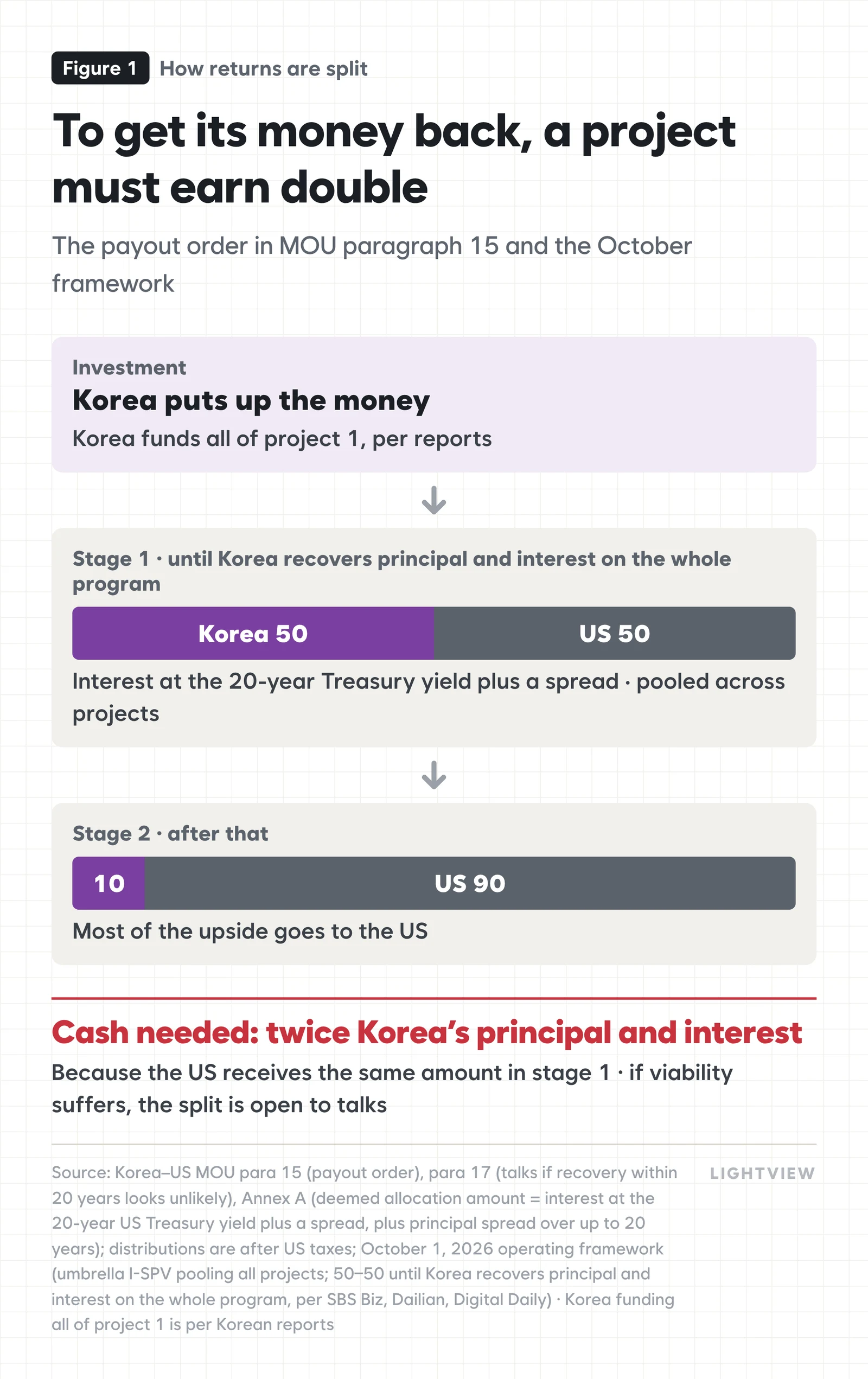
On March 4, Deputy Prime Minister and Finance Minister Koo Yun-cheol told the National Assembly’s special committee on US investment: “This investment is not free money; it is an investment that recovers principal and interest.” He is not wrong. Under the Korea–US memorandum and the operating framework released on October 1, Korea receives half of project returns until its money and interest come back.
The problem is the other half. Korea supplies the money, yet the US also takes half of the returns over the same period. For Korea to recover its principal and interest in full, the projects have to earn twice that amount. Once Korea is repaid, 90% of further returns go to the US. The 90% figure has been reported many times since last year; the doubling needed just to break even has drawn little attention.
Interest is set at the 20-year US Treasury yield plus a spread agreed project by project. Korea did win something in the October framework. All projects sit under one umbrella investment vehicle so that gains and losses are pooled, and the split can be renegotiated if a project’s viability is at risk. As recently as mid-September, the US was reported to be pushing for project-by-project accounting. The risk that one weak project blocks recovery of the whole has been reduced.
1A pledge worth 64% of the budget
At October’s average exchange rate, $350 billion is about ₩468 trillion. That is 64% of this year’s ₩727.9 trillion government budget, 79% of FX reserves at the end of October, and roughly ₩9 million per person.
Against the size of the economy, the weight shows more clearly. Korea’s pledge equals 18.6% of 2025 nominal GDP, against 12.4% for Japan, which pledged $550 billion. On the IMF’s 2026 estimates the figures are 15.6% and 12.7%.
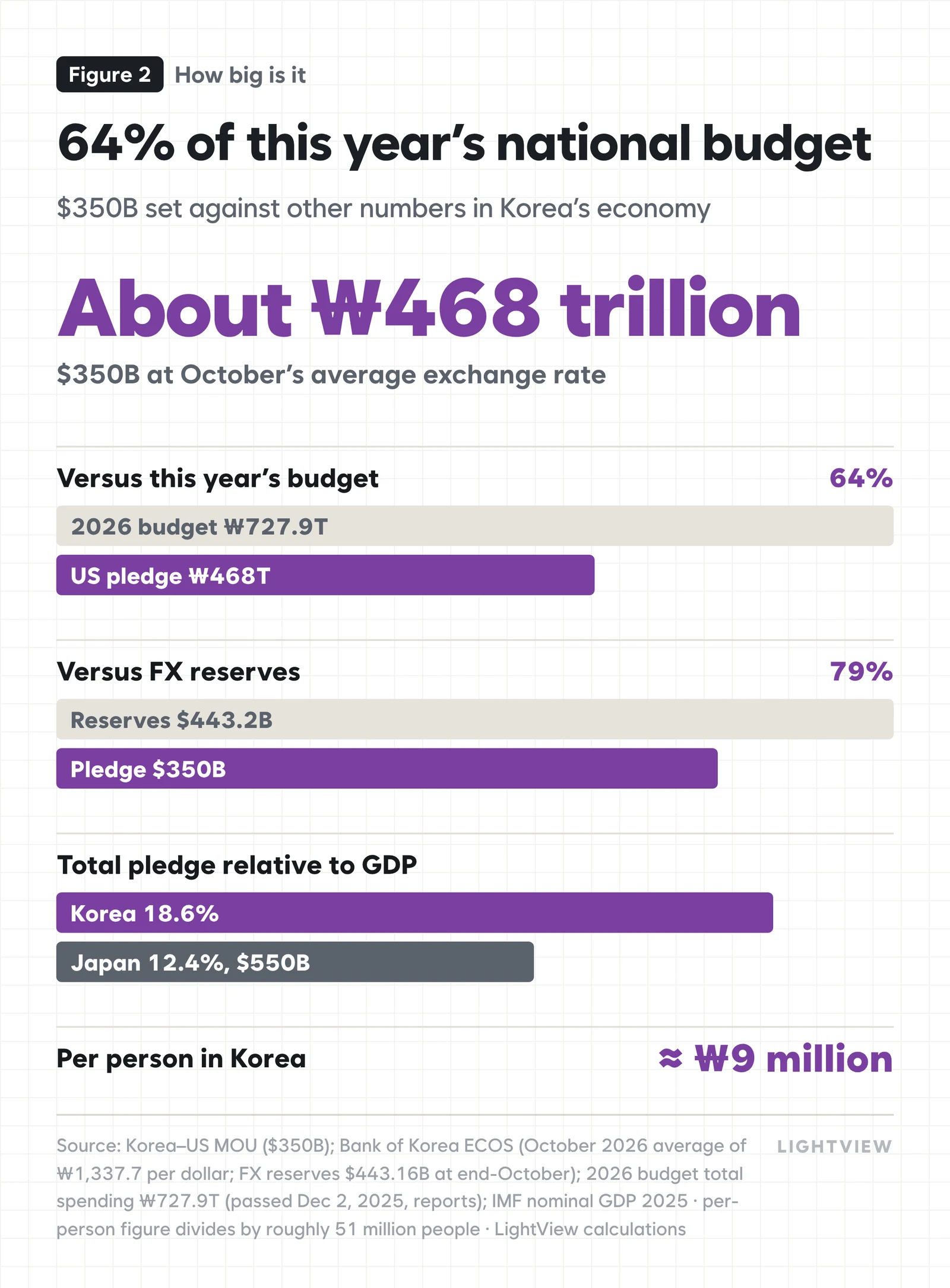
The money does not leave at once. The $350 billion splits into $200 billion of strategic investment in projects chosen by the US president and $150 billion for shipbuilding cooperation, and Korea cannot be asked for more than $20 billion of the strategic part in a year, which is 4.5% of reserves. The funding differs from Japan’s. Japan’s lead negotiator reportedly said cash equity is only 1–2%, with the rest in policy-bank loans and guarantees. Korea’s first project, according to Korean reports, is funded entirely by the Korean side.
2Held in place by tariffs, not the text
Paragraph 25 of the memorandum says it creates no legally binding rights or obligations. Paragraph 27 lets either side suspend it by written notice.
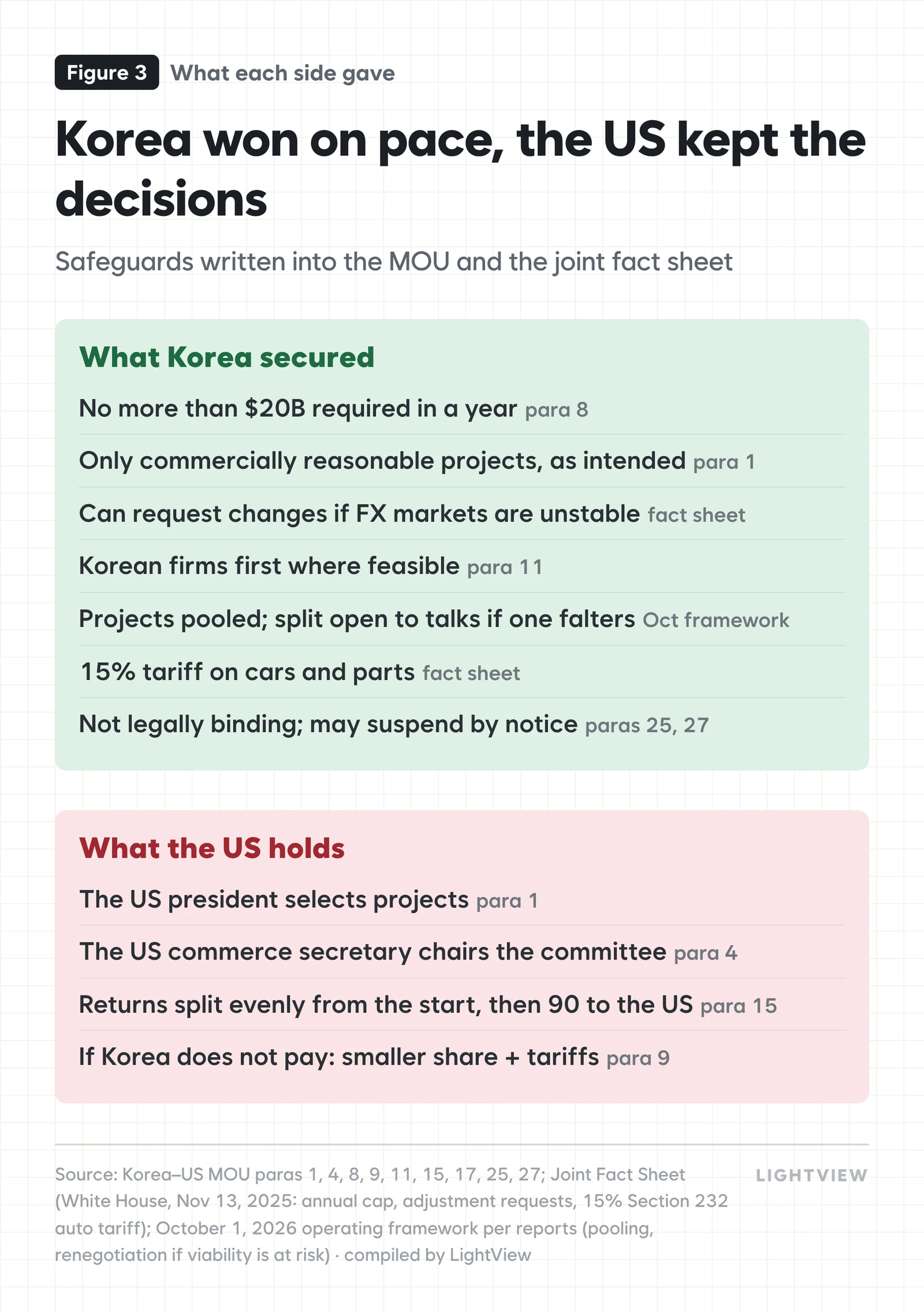
The pledge holds because of paragraph 9. If Korea does not fund a selected project, its share of returns shrinks and the US may impose tariffs at a rate the president sets. The US president picks the projects, and the commerce secretary chairs the investment committee. Korea secured the annual cap, the commercial-reasonableness language and a preference for Korean firms where feasible. The FX safeguard widely cited in Korea, a right to request adjustments, sits in the accompanying joint fact sheet, not in the memorandum itself.
The legal basis for those tariffs changed twice in a year. On February 20 the Supreme Court ruled 6–3 that the International Emergency Economic Powers Act gives the president no power to impose tariffs, and the administration invoked a 10% tariff under Section 122 of the Trade Act the same day, effective February 24. When that 150-day limit ran out on July 24, Section 301 tariffs framed around forced labor were applied to 60 economies, with Korea placed at 12.5% taking existing rates into account. We found no official notice changing the 15% Section 232 rate on cars and parts.
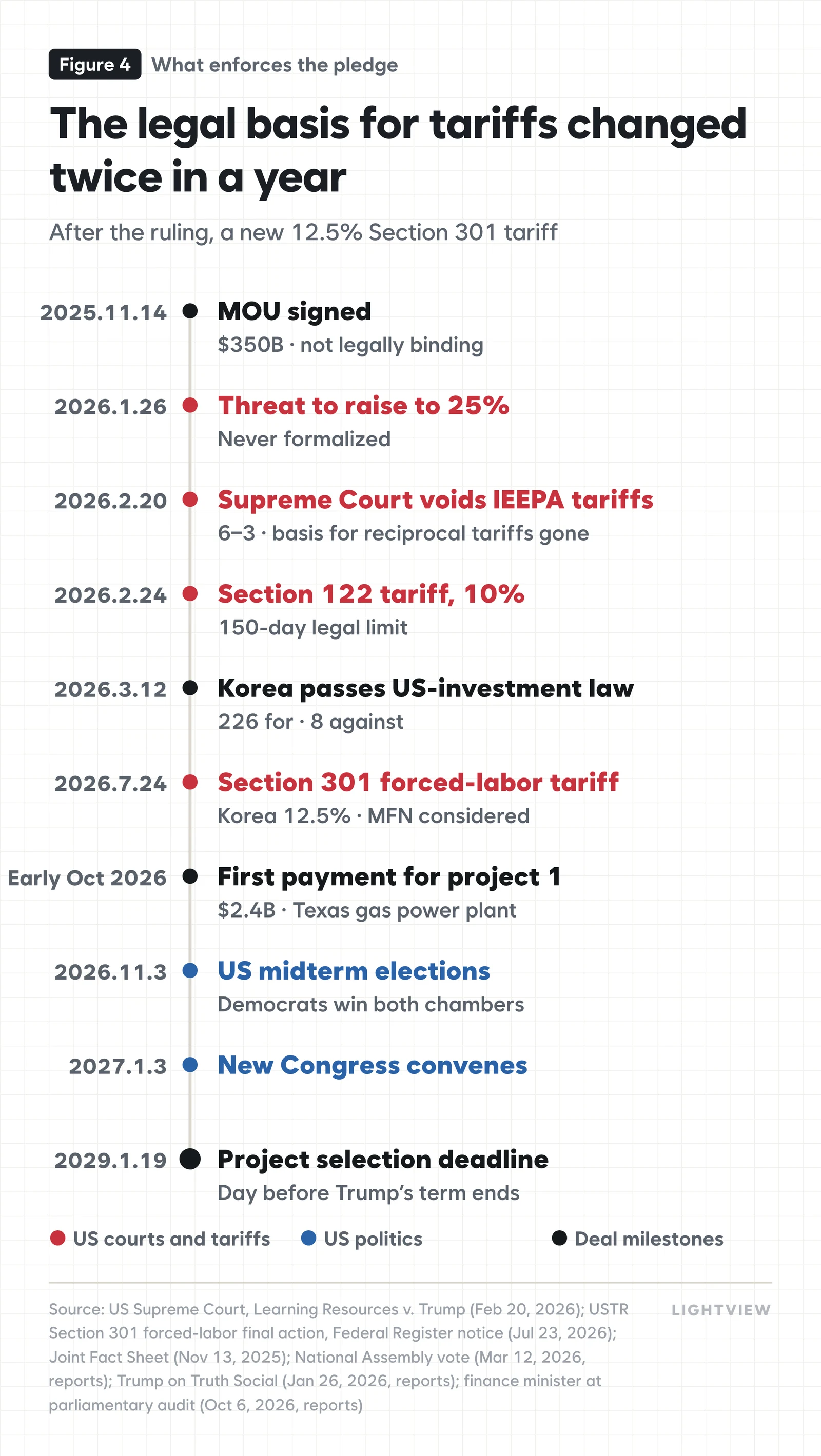
In the November 3 midterms, provisional counts give Democrats 54 Senate seats, including two independents who caucus with them, and 255 House seats. Their main check, Senator Wyden’s Congressional Trade Powers Reform Act, would require congressional approval for Section 301, 232 and 201 tariffs, but only for tariffs imposed after it becomes law. A veto would need two-thirds of both chambers to override. Even if Trump weakens, the tariffs now applied to Korea are likely to remain.
The local picture is the variable. Scott Snyder, president of the Korea Economic Institute of America, noted Democratic gains in states such as Georgia and Texas where Korean investment is concentrated, and that 40 of 41 local ballot measures opposing data centers passed. It is a sign that large investment projects may face tougher scrutiny inside the US too.
3Money sent in a year: $2.4 billion
A year after signing, one project has been committed: the Encinal gas-fired power plant in Texas. It costs $22.3 billion, has more than 6 GW of capacity, and aims to start its first phase in 2029 and run fully in 2032.
Korea’s finance minister confirmed at the October 6 parliamentary audit that $2.4 billion had been sent, 1.2% of the $200 billion. As of early October the project had no long-term power purchase contract, with 2027 reported as the target. Nor did Korea get a guarantee that Korean companies would be chosen, according to September reports. In a structure where projects must earn double to break even, a power plant without a buyer for its electricity starts behind.
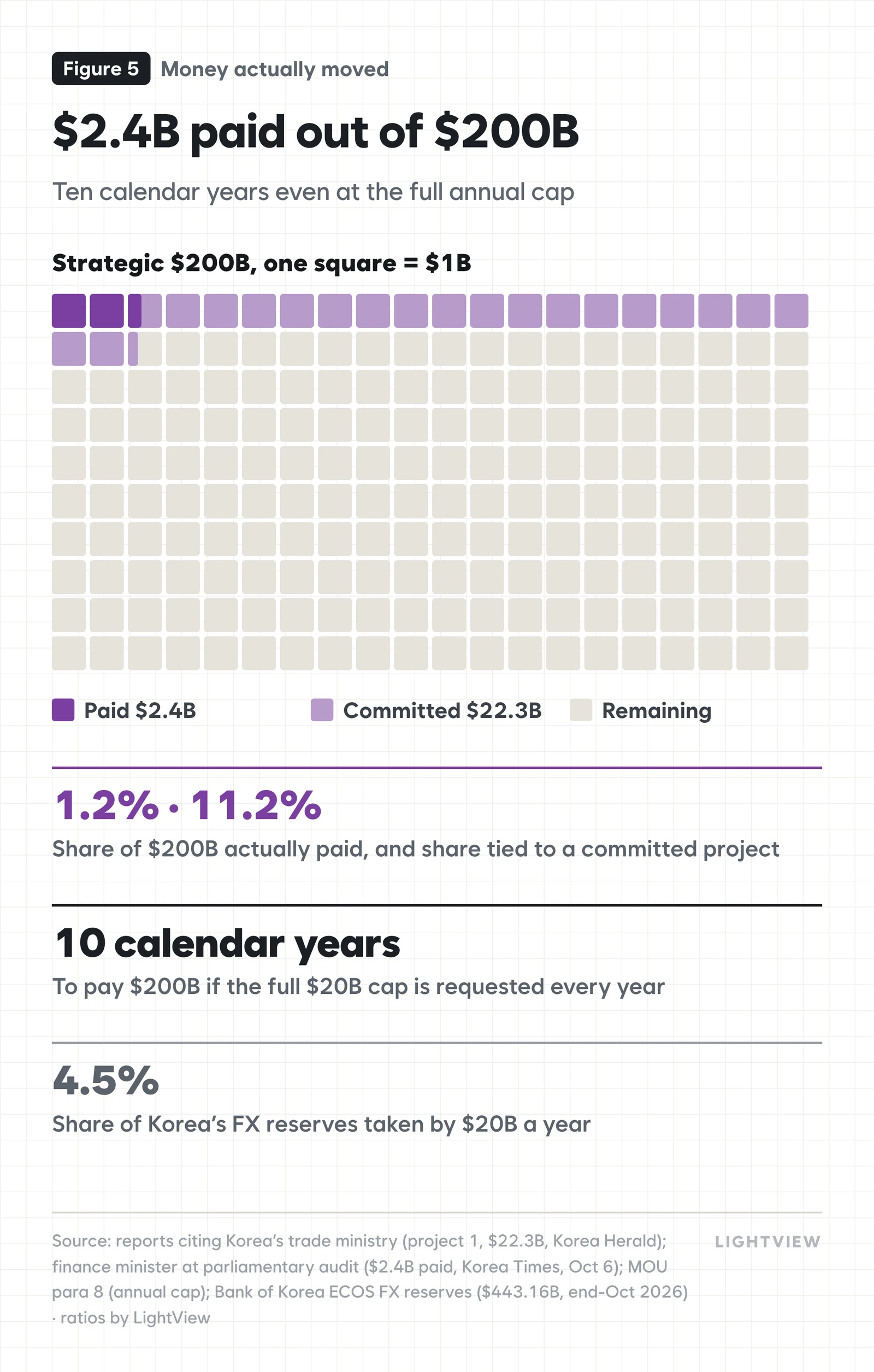
Even if the full $20 billion is requested every year, paying $200 billion takes ten calendar years. Japan moved faster, committing three projects worth about $36 billion in February, including an Ohio gas plant and a Texas crude export terminal.
4What waiting shrinks, and what it doesn’t
The question most asked after the midterms is whether Korea can lose less as Trump’s power fades.
The clue is in paragraph 2. The last day for the US to select strategic projects is January 19, 2029, the day before Trump’s term ends. Anything not selected by then has a weaker basis under this memorandum and is likely to become a matter for the next administration. Money for selected projects is also spread over years by the annual cap. Even if many projects are chosen before the deadline, most of the money would leave after Trump’s term.
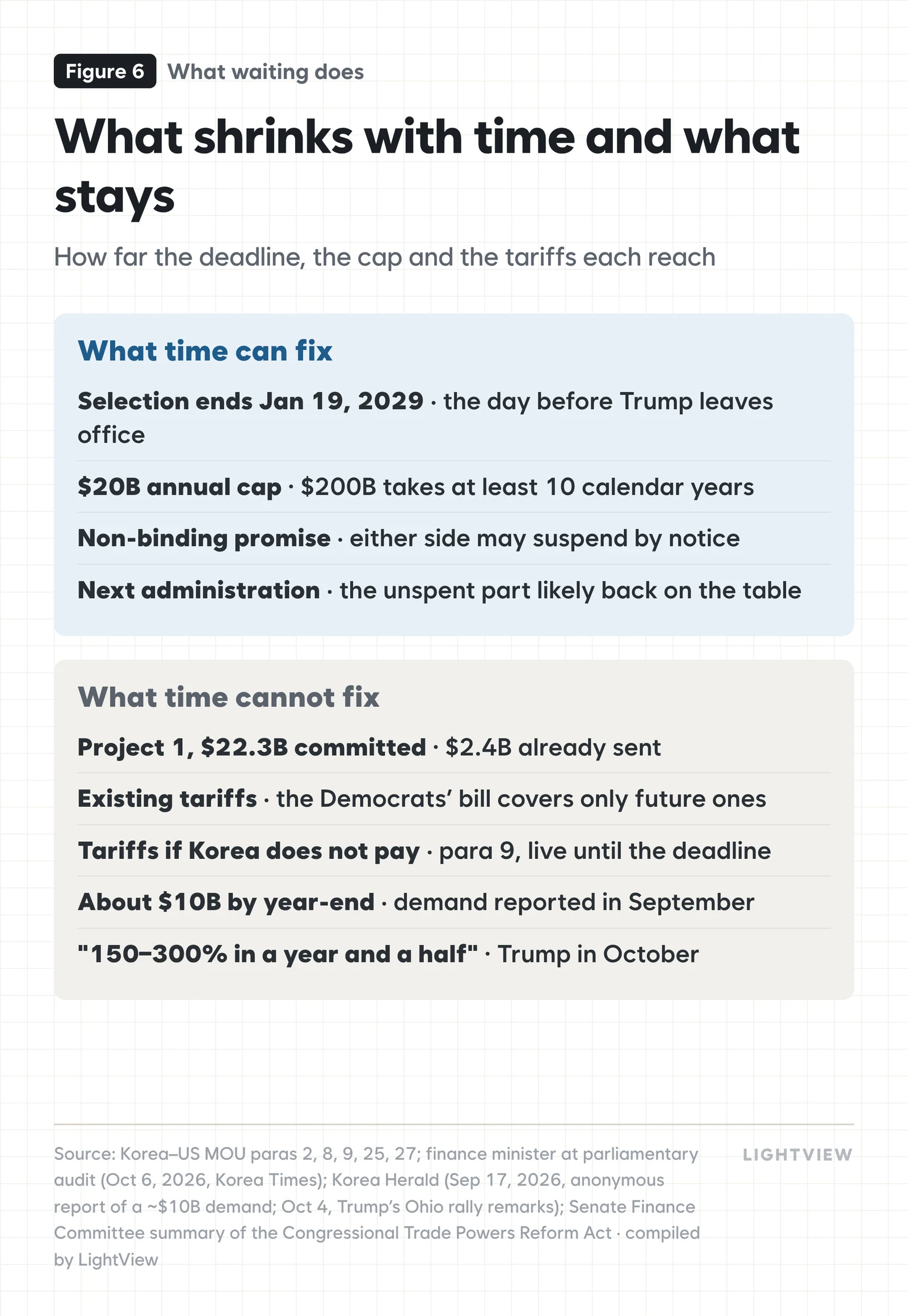
Some things stay. The first project’s money is already out, and the tariff lever stays alive until the deadline. In September an anonymous report said the US had asked for about $10 billion by year-end. At an October rally in Ohio, Trump said countries that do not build factories in America could face tariffs of 150–300% in about a year and a half, and mentioned Korea. His year and a half arrives before the deadline.
What waiting can buy is less about paying less and more about choosing: taking projects with proven economics first, on the strength of the commercial-reasonableness language and the annual cap, and letting reviews of the rest run long.
5Between reactors and Alaska LNG
When projects must earn double to break even, where the money goes decides the outcome. The remaining candidates are reactors, shipbuilding and Alaska LNG.
Reactors are the largest candidate, discussed at up to $120 billion. The plan covers two Korean-designed APR1400 units and six Westinghouse AP1000s, and the Korean design leaves ample room for Korean companies. Stakes and amounts were still undecided in mid-October, and sites have not been disclosed. The $150 billion for shipbuilding could play to the strength of Korean yards. An August presidential memorandum lets foreign companies that own or build US shipyards construct up to two navy ships in their home yards. As of mid-October reports, though, there is no specific investment project. Hanwha’s first US Navy landing-ship order in early November is separate from the investment program.
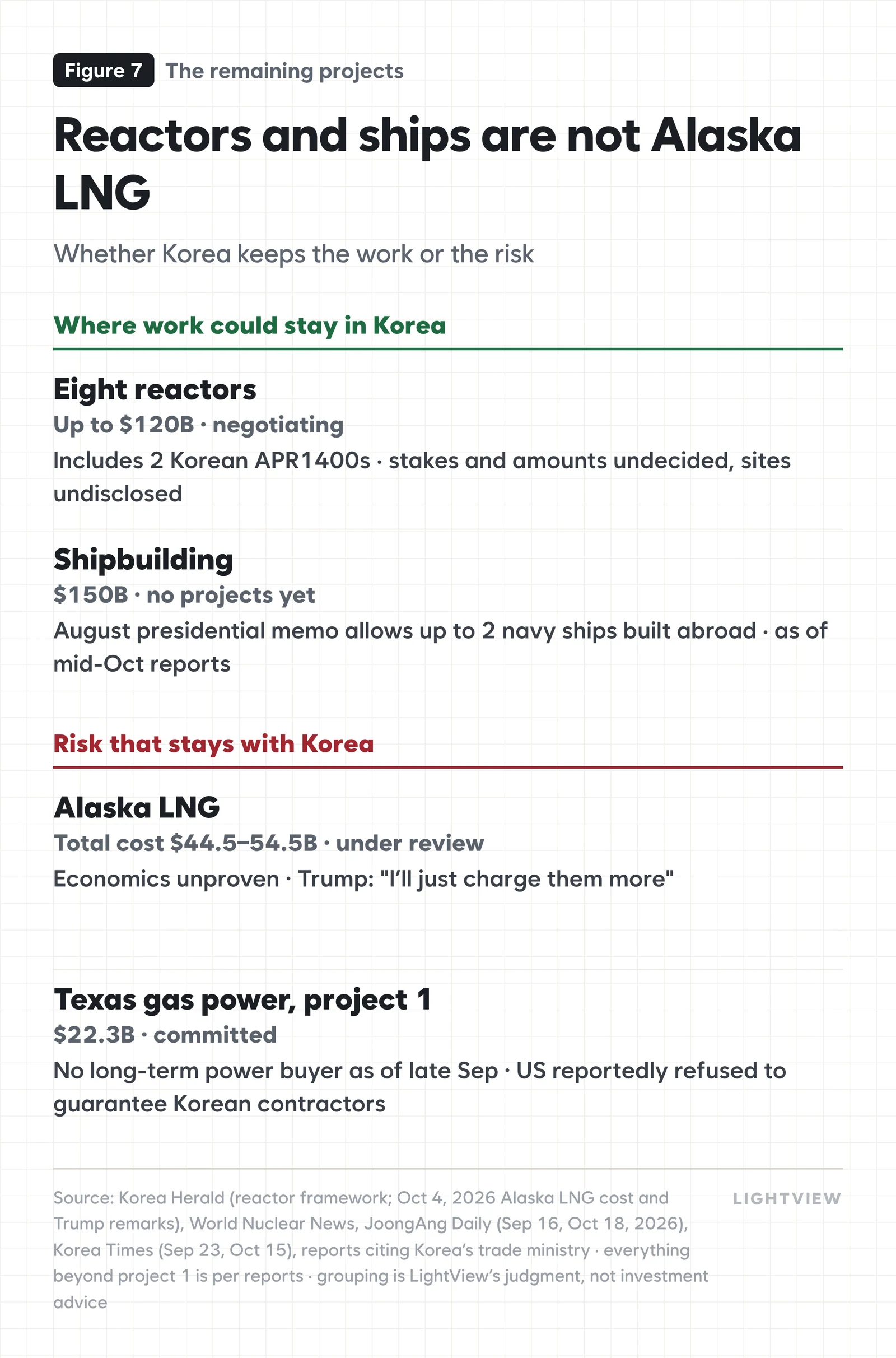
Alaska LNG sits at the other end. The developer estimates the total cost at $44.5–54.5 billion, but Korea remains at the review stage, saying the economics must be proven first. At the October rally, Trump said it would be fine if Korea stayed out: “I’ll just charge them more.” Put money into a project with uncertain economics and, facing the doubling threshold, the losses stay with Korea; stay out and the tariff threat stays.
What happens to the $350 billion depends on what is decided by January 19, 2029. If the reactor talks close, much of the $200 billion fills up with nuclear. If selection stalls after the first project, the pledge stays on paper while actual cash is a fraction, and the price is enduring tariff threats in 2027–28. If few projects are chosen by the deadline, the rest passes to negotiations with the next administration.
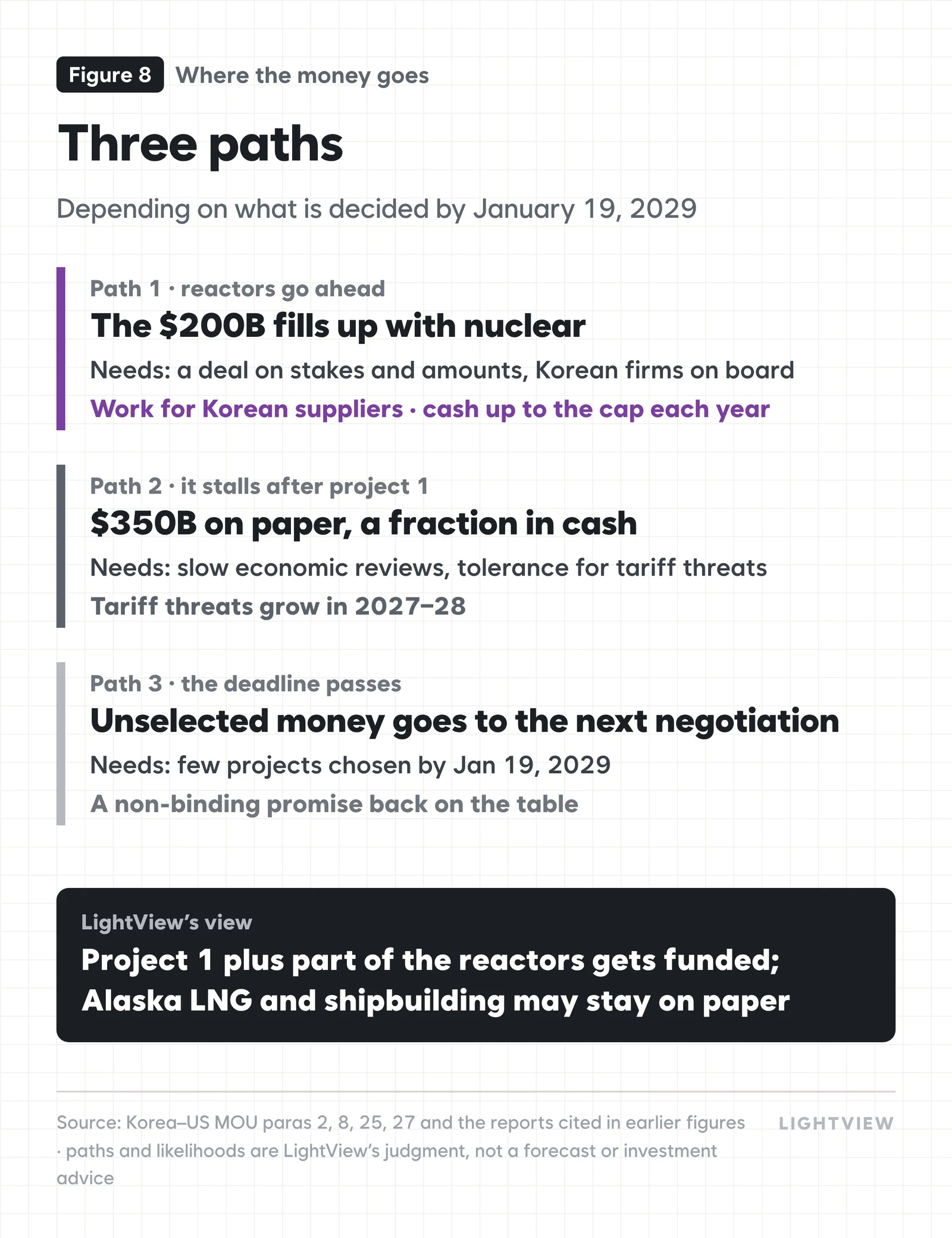
LightView sees the likeliest path in between. The first project and part of the reactor program get funded, while Alaska LNG, with unproven economics, and shipbuilding, with no projects yet, may stay on paper.
The $150 billion for shipbuilding still has no projects. Nowhere does the memorandum say whether the $20 billion annual cap applies to it.
+Glossary and sources
Glossary
- Korea–US MOU on strategic investment, English original (signed Nov 14, 2025, posted by Korea’s trade ministry) · Joint Fact Sheet (White House, Nov 13, 2025) · US Supreme Court, Learning Resources, Inc. v. Trump (Feb 20, 2026) · USTR Section 301 forced-labor final action, Federal Register notice and fact sheet (Jul 23, 2026) · Senate Finance Committee summary of the Congressional Trade Powers Reform Act · Bank of Korea ECOS FX reserves and won/dollar rate · reports on the 2026 budget passing the National Assembly (Dec 2, 2025) · IMF DataMapper nominal GDP · Japan Ministry of Foreign Affairs joint document
- Newsis (Mar 4, 2026, Koo Yun-cheol at the special committee; Sep 17, profit accounting) · SBS Biz, Dailian, News Tomato (Oct 1, 2026, operating framework) · Digital Daily (Oct 4) · Korea Times (Nov 14, 2025; Jan 27, Sep 23, Oct 6, Oct 15, Nov 1, Nov 4, 2026) · Korea Herald (Sep 17, Oct 4, Nov 4, 2026, reactor framework article) · Dailian, News Tomato (project-1 funding) · JoongAng Daily (Sep 16, Oct 18, 2026) · Newsis, Money Today (Mar 12, 2026) · Asia Economy (Oct 30, 2025) · KOTRA (Nov 5, 2026) · Scott Snyder, KEI (Nov 6, 2026) · World Nuclear News · Jiji, Adnkronos (Feb 2026) · Al Jazeera (Jan 27, 2026) · Wikipedia 2026 US election tallies (Nov 9–10)
Official documents
Reporting and analysis
This column's topic and analytical direction are set by the editor, who reviews and revises it before publication. AI tools were used for research, drafting and infographics, and every figure was checked against its source.